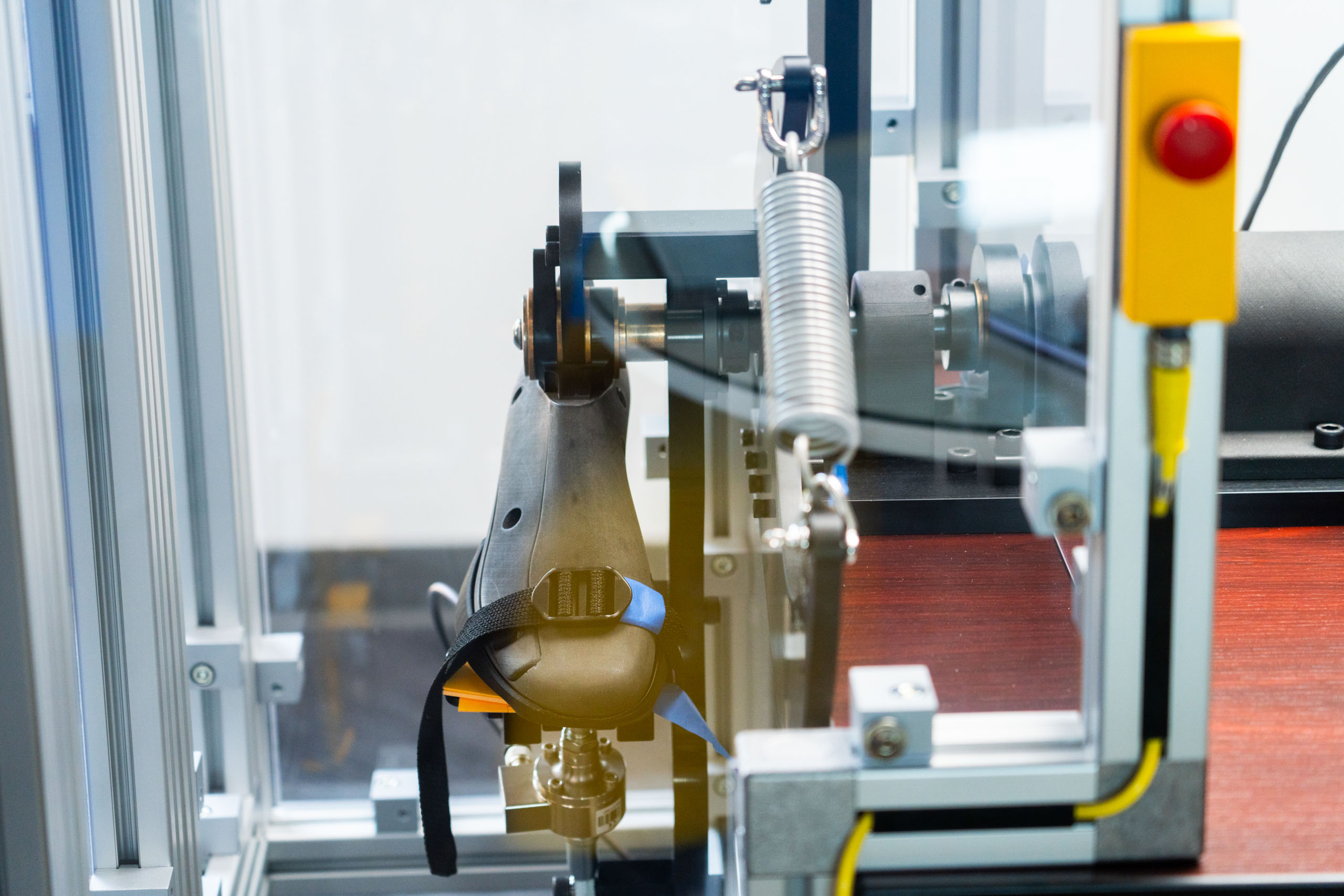
The runner in Sigma Design’s test fixture has a synthetic foot and no ambition whatsoever. A shoe is fastened to the foot. A mechanical appendage and spring approximate the load of a human body. A servo motor moves the simulated ground. The apparatus exists to answer a question that a handsome prototype cannot settle on its own: what does a running exoskeleton actually do?
It is a useful introduction to a company whose name might suggest a room full of sketches. Sigma Design does make sketches. It also makes the machinery required to interrogate them. Its business sits in the crowded space between a promising idea and a product that can be built, measured, maintained, and used.
- One connected brief: design, engineering, fabrication, testing, and manufacturing for business customers.
- The interesting work is specific: a running rig, an autonomous vehicle, and a retrofit handling 23 part types.
- The practical lesson: measure the uncertainty and inspect the handoffs before buying more capacity.
A runner without a runner
The client’s exoskeleton attached to a calf and shoe and was intended to assist ankle movement during running. Sigma’s task was to build a reliable way to assess its performance. Sensors recorded torque, force, and angular position; a data-acquisition system fed measurements to a laptop. Custom software converted and displayed the results. A Raspberry Pi also collected information from the device’s internal sensors.
Changing the spring position let the fixture approximate different body weights. That detail matters. A test that represents only one loading condition answers a narrower question than its designer may intend. The engineering job included making the experiment useful, as well as making the apparatus move.
The project crosses mechanical design, controls, instrumentation, and software. It illustrates Sigma’s central proposition: when a question moves between disciplines, the people responsible for answering it should be able to move with it.
58 harnesses, and somewhere to come home
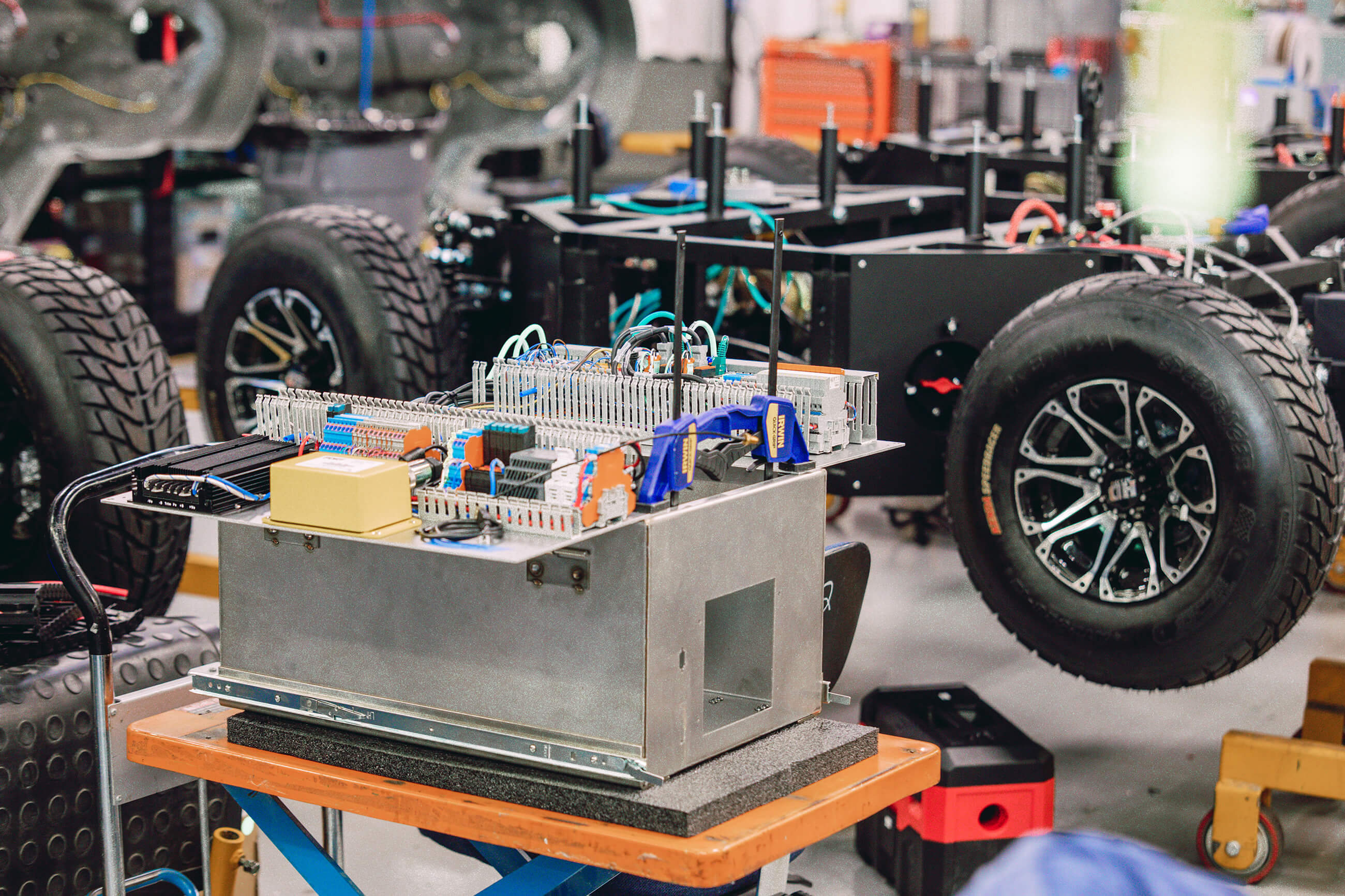
Another client wanted an autonomous ground vehicle for outdoor operation. GPS and LiDAR were part of the navigation system. Sigma integrated electrical and mechanical systems for driving, steering, braking, and safety. The vehicle also had to return to a home location to recharge without human intervention.
In one published UGV project, connecting the system was a substantial engineering job of its own.
The communication architecture used two CAN networks, Ethernet, and EtherCAT. Recharging involved a guide ramp and a pneumatic scissor mechanism that positioned wireless charging equipment beneath the vehicle. For maintenance, a slide mechanism made critical components accessible without removing the bodywork.
Here is the overlooked part of the autonomy story: reaching a destination is only one requirement. Recharging and servicing the machine are requirements too. Sigma’s case study makes the usually invisible work visible, right down to the wiring.
The robot was waiting for its parts
A manufacturing customer faced production-schedule pressure and staffing constraints. Its machining cell already contained a Fanuc vertical machining center and semi-automated material handling. But an operator still loaded individual parts. The cell handled 23 different part types, each with its own machining and recognition requirements.
Sigma added flexible feeding and a new infeed system while retaining the robot, fixtures, frame, and tooling. The company reports that the retrofit removed manual single-part feeding and met production goals without additional operators. The economic choice was visible in the equipment it kept: useful machinery stayed in service.
This was painstaking integration work. Sigma modeled the cell, simulated robot paths, tested material-handling options, tuned vibration profiles for all 23 parts, and adjusted machine vision for the customer’s actual lighting. The apparent bottleneck was the arrival of parts. Solving it required understanding the rest of the cell.
- 01PresentConveyor + hopper
- 02SeparateVibration profiles
- 03LocateMachine vision
- 04PickRobot motion
Part availability feeds back into conveyor control. A sequence becomes a coordinated system.
For another manufacturer, this is a diagnostic habit worth borrowing. Watch where the work waits. A faster machine cannot help much if the next part is still in somebody’s hand.
A business built by adding tools
John Barker and Sue Wainwright founded Sigma Design in 1994. Its early operation was based in their house. Bill Huseby left Hewlett-Packard to join the two-person company in 1997. The firm purchased its first model-shop mill in 2000 and opened Singapore operations in 2007.
The subsequent additions read like an expanding answer to a customer’s brief. Electrical engineering arrived in 2009. A first environmental chamber began the test-lab capability in 2012. Software and firmware engineering followed in 2013, and systems engineering in 2018. In 2020, Sigma added an 89,000-square-foot advanced prototyping facility.
The pattern suggests a business growing around adjacent work. A physical product rarely respects the boundary between a mechanical drawing and the electronics inside it. Sigma accumulated more of the capabilities needed to cross that boundary, eventually extending the offering through manufacturing.
Confidentiality has an engineering cost
Sigma serves businesses across aerospace, defense, agricultural technology, automation, consumer products, health and wellness, industrial equipment, semiconductors, and uncrewed systems. Its published examples often leave the client unnamed. The industrial-design page says confidentiality rules prevent it from discussing many projects.
For a development partner, discretion needs procedures behind it. Sigma lists ISO 9001:2015 quality management certification, ISO/IEC 27001:2022 information security management certification, and an ISO/IEC 17025:2017-accredited mechanical test laboratory. These address different questions: how work is managed, how information is protected, and how laboratory competence is established.
Its test-planning process begins with feasibility, safety, article size, fixtures, and exposure parameters. Reports can include conditions, observations, raw data, photographs, and measurement-equipment calibration status. That documentation gives a client something more useful than a reassuring adjective: a record it can examine.
Small runs, serious complexity
The company’s position in the market becomes clearer at the manufacturing end. In its 2025 announcement of Manufacturing Honoree recognition, Sigma emphasized complex, high-mix, low-volume production. These are products whose variety and engineering demands complicate the familiar logic of making enormous quantities of the same thing.
“What truly sets Sigma Design apart is our ability to manufacture complex, high-mix, low-volume products, filling a critical gap in the U.S. manufacturing sector.”
Andy Boyes / Director of Customer Solutions / 2025
Sigma’s stated model lets customers use flexible production capabilities without committing to permanent manufacturing infrastructure. Design iteration and production support stay connected. For a company introducing a complex product, that can be a more suitable brief than simply finding the lowest assembly price.
The business model is B2B services: clients commission development, engineering, testing, fabrication, and manufacturing work. Staffing adds another route, including contract-to-hire, direct placement, and on-site engineering support. A client can buy help with a stage of development or engage across several stages.
Alternatives change with the assignment. A design consultancy, independent laboratory, automation integrator, contract manufacturer, staffing firm, or internal team may each solve part of the problem. Sigma’s distinction is the breadth of work it can connect. The case for that breadth is strongest when the problem itself crosses those boundaries.
Put the workshop beside the flight test
At Pendleton UAS Range in Oregon, Sigma’s model has a particularly concrete expression: an on-site machine shop. The partnership began in 2022. In February 2026, the partners announced expanded staffing services alongside continuing fabrication and engineering support.
Flight development creates an obvious geography problem. A team needs a place to test, then people and equipment to revise what it has tested. Putting the shop at the range shortens the physical distance between those activities. The staffing expansion addresses a related constraint: having the right mechanical, electrical, software, and aerospace personnel available for the work.
Another development came in 2025, when Sigma joined SEMI. Its member-directory profile describes custom automated test platforms, integrated test-rack systems, prototyping, manufacturing, and turnkey development for semiconductor customers. The offering concerns equipment and engineering support within that ecosystem.
What a hardware team can borrow
Leadership changed in 2023, when Lindsey Dotson succeeded Huseby as president and CEO after nearly a decade at Sigma. The company’s stated culture includes integrity, adaptability, helping clients and colleagues, and the pleasantly practical instruction to “Take Time to Laugh.”

The more transferable habits sit in the projects. Build a test around the claim you need to evaluate. Check the loading conditions. Include recharging and maintenance in the original requirements. Model the whole work cell before replacing its expensive components. Bring the ability to revise hardware close to the place where it gets tested.
Those habits have conditions. The feeding retrofit required samples, geometry, tuned recipes, and lighting adjustments; copying the equipment list alone would miss the work. A single-discipline assignment may favor a specialist. A mature, high-volume product calls for its own manufacturing comparison. Integration earns its keep when the interfaces are the problem.
The synthetic foot is an apt final image. It has no opinion about the product, and no patience for a pitch. It produces measurements. Sigma Design’s most instructive work begins at precisely that point, where an idea has to submit to the inconvenience of being made real.
Into the workshop
Explore Sigma’s capabilities, project notes, company news, and films.