In a semiconductor factory, one of the harder questions sounds almost childish: how do you spin something inside a chamber without letting the outside in? The chamber needs a vacuum. The mechanism needs a turning shaft. A conventional seal invites friction, wear and unwanted particles into a place where particles are expensive. Ferrotec’s original answer was a liquid that stays put in a magnetic field. It forms a ring around the shaft, lets it rotate and holds the boundary. A remarkably tidy solution for a thoroughly untidy problem.
- Ferrotec sells precision parts and manufacturing systems, chiefly to businesses that build or run demanding equipment.
- Its Japanese operation began as a U.S. subsidiary, became independent in 1987 and acquired its former parent in 1999.
- The original ferrofluidic seal led into quartz, ceramics, thermal control, coating systems and contract manufacturing.
- Its next test is scale: Ferrotec announced RM1 billion for a second plant in Kulim, Malaysia, in 2025.
A family tree with the arrow reversed
Ferrotec began in Tokyo in 1980 as Nippon Ferrofluidics, formed to import and sell computer seals, vacuum seals and ferrofluids. It was a Japanese subsidiary of an American company. In 1987, the Japanese business became independent. It opened manufacturing in China in 1992, listed shares in Japan in 1996 and, in 1999, acquired Ferrofluidics Corporation in the United States - the old parent. Ferrotec president He Xian Han later described the result in one wonderfully plain sentence: “The parent-child relationship had reversed.”
A corporate reversal makes a good anecdote. It also reveals a useful business mechanism. Ferrotec did not build a chip brand or ask consumers to learn its name. It learned the consequences of a seal failure, made that seal, and kept moving toward adjacent problems its industrial customers already had. The catalogue grew into materials that survive harsh processing, parts that move energy or matter with precision, and machines that deposit thin films. What appears, from the outside, to be an eccentric assortment has a common buyer: someone responsible for making a complicated process work repeatedly.
The small leak with an enormous bill
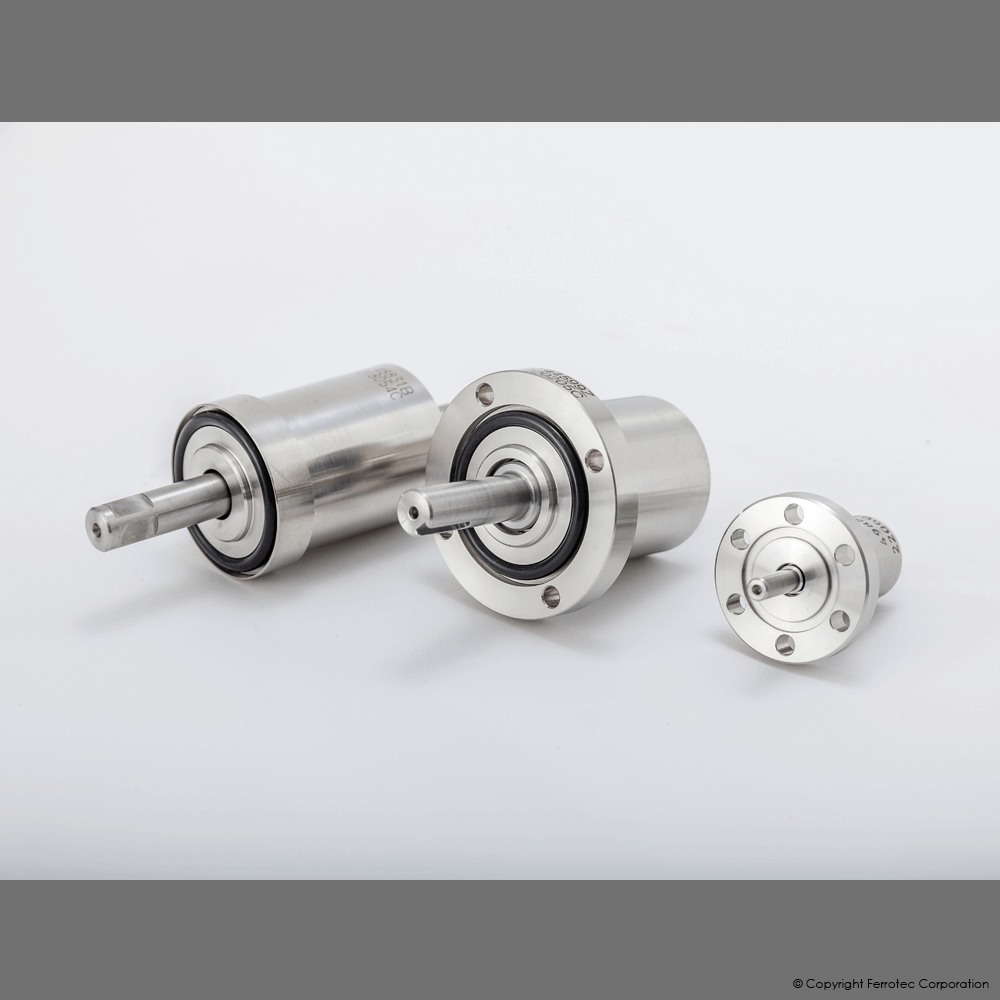
A ferrofluidic rotary feedthrough uses a permanent magnet, pole pieces, a magnetically permeable shaft and ferrofluid. The magnetic circuit holds fluid in narrow gaps around the rotating shaft. Ferrotec calls it a liquid O-ring. Several rings can be staged together to handle the pressure difference between the chamber and the room. The practical result is motion through a chamber wall while preserving a hermetic seal. It is an elegant piece of industrial plumbing, provided one remembers that the plumbing may serve a wafer etcher, a deposition tool or a handling robot.
That is why Ferrotec matters to equipment makers. A process tool can be brilliant on paper and still fail because a seal leaks, a quartz liner sheds contamination, a ceramic component cannot tolerate heat, or a temperature controller wanders. Ferrotec sells answers at those pinch points. Its fabricated quartz range includes windows, rings, tubes, liners, boats and tanks. Its ceramics and CVD silicon-carbide parts address other demanding surfaces. Thermoelectric modules move heat with no compressor in applications such as scientific instruments and industrial equipment. Temescal and MeiVac add electron-beam sources, controllers and complete thin-film systems.
“The parent-child relationship had reversed.”He Xian Han, Ferrotec president and group CEO
The catalogue is a map of the customer
The company’s best known market is semiconductor equipment, where it offers components from raw-material growth through deposition, photolithography, assembly and testing. Its published markets also include automotive, electronics, biomedicine, lasers and infrared systems. Applied Materials and Lam Research are publicly identified supplier relationships, though Ferrotec does not disclose a neat customer count. Applied Materials gave it a 2025 supplier award for aftermarket support. Lam Research had given it a 2022 award for scaling capacity ahead of demand. Those honors describe what the purchaser values: a component that arrives, works and can be supported after installation.
This is a business-to-business model built around both standard and custom work. An equipment maker might select a thermoelectric module from a catalogue; another might need a seal integrated into a particular assembly; a third might outsource machining, clean-room assembly, coating or testing. Ferrotec’s contract manufacturing offer explicitly spans component manufacture through project outsourcing. The advantage is breadth near a narrow class of customer problems. The disadvantage is equally physical: precision manufacturing requires machines, skilled operators, quality systems, inventory and places to put them.
Ferrotec’s consolidated net sales for the fiscal year ended March 31, 2026.A revenue figure, not a valuation or funding round
The 2025 Malaysia announcement makes the cost of that strategy visible. Ferrotec said its second Kulim factory would require RM1 billion, bringing its announced Malaysian investment to RM1.9 billion. The planned site covered nearly one million square feet, with more than 700 CNC machines and over 1,000 jobs expected. These are plans in the company’s groundbreaking announcement, not completed output. They show what scaling a supplier of physical precision entails: space, equipment and a workforce long before a part reaches a customer.
A magnetic particle learns a new trade
There is a more surprising recent turn. In April 2026, Ferrotec introduced Ferrobeads DNA/RNA isolation kits for research laboratories and created a Life Sciences Business Unit. The kits use magnetic beads to separate nucleic acids in manual or automated workflows. The company states a 10 to 25 minute extraction window, depending on the workflow, and labels the kits for research use only. This is far from a rotating vacuum seal, but not far from the original skill: managing magnetic particles to make an exacting task easier. The customer, of course, has changed from a process engineer to a laboratory professional.
That move also clarifies what can be copied from Ferrotec. Start with a particular, measurable failure: leakage, contamination, unstable temperature, uneven deposition. Learn the material or process deeply enough to solve it. Then ask where the same competence relieves a neighboring customer’s pain. Ferrotec’s journey suggests that adjacency is more useful than variety for its own sake. It also offers a limit: a magnetic-particle idea does not become a life-sciences product merely because both use magnets. Validation, workflow fit and support have to travel with it.
The quiet supplier in the loud industry
Semiconductors are usually narrated through fabs, chip designers and the occasional machine with a spectacular price tag. Ferrotec occupies the quieter territory between them: the seal, chamber part, thermal module or coating system that lets someone else’s machine keep its promise. This is how a company can be important without being familiar. It sells fewer grand pronouncements than very specific tolerances.
The family tree is the irresistible part of the tale. The lasting lesson is in the machinery. Ferrotec used one unusual liquid to enter a hard industrial conversation, then stayed close enough to its customers to hear the next question. It now has to answer those questions on a global manufacturing scale. Every new factory, product line and acquisition is a larger version of the original wager: that solving a small, stubborn problem is worth a great deal to the person whose whole process depends on it.
Follow the machinery
Explore Ferrotec’s product catalogue, its company history, recent announcements and a short animation of the seal at work.