The machine in front of Motivo's engineers can be almost anything. One week it is an autonomous security vehicle built to patrol broken ground. Another, it is a wireless charger that must persuade a Ford Mustang Mach-E to accept power without help from Ford. There have been tilting electric trikes, headphones, vegetable planters, poultry-line robots, aircraft seats and parts for an autonomous electric aircraft. The objects share very little. The failure mode they arrive with is usually the same: too many disciplines must agree at once.
That is the business Motivo has constructed in Rancho Dominguez, just south of Los Angeles. It is a contract product-development company for physical technology - part consultancy, part embedded engineering department, part prototype shop and part early factory. Mechanical, electrical, software, controls, industrial design and fabrication sit inside the same organization. Clients can bring a rough brief and hire the whole stack, or insert Motivo into a subsystem that has become the schedule's problem child.
The company is the product
Founder Praveen Penmetsa borrowed the operating model from race-car teams. In racing, the person worrying about airflow cannot treat suspension, power, controls and the deadline as somebody else's issue. The whole car has to work on Sunday. Motivo applied that compact-team logic beyond motorsports when it started in 2010. The current company describes its method as Spark, Create, Build and Launch: define the purpose, engineer the product, fabricate and validate it, then support low-volume production.
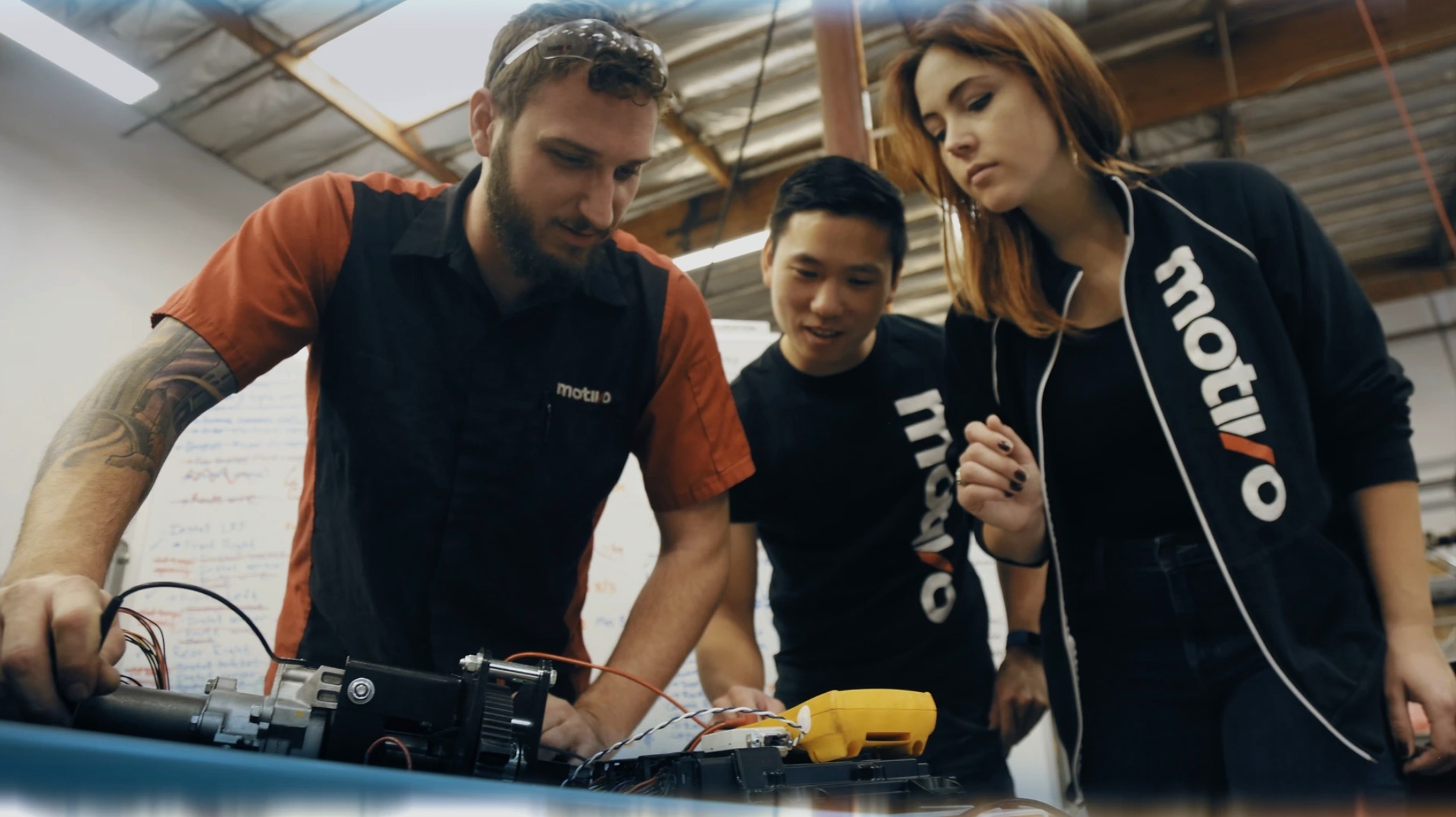
The useful distinction is not that Motivo employs many kinds of engineer. Plenty of firms do. It is that the disciplines are expected to work in parallel, around the same physical artifact, with fabrication close enough to expose a bad assumption quickly. A bracket that blocks a harness, a controller that overheats inside a beautiful enclosure or firmware that disagrees with a brake can surface at a bench instead of after the drawing package travels to another vendor.
“If the vision is not audacious, you don't need Motivo.”Praveen Penmetsa, founder
It is sharp positioning because it also defines the projects Motivo should refuse. Routine cost-down work, an isolated drawing task or a stable mass-production line does not need an expensive cross-functional swarm. The model earns its keep when integration risk, a fixed demonstration date or the cost of building an internal team outweighs the consulting bill. Motivo once called itself a “bolt-on start-up” for precisely this reason.
Seventy days, two drivetrains, no trench
Knightscope's K7 makes the method unusually legible. The security-robot company wanted to move its autonomy and edge-computing stack beyond smooth indoor floors and paved patrol routes. Motivo and design partner Phiaro helped turn the clean-sheet idea into a rugged vehicle. Motivo owned the core structure and propulsion: a hybrid chassis, dual transaxles, gear reduction, electromagnetic brakes, power distribution, steer-by-wire controls and cooling. It also built a hardware-in-the-loop bench so the control logic could fail safely before the first complete vehicle existed.
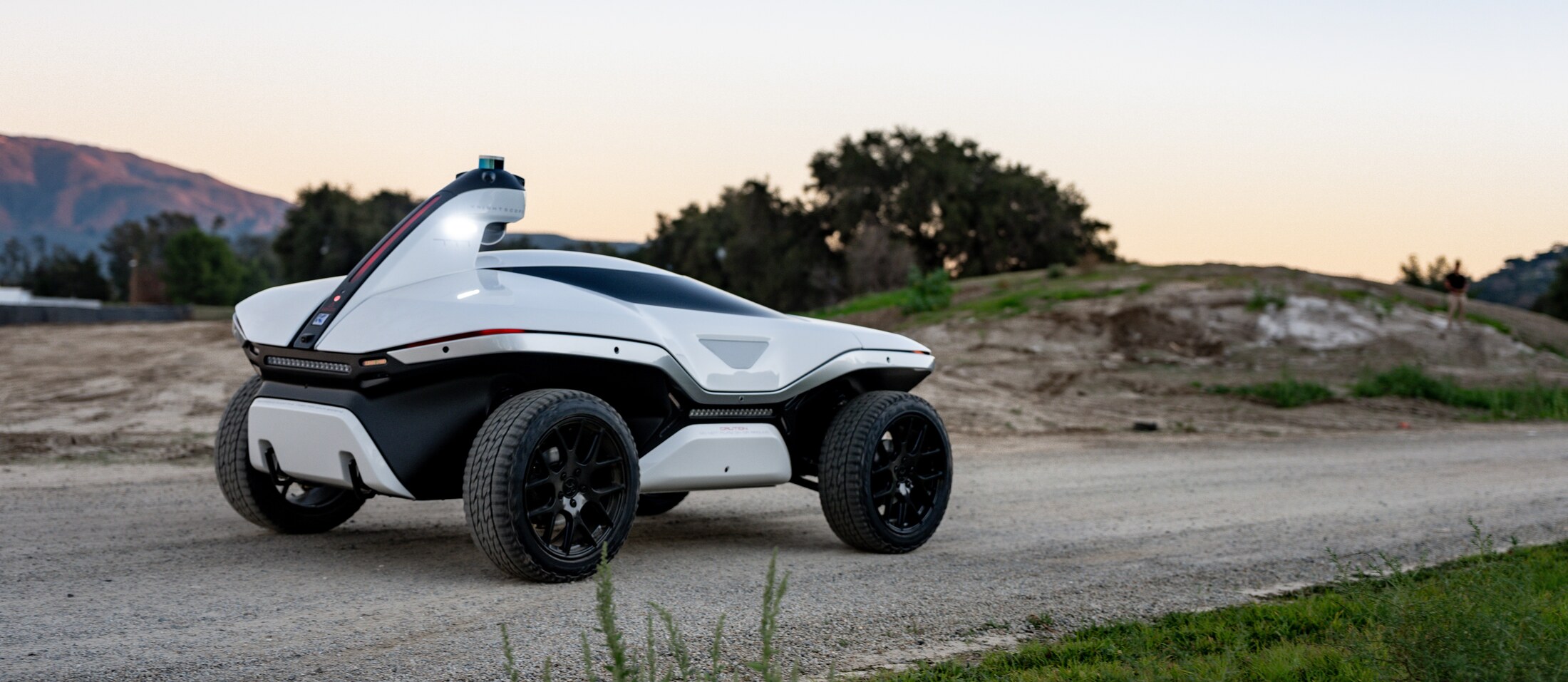
From aligned requirements to build-ready design took 70 days, according to Motivo. The details explain more than the stopwatch. A wireless charging base let the vehicle dock without a person or a trench. Simulink-based firmware managed vehicle states and brakes. Forced ventilation protected electronics through continuous duty. The exercise was not “move fast” in the abstract. It was identify the interfaces most likely to betray the program, create smaller ways to test them, and keep the teams close enough to correct the design.
Knightscope K1
Simplify before you optimize
A sprawling emergency-communications portfolio created duplicate parts, supplier friction and awkward maintenance. Motivo audited the products, established a visual language and designed a common modular chassis. Design-validation prototypes arrived in less than three months.
WiTricity
Make the car say yes
The power-transfer science worked; vehicle integration did not yet look like a product. Motivo analyzed CAN traffic, built control logic, packaged roadworthy hardware and supported batches of more than 50 kits for the Mach-E.
Airbus A3
Flight hardware on a startup clock
For Project Vahana, Motivo delivered three ship-sets of variable-pitch fan equipment plus battery-swap, high-voltage and actuated-canopy hardware inside a four-year aircraft program.
The tractor started with the grid going dark
Motivo's best origin story belongs to HARVEST. Penmetsa, who comes from an Indian rice-farming family, was visiting during a power cut. He remembered a Motivo military project that turned a Toyota Prius into an emergency power source. A Prius in a rice field was absurd, but a mobile battery was not. The team gave the battery a useful body: an electric tractor that could pull implements, store renewable energy and move electricity to a pump or remote community.
HARVEST became a finalist in a USAID-backed agriculture challenge and was tested in California and India. The first thing to fail was not propulsion. It was logistics. A USAID assessment recorded a customs delay of six to eight months before planned field testing. That is hard tech in one sentence: atoms must cross borders before hypotheses can cross off the test plan.
Combined public SBIR Phase I and II awards to Motivo for a separate zinc-manganese-dioxide naval backup-power system. It is a rare disclosed cost marker in a portfolio where most client budgets stay private.
The tractor also shows what changed minds. Motivo examined several routes to market, including licensing. Continuing demand convinced Penmetsa and partners with farming, robotics and factory experience to form Monarch Tractor as an independently funded company in 2019. After the spinout, the price of learning stayed steep: Monarch's first prototype reportedly cost about $500,000 and produced only two machines. The point is not that every prototype becomes a startup. It is that a service firm with repeatable build capability can discover products of its own - and should separate them when commercialization demands a factory, sales network and risk profile the parent was not built to carry.
What a reader can steal
You do not need an 82,000-square-foot facility to copy the useful parts. Start with interfaces, not departments. Put the electrical, mechanical and software owners in the same requirements review. Build a test bench for the riskiest handshake before funding the polished prototype. Audit a messy product family before improving individual variants. Keep the person who will fabricate a component in the design conversation. And define the market demonstration separately from the production destination; a convincing alpha and a scalable unit are related, not identical.
Borrow this when...
- Several engineering disciplines must converge on one milestone.
- A startup needs a temporary full team faster than it can hire.
- A physical prototype will unlock testing, sales or financing.
- Integration uncertainty is larger than component uncertainty.
Skip it when...
- The work is routine cost reduction or a narrow specialist task.
- The design is stable and high-volume procurement is the real problem.
- Decision-makers cannot join fast feedback loops.
- Certification or supply lead times dominate any iteration advantage.
Speed can also become thrashing. Hardware cannot be patched after shipment as casually as software; tooling, safety and regulatory tests punish casual pivots. Motivo's strongest cases therefore combine rapid iteration with systems architecture, testing and design for manufacturing. The company is differentiated less by haste than by arranging the work so that haste produces evidence.
Where Motivo sits
A founder could hire separate industrial designers, embedded developers, a mechanical consultancy and a contract manufacturer. A corporation could staff a permanent advanced-development group. Motivo competes with both choices. Against a collection of vendors, it sells fewer handoffs and one chain of accountability. Against internal hiring, it sells immediate capacity without years of payroll after the milestone. Against a conventional consultancy, it sells the smell of the workshop: prototypes, harnesses, fixtures and early units, not just recommendations.
That makes Motivo most useful in the uncomfortable middle between a credible idea and repeatable production. Its customers include venture-backed teams short on specialists and large incumbents whose own engineers have concluded that something cannot be done on the current schedule. Public projects span Airbus, WiTricity, Knightscope, Audeze, Sway and government research. Many others remain confidential, which is ordinary in outsourced R&D and also why the public case studies matter: they reveal the method through the machines.
Fifteen years after the garage, Motivo has a bigger building, roughly 80 employees by public counts and a leadership transition from founder Penmetsa to CEO Allen Goad, with Penmetsa serving as chairman while leading Monarch. The company has changed scale without abandoning the original bet. When the product is new enough, the org chart is part of the engineering. Put the people who can settle the argument beside the object they are arguing about, and “impossible” becomes a list of tests.
Open these tabs next
Capabilities and current work ↗ Case-study library
Robots, aircraft, farms and more ↗ Motivo on LinkedIn
Company updates and team posts ↗ Motivo on YouTube
Engineering talks and project video ↗ The K7 build
Inside the 70-day vehicle program ↗ From HARVEST to Monarch
The spinout announcement ↗