Consider the pulley. It is an unglamorous object to place at the center of a space story. Yet when the James Webb Space Telescope unfolded its sunshield in January 2022, roughly 400 pulleys helped make the operation possible. There were also 90 cables, eight deployment motors and five delicate membranes. A telescope famous for looking backward through time first had to solve a very practical problem: opening its own umbrella.
- Northrop builds aircraft, spacecraft and the systems that connect them.
- Its customers buy years of development, production and support.
- The revealing detail: a successful machine can still be an expensive business.
Four hundred pulleys. One chance.
Northrop Grumman was NASA’s main industrial contractor for Webb, responsible for the optical telescope, spacecraft bus, sunshield and preparing the observatory for launch. NASA, European and Canadian agencies, scientific institutions and other manufacturers supplied the wider enterprise. Calling Webb a Northrop product is convenient shorthand. Understanding the company requires noticing how much that shorthand leaves out.
The work was integration: making things designed by different specialists behave as one instrument. Webb needed cold instruments to detect faint infrared light. Its tennis-court-sized sunshield had to fit inside a rocket, then unfold in space. During ground testing, gravity created friction the deployment would not encounter in flight. Even rehearsing the operation required solving a different version of the problem.
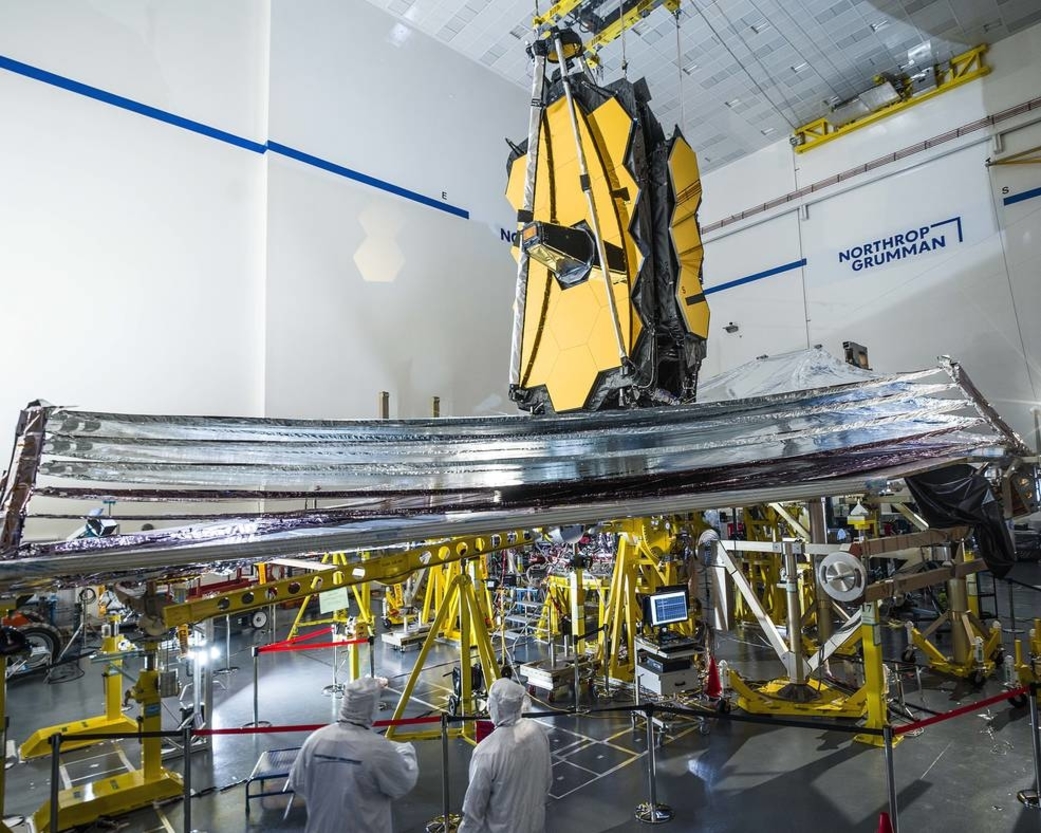
And the problems were sometimes painfully ordinary. In April 2018, hardware on the sunshield cover came loose during testing. NASA’s revised schedule included time to address the cover’s design. The agency’s new $9.7 billion life-cycle estimate reflected the cost of keeping the contractor’s workforce longer. Delay meant paying people to finish and verify hardware that already largely existed.
NASA subsequently strengthened oversight and communication with its contractor. The sunshield completed deployment on January 4, 2022. Success followed years of tests, revisions and scrutiny. The useful detail is the sequence: evidence forced the plan to change before the observatory left Earth.
The company inside the aircraft
That combination of specialized hardware and coordination runs through Northrop’s business. It makes stealth bombers, satellite systems, rocket motors, radar and electronic warfare equipment. Its Integrated Battle Command System, or IBCS, connects sensors and interceptors so air defenders can work from a shared picture. Poland’s WISŁA system uses it. The product is partly the connection between products.
The breadth came through accumulation. Jack Northrop founded Northrop Aircraft in 1939; Northrop acquired Grumman in 1994. Westinghouse electronics, TRW and Orbital ATK brought additional capabilities. Today’s enterprise contains the heritage of more than 20 companies. Apollo’s Lunar Module belongs to Grumman’s earlier history; the combined company inherited that experience rather than retroactively building the Moon landing.
Northrop occupies the layer of the defense market where whole programs are assembled and sustained, while also supplying other manufacturers. Lockheed Martin is a rival and the lead contractor on the F-35, for which Northrop supplies center fuselages and mission-system technology. Raytheon, part of RTX, partners with Northrop on hypersonic missile propulsion. The competitive map has overlapping lines.
of 2025 sales came from the U.S. government, including subcontracted work for that ultimate customer.
Reported sales reached $41.954 billion in 2025. The business earns money from development, manufacturing, upgrades and support, using both cost-type and fixed-price contracts. Under the latter, an inaccurate estimate can leave the contractor absorbing extra costs. These are long relationships with concentrated buyers, annual budget decisions and extensive rules.
The factory gets a vote
The B-21 Raider makes the trade-off visible. Designed for the U.S. Air Force, the stealth bomber combines a penetrating aircraft with sensors, communications and weapons. Its open architecture is intended to accommodate future technology. Its distinction rests on the combination of low-observable design, integration and production expertise, rather than a consumer-style feature checklist.
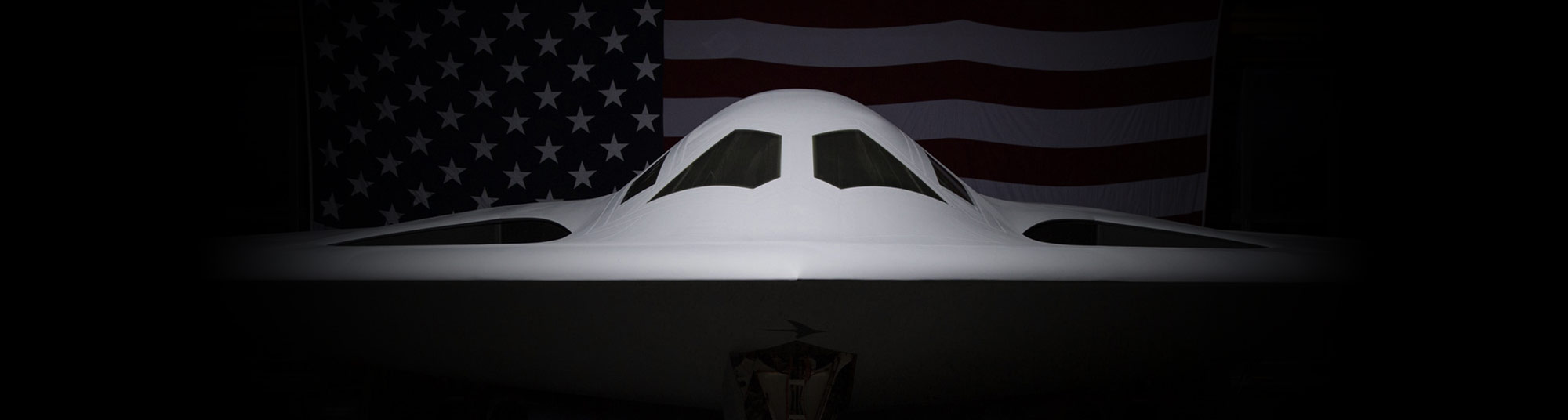
Test aircraft were built with the manufacturing processes and tooling intended for production. That matters. A prototype assembled through exceptional improvisation can conceal problems that appear when a factory must repeat the achievement. Using production methods during testing brings those questions forward, while engineers can still learn from them.
It does not guarantee profitable production. Northrop recorded an additional $477 million loss provision on B-21’s early production phase in the first quarter of 2025. Its April 2026 filing described an expected roughly $2.5 billion multiyear capacity investment, alongside opportunities for improved returns. Getting an aircraft airborne and getting its economics right remain separate assignments.
The ground beneath the missile
Sentinel offers a second, less photogenic lesson. Northrop leads the replacement of America’s Minuteman III intercontinental ballistic missile system. In July 2024, the government estimated a modified program’s acquisition cost at $140.9 billion, 81% above the September 2020 baseline. Much of the growth lay in command and launch infrastructure and the work of converting the existing system.
“There are reasons for the cost growth, but there are no excuses.”William LaPlante, government acquisition chief
Sentinel review, July 2024
The government directed restructuring. A new missile also required launch facilities, centers, staffing and a transition plan. The surrounding system had become an expensive part of the story. The $140.9 billion figure describes government program acquisition costs, not a payment of that amount to Northrop.
NASA replan, 2018
Northrop, Q1 2025
Government review, July 2024
Different scopes, dates and payers. These figures should not be added together.
Borrow the handoff test
For another builder, the practical inference is straightforward: test the handoffs. Give interfaces an owner. Rehearse how a product is assembled, deployed and maintained. Let physical evidence revise the schedule. Northrop’s programs also show the limits: years of bespoke verification require patient funding, while uncertain costs make fixed-price promises hazardous.
Individuals mostly encounter Northrop through careers, supplier opportunities or the science its hardware enables. Governments buy its systems through regulated procurement. On October 20, 2026, the company reported $109.6 billion in backlog. That number measures future work, not completed success. Somewhere inside those commitments are the next pulleys, covers and connections that will have to work.