In 1916, William Boeing found some badly cut spruce wing ribs in his workshop. He knocked them to the floor and broke one. The future of aviation, apparently, could wait for better carpentry. His warning survives in the company’s archives: “I, for one, will close up shop rather than send out work of this kind.”
It is a revealing origin story for a business associated with swept wings and distant planets. Boeing’s central problem has always lived closer to the workbench. Someone must decide whether a part is ready. Someone else must trust that decision. Multiply those exchanges across a factory and you begin to understand both the company’s achievement and its predicament.
- Boeing sells aircraft, defense systems and years of fleet support.
- Its recovery depends on completing work correctly before it moves.
- More deliveries are progress. Profitability is a separate test.
01Four bolts. A much bigger failure.
On January 5, 2024, a door plug separated from an Alaska Airlines 737-9 after takeoff from Portland. The airplane landed safely. Investigators found that four securing bolts had not been reinstalled after manufacturing rework. The NTSB attributed the accident to Boeing’s inadequate training, guidance and oversight of its parts removal process; ineffective FAA oversight contributed.
This followed the 2018 and 2019 MAX crashes that killed 346 people and led to a worldwide grounding. Those disasters involved flight-control system issues. The door-plug accident exposed a manufacturing failure. Different mechanisms, the same unavoidable question for customers: can the system behind the airplane be trusted?
Boeing’s business makes that question unusually consequential. Airlines buy capacity, fuel economics and dependable schedules. Governments buy capability and readiness. A passenger buys a ticket from an airline, but depends on engineering and factory decisions made long before boarding. Boeing serves customers in more than 150 countries. Its work reaches people who never choose it directly.
02The airplane is only the beginning.
The product range explains why Boeing remains difficult to replace. The 737 MAX serves the single-aisle market. The 787 Dreamliner carries passengers on longer routes; the 777 family serves larger passenger and cargo missions. Defense products include fighters, Apache and Chinook helicopters, maritime patrol aircraft and tankers. Space work includes satellites, rocket hardware and Starliner. Few purchasing decisions here resemble shopping for an interchangeable machine.
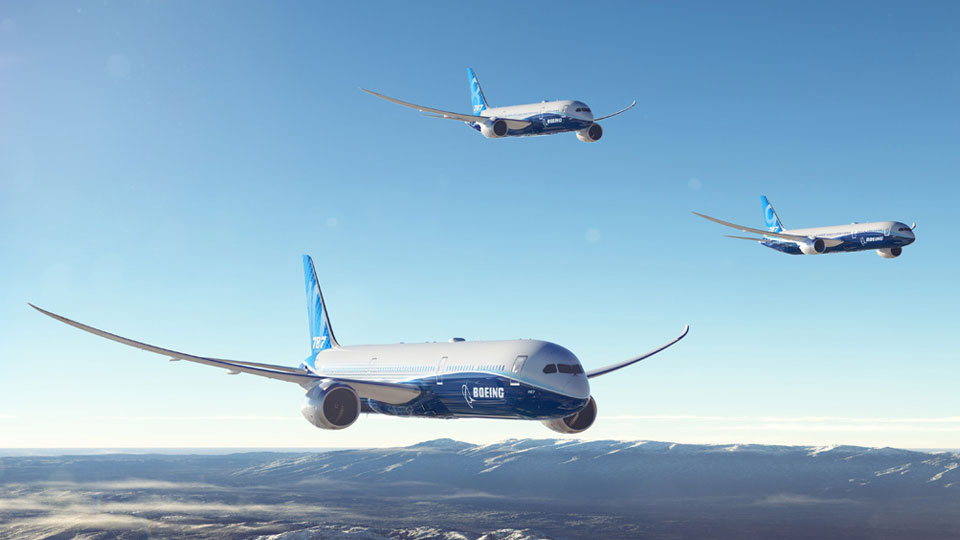
Take the 787. About half its airframe weight is composites. Boeing says it uses 25 percent less fuel than the airplanes it typically replaces. That comparison matters: it is a replacement benchmark, not a promise against every competing jet. Lower fuel use and long range give an airline more choices about which cities to connect without a stop.
For an airline evaluating Boeing, the practical purchasing questions are specific: does the aircraft fit the route, can the airline support it, and when will delivery actually happen? A fuel-saving design has limited value while the aircraft is unavailable. The same logic applies to military customers, where maintenance access and training belong in the purchase decision alongside the performance of the aircraft itself.
Then comes the less photogenic business of keeping aircraft useful: spare parts, repairs, modifications and training. Boeing earns money from aircraft deliveries, defense and space contracts, and fleet support. Customers need equipment to work for years. The installed fleet therefore creates opportunities long after the original handover, alongside obligations that do not disappear when the sale closes.
03Buying back the missing connection.
Airbus is the central commercial-aircraft alternative; Lockheed Martin and Northrop Grumman compete in defense, depending on the program. Boeing’s position combines civil aviation, military systems and services. That breadth is useful, but it cannot cancel a manufacturing problem. An order book measures what customers want. Production measures what the company can actually provide.
One consequential response was to bring major supplier operations back inside. Spirit AeroSystems had emerged from Boeing factories sold in 2005. In July 2024, Boeing announced a roughly $8.3 billion transaction, including Spirit’s reported net debt. The acquisition closed in December 2025, bringing Boeing-related fuselages and other major structures back into the group. The announced transaction value is not a total bill for Boeing’s recovery.
The merger filing supplies a concrete account of the change in thinking. In January 2024, Boeing leaders discussed reintegration to combine engineering, manufacturing and quality programs and improve supply stability. Ownership offered a way to align priorities across a boundary that contracts alone had not made reliable. Whether integration delivers those benefits remains a matter of execution.
Partnership still has a place. Boeing and Saab developed the T-7A training system together. In July 2026, BAE Systems joined them in a formal agreement for a UK training proposal anchored by the T-7. The useful distinction is responsibility: which interfaces benefit from specialist partners, and which need tighter control? Buying everything is hardly an operating method.
Moving the airplane can look like progress while moving the problem with it.
04The useful kind of boring.
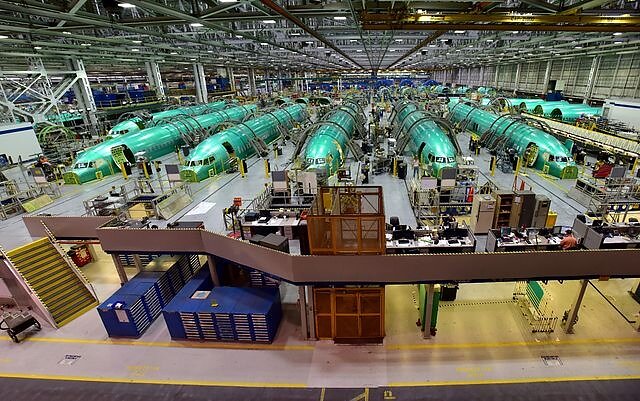
Boeing’s repair work includes longer training, simpler instructions and “move ready” checks before aircraft advance through production. These target traveled work: unfinished tasks passed to a later station. Moving the airplane can look like progress while moving the problem with it. Boeing reports a 50 percent reduction in traveled work at 737 rollout since March 2024. That is a company-reported process measure, not an independent safety verdict.
There is something here that a manager outside aerospace can copy. Define what finished means before handing work over. Track unresolved defects where they originate. Make it easy to raise concerns, then examine whether they are resolved. Those practices require authority to stop and correct work. They lose their force when a deadline overrides the acceptance criteria.
The financial recovery deserves the same attention to definitions. Boeing delivered 600 commercial airplanes in 2025, up from 348 in 2024. Revenue reached $89.5 billion. Yet its commercial-airplane segment still reported a $7.1 billion operating loss. A $9.6 billion gain tied to selling Digital Aviation Solutions operations helped reported earnings. Higher revenue, healthy production and underlying profitability are different tests.
By the second quarter of 2026, revenue was $24.6 billion, with 171 commercial deliveries, though Boeing still recorded a net loss. October brought FAA certification for the 737-10. In space, NASA plans an uncrewed Starliner flight before another crewed mission, currently targeted for 2028. Each milestone answers a narrower question than whether Boeing has recovered. The enduring test is wonderfully ordinary: was the work completed, checked and handed over correctly?