WARDSTONE RAISES $5M SEED ROUND /// YC F25 BATCH - DEMO DAY 2ND PLACE /// HAILSTORM INTERCEPTOR: 3 SUCCESSFUL MISSILE INTERCEPTS IN TESTING /// FIRST PROTOTYPE LAUNCH ON SUPERSONIC SOUNDING ROCKET - APRIL 2026 /// GOLDEN DOME CONSTELLATION TARGET: 2028 /// FOUNDERS: SEBASTIAN + TOBIAS FISCHER - BROTHERS BUILDING AMERICA'S SHIELD /// WARDSTONE RAISES $5M SEED ROUND /// YC F25 BATCH - DEMO DAY 2ND PLACE /// HAILSTORM INTERCEPTOR: 3 SUCCESSFUL MISSILE INTERCEPTS IN TESTING /// FIRST PROTOTYPE LAUNCH ON SUPERSONIC SOUNDING ROCKET - APRIL 2026 /// GOLDEN DOME CONSTELLATION TARGET: 2028 /// FOUNDERS: SEBASTIAN + TOBIAS FISCHER - BROTHERS BUILDING AMERICA'S SHIELD ///

YC F25 • El Segundo, CA • Defense Technology

Wardstone

Satellites that shoot back.

Two brothers. One radical idea: put interceptors in orbit before the missiles leave the ground. Wardstone is building America's space-based missile defense layer - satellites armed with kinetic interceptors that can destroy hypersonic threats at the speed the threat demands.

YC F25 Seed Funded Defense Tech Hypersonic Interceptor
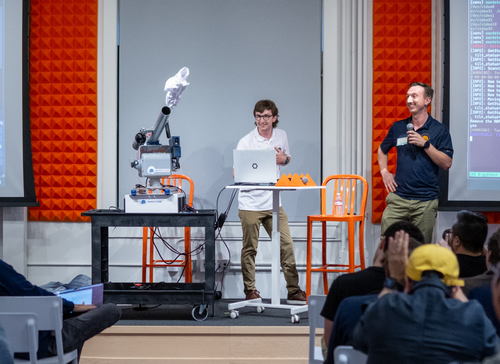
Wardstone founders Sebastian and Tobias Fischer
$5M Seed Round
3 Successful Intercepts
7 Investors
$40B Market Opportunity/yr
2028 Constellation Target

The Story

A Different Kind of Startup Problem

Most startups are trying to find product-market fit. Wardstone already knows its market. It's the same one that's kept every US president awake since the Cold War: what happens when a hypersonic missile is launched and nobody can stop it in time?

The answer, until now, has mostly been: pray. Ground-based interceptors are expensive, limited in number, and face the brutal physics of trying to hit a bullet with a bullet traveling at 15,000 mph. The window for interception is short. The margin for error is zero.

Sebastian and Tobias Fischer looked at that problem and decided the solution wasn't faster ground missiles. It was getting above the problem entirely - literally. Put the interceptors in orbit. Engage threats earlier. Cover more of the globe. Do it with satellites.

The brothers aren't newcomers to aerospace. Sebastian spent years at NASA working on planetary spacecraft, then moved to Lockheed Martin, then Amazon Prime Air, then Cruise's self-driving program. Tobias came out of Astranis, one of the most technically ambitious satellite companies working on geostationary internet access. Between them, they'd touched nearly every hard problem in aerospace and autonomy before they decided to tackle the hardest one.

"Wardstone designs, builds, and deploys satellites equipped with space-based interceptors to kinetically counter hypersonic and ballistic missiles."
- Wardstone mission statement
Founded
2025, El Segundo, California
YC Batch
Fall 2025 - placed 2nd at Demo Day Product Showcase
Headquarters
El Segundo, CA - the aerospace capital of Southern California

The People

Two Brothers. One Constellation.

Defense startups often talk about having a "team with unfair advantages." Wardstone's advantage is that its two co-founders are literally family - brothers who grew up together, think alike, and between them have touched every part of the aerospace and autonomy stack.

Sebastian Fischer
CEO & Co-Founder

MIT aerospace engineering. Harvard dual MS/MBA. Then: NASA planetary spacecraft, Lockheed Martin, leadership at Amazon Prime Air, leadership at Cruise self-driving cars.

Ten years of building things that fly, drive themselves, and survive failure. That resume doesn't happen by accident - it happens when someone genuinely can't stop chasing the hardest engineering problems in the room.

Tobias Fischer
CTO & Co-Founder

Cornell mechanical engineering. Then: Astranis - one of the most ambitious geostationary satellite companies in the world, building compact, high-powered internet satellites for underserved regions.

Tobias knows what it takes to design, build, and operate satellites that actually work on orbit. At Wardstone, he brings that systems-level thinking to a weapon system that cannot afford a single point of failure.

Things you don't learn in engineering school

The Technology

Space Buckshot. Seriously.

The core insight behind Wardstone isn't exotic directed-energy weapons or massive laser arrays. It's something more elegant: if you can't reliably hit a single point at hypersonic speed, stop trying to hit a single point. Deploy a cloud.

Hailstorm
Space-Based Kinetic Interceptor - Primary Weapon System

Hailstorm deploys high-speed clouds of buckshot - a 1-kilometer-diameter field of particles - directly in the path of an incoming hypersonic missile. No need to achieve a direct hit. At hypersonic approach velocities, the missile does the kinetic work itself. The target runs into the cloud at the speed of the threat.

This approach sidesteps one of the fundamental challenges of missile defense: the extreme precision required to achieve a direct kinetic intercept against a maneuvering hypersonic target. Instead of needing to know exactly where the missile will be at a precise moment, you fill the space. Simple in concept. Brutally effective in execution.

Golden Dome Constellation
Multi-Layer Integrated Missile Defense System - Target: 2028

Beyond Hailstorm, Wardstone's long-game is the Golden Dome - a global constellation of satellites equipped with both sensors and interceptors. The system is designed to detect ballistic, hypersonic, and cruise missiles and engage them at any phase of flight, including before launch.

The methodology is detect-predict-intercept. Persistent orbital coverage means no gaps, no gaps means no safe launch windows for adversaries. The constellation doesn't sleep. It doesn't rotate shifts. It just watches.

April 2026: Wardstone's first prototype interceptor is scheduled for launch aboard a supersonic sounding rocket - moving from ground-based demonstrations to the actual operating environment.

Detect. Predict. Intercept.

Wardstone's interceptors use infrared computer vision for active tracking of hypersonic threats - the same general class of sensing technology used in modern autonomous systems, adapted for the thermal signature of high-velocity missiles against the cold backdrop of space.

The predict step is where the engineering gets interesting. Hypersonic missiles maneuver. Their trajectory is not a simple ballistic arc. Wardstone's system must model the threat's flight path and position the cloud where the missile will be - not where it is.

$40B
per year, emerging space defense market
America's Golden Dome initiative is the primary demand driver. Wardstone is positioning as a key technology provider for DoD space-based interception contracts.

Funding & Investors

$5 Million. A Constellation of Believers.

In November 2025, Wardstone closed a $5M seed round anchored by Y Combinator. The investor list reads like a directory of people who have been waiting for someone to take this problem seriously with actual engineering credibility behind it.

The capital goes toward advancing the Hailstorm interceptor toward its first space qualification, pursuing SBIR contracts from Space Force and the Missile Defense Agency, and building the engineering team capable of actually delivering a constellation.

$5M
SEED ROUND • NOVEMBER 2025
Y Combinator Pioneer Fund Nova Threshold Liquid 2 Ventures Bow Capital B5 Capital Allegis Capital

The US Government, All Branches

Wardstone's target customer list is essentially the entire US Department of Defense:

Space Force
Primary SBIR contract target and orbit operations authority
MDA
Missile Defense Agency - direct technology procurement
Air Force
Aerial threat integration and joint operations
Navy
Maritime and sea-based threat defense
Army
Integrated joint theater defense

Milestones

Fast by Any Measure

Defense programs are not known for their pace. The F-35 took 20 years and $1.7 trillion. The Army's Future Long-Range Assault Aircraft program has been "imminent" since 2019. Wardstone is operating on a different timeline: the startup kind.

In the 8 weeks of YC's program, they built a complete automated missile tracking and intercept system with infrared computer vision. From concept to three successful live demonstrations. That's not a slide deck. That's a proof of concept with physics attached.

2025 - YC F25
Wardstone joins Y Combinator's Fall 2025 batch. In 8 weeks, builds fully automated missile tracking and intercept system with infrared computer vision.
October 2025 - Demo Day
Demonstrates three successful automated missile intercepts at YC F25 Demo Day. Places 2nd in the Product Showcase.
November 2025 - Seed Round
Closes $5M seed round led by Y Combinator, with Pioneer Fund, Nova Threshold, Liquid 2 Ventures, Bow Capital, B5 Capital, and Allegis Capital.
April 2026 - First Launch
First prototype Hailstorm interceptor scheduled for launch on a supersonic sounding rocket. Transition from ground-based to real operating environment.
2028 - Constellation Target
Golden Dome satellite constellation deployment target. Global coverage for ballistic, hypersonic, and cruise missile interception.
  • 🏆 2nd place at YC F25 Demo Day Product Showcase - out of a full batch of technically ambitious startups
  • 🎯 Three successful automated missile intercepts demonstrated during YC program using ground-based prototype
  • 🛰 First sounding rocket launch planned April 2026 - first real-world test of the Hailstorm interceptor in an actual flight environment
  • 💰 $5M seed round from 7 investors including Y Combinator, Liquid 2 Ventures, and Allegis Capital
  • 🤖 Infrared computer vision intercept system built in 8 weeks - fully automated detect-predict-intercept pipeline
  • 🔬 Novel "buckshot cloud" intercept approach - 1 km diameter particle deployment field sidesteps the precision challenge of hypersonic intercept

Context

Why Now, Why Space, Why This

Hypersonic weapons are the current arms race. China's DF-17 can reportedly reach 6,000 mph and maneuver in flight. Russia's Kinzhal was used operationally in Ukraine. North Korea has tested multiple hypersonic glide vehicles. Every major adversary is investing heavily in weapons that existing ground-based systems struggle to intercept reliably.

The United States' current missile defense infrastructure was largely designed for a different threat environment - primarily ballistic missiles on predictable arcs. Hypersonic glide vehicles fly at lower altitudes, maneuver, and compress the decision timeline dramatically. Ground-based response systems don't have the geometry to intercept early enough.

Space changes the geometry. An orbital interceptor can engage a threat much earlier in its flight path - before it reaches hypersonic glide phase, before it maneuvers, before the available response time collapses. The physics favor the defender when the defender has altitude.

America's "Golden Dome" initiative - a layered national missile defense system - explicitly calls for space-based components. It's a $40B/year emerging market, and it's looking for exactly what Wardstone is building: small, capable, affordable satellite interceptors that can be deployed at scale to create persistent global coverage.

The timing is not accidental. It is the natural consequence of a threat environment that has outpaced the existing defense architecture. Wardstone exists because the problem finally got urgent enough to attract engineers willing to start a company around it instead of waiting for a prime contractor to move at prime contractor speed.

That's the bet. That a two-person founding team with rocket science credentials, a novel technical approach, and the urgency of a defense startup can out-iterate the traditional defense industry on the timeline that actually matters.

Wardstone is currently hiring engineering and business development interns with backgrounds in space systems and missile defense. For a company this early, the people who join now will shape what the constellation actually looks like.

Details Worth Knowing

The Small Things That Tell the Real Story

What makes Wardstone unusual
  • The founders are brothers. Most co-founders met at school or work. Sebastian and Tobias grew up together before they built missiles together.
  • Sebastian's resume includes planetary spacecraft, self-driving cars, drone delivery, and commercial aviation before landing on missile defense satellites. Most defense founders come up through defense. He came sideways from everywhere else.
  • The "buckshot cloud" approach - a 1 km field of particles - is elegantly low-tech in its core concept. The hard part is the targeting and deployment precision needed to position it correctly.
  • El Segundo, CA, their headquarters, is within a few miles of some of the largest aerospace and defense facilities in the US, including Raytheon, Northrop Grumman, and the LA Air Force Base.
  • Their YC Demo Day demo wasn't rendered or simulated. Three live automated intercepts, built during the 8-week program.
The Technical Edge
Wardstone's approach to intercept geometry - filling a volume rather than hitting a point - potentially allows their satellites to be less computationally precise than traditional kinetic interceptors. The trade-off is payload mass (you're deploying more material) versus guidance complexity (you need less precision). For a startup building its first constellation, that trade-off probably makes sense.
The Business Model
Defense contracting is a known path for space-based defense tech. The SBIR (Small Business Innovation Research) program specifically exists to help startups like Wardstone prove out technology before scaling to full procurement contracts. Space Force and the Missile Defense Agency are both identified targets - agencies with real budgets and existential interest in what Wardstone is building.

Find Wardstone

Go Further