Brandon Alexander’s route back to farming involved a detour through flying burritos. At Google, he worked on the drone program that became Project Wing. It was a technically demanding job, the sort of work a young robotics engineer might have imagined while studying at the University of Texas at Austin. Yet the prospect of using that machinery to deliver fast food left him wondering where else his skills might be useful. He had spent childhood summers working on his grandparents’ farm. Years later, having acquired the qualifications to stay comfortably away from the fields, he began considering a return.
The company he co-founded in 2015, Iron Ox, would put robots among the vegetables. There would be mobile machines, robotic arms, hydroponic growing modules and software coordinating the work. Lettuce would travel across the farm without anyone carrying it. But before any of that came a less photogenic piece of equipment: a car. Alexander and his co-founder, Jon Binney, went to talk to farmers. The people with dirt under their fingernails got the first word.
The farm he meant to leave
His family’s agricultural background stretched across Texas and Oklahoma. In his own recollections, summer meant cotton, potatoes and peanuts, with hours of picking under the Texas sun. The work supplied an early education in what food production demanded of people. It also supplied a perfectly reasonable incentive to find something else to do.
At UT Austin, Alexander developed his interest in engineering and robotics. He graduated in 2007. The appeal is easy to understand: robots offer problems with moving parts, visible consequences and the possibility that a well-written piece of software might persuade a machine to do something useful in the world.
Farming offered moving parts too, although they were rather less inclined to follow instructions. Plants, weather and the availability of workers could complicate any plan. Alexander would eventually bring the two experiences together. At first, however, he pursued the engineering career. His later decision to become a farmer again surprised relatives who had watched him find his way out. The family had already seen the original version of the job.
A browser, a drone, then a detour
At Willow Garage, Alexander worked on web robotics: the tools that let people interact with robots through networked software. His work included interfaces for managing machines at multiple facilities. It was an education in making robots usable beyond the immediate reach of the person who built them.
In May 2013, he presented Robot Web Tools at ROSCon. His slides walked through connecting a browser to a robot, receiving position information, adding a map and displaying a three-dimensional model. The examples were practical. Before a robot can be useful at a distance, somebody has to make its whereabouts and behavior intelligible on a screen.
His public code provides another view of that period. Projects include an XML-RPC client and server for Node.js, an asynchronous port scanner and a ROS client library. These are the plumbing of connected systems. They lack the theatrical appeal of a robotic arm, but machines have an unfortunate habit of depending on their plumbing.
At Google X, Alexander developed mission control software for the drone delivery program. A recurring problem ran through these jobs: coordinating physical machines with software. Iron Ox would give that problem a different setting, and something considerably more delicate than a package to look after.
Six months without a prototype
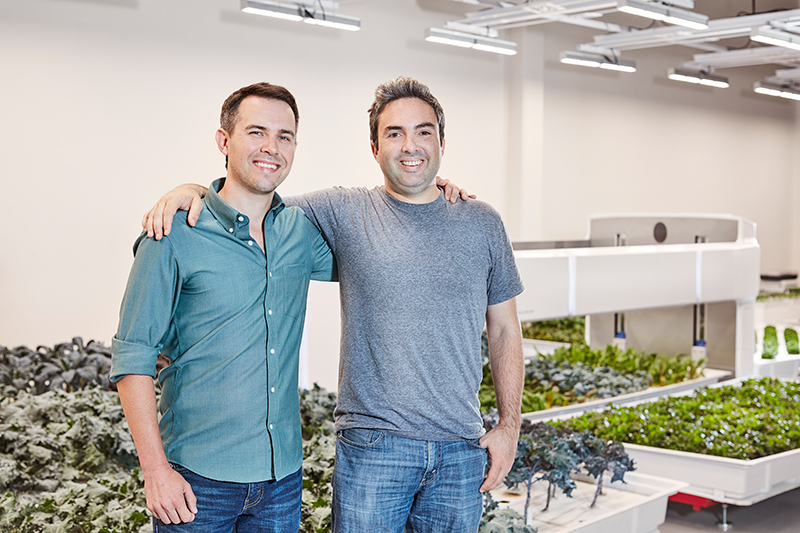
Alexander dates his connection with Binney, a robotics PhD, to 2012. They shared an interest in putting advances in robotics to practical use. Cheaper sensors, cloud computing and improving machine learning made new applications possible. Choosing one still required a reason to build it.
Their California trip lasted six months. They visited growers with different crops and different approaches, looking at outdoor farming, indoor growing and systems including hydroponics. They began with the possibility of automating individual jobs, such as weeding or harvesting. Farmers described difficulties that extended beyond any single task.
Labor was scarce. Water was a constraint. Produce often had to travel a long way to its buyer. A machine that improved one operation would still work inside a system carrying all the other costs. By the end of the trip, Alexander wanted automation designed into the growing process from the beginning.
That decision made the undertaking larger. It also explains something about his method at this point in his career. He had enough robotics experience to start building immediately. Instead, he spent months collecting reasons to change the design. For an engineer, leaving the prototype unbuilt can be a demanding form of work.
“If we can feed people using robots, what could be more impactful than that?”
Brandon Alexander, 2018
Angus gets a job
In 2018, Iron Ox opened its robotic production farm in an 8,000-square-foot warehouse in San Carlos, California. The early cast included Angus, a mobile robot weighing nearly 1,000 pounds. Its assignment was to move growing modules weighing about 800 pounds, including their water. It was an agricultural job with little need for rustic charm.
The division of labor mattered. Angus carried the modules to a separate robotic arm, which handled individual plants. Moving the growing environment to a workstation meant the more precise machine could stay put. The farm itself had been arranged around what the robots could do.
As plants grew, they needed more space. Transferring them into larger positions allowed the system to use its growing area differently at different stages. Software coordinated the movements, while cameras and sensors supplied information about the plants and their surroundings.
The early operation still depended on people, including for clipping vegetables at harvest. The word autonomous could make the place sound more complete than it was. The useful distinction was in the actual tasks: heavy transport, delicate handling, observation and decisions about what should happen next. Each presented its own engineering problem, and a working demonstration did not settle all four.
- 01 / GrowPlants share a hydroponic module.
- 02 / CarryA mobile robot brings the module to a station.
- 03 / HandleA robotic arm works with individual plants.
- 04 / ObservePlant and sensor data guide the next operation.
Simplified view of the early Iron Ox system.
The lettuce gets a vote
Alexander spoke about the farm’s blind taste tests with an attention that complicates the familiar picture of a technology founder. The team bought produce from grocery stores and compared it with their own. They considered appearance, texture, crispness, bitterness and sweetness. A technically interesting lettuce could still be a disappointing lunch.
He also credited head of growing Nicole Bergelin and her team with improving yield and quality. Her close attention to the plants gave the engineers another task: translate what an experienced grower noticed into monitoring the robots could perform.
That is a different challenge from simply moving a tray. It begins with the possibility that another person sees something the machine does not yet know to look for. The grower’s expertise shapes the technical work. Alexander’s account made room for that dependency.
Keep the sun. Count the inputs.
As Iron Ox developed, Alexander argued for naturally lit greenhouses. Artificial lighting could make indoor growing possible, but it also added an energy bill. Sunlight already performed an essential part of the job. His vision of a more automated farm kept that familiar resource in the plan.
He increasingly described the ambition in terms of waste: water, fertilizer, energy and the gap between what a plant received and what it used. He called for renewable food, with the longer-term goal of making produce production carbon negative. Those were objectives for the system, rather than a certificate that the business had already achieved them.
“But eating isn’t optional,” he said in 2021. The bluntness suited the problem he had chosen. Food offered recurring demand, biological complexity and very little scope for asking the customer to stop needing it.
That November, Iron Ox introduced Grover, a mobile robot designed to lift more than 1,000 pounds. Its job included carrying hydroponic modules to inspection and service stations. The company had also announced a $53 million funding round led by Breakthrough Energy Ventures. The equipment was becoming more capable; the proposed operation was becoming larger.
A greenhouse still needs a business
Expansion brought Iron Ox to Lockhart, Texas. It also brought the ordinary demands of an unusually complicated company: assembling engineering teams, operating farms, selling produce and financing the work. Capital could pay for equipment and people. It could not remove the need to make the operation viable.
In November 2022, Iron Ox cut about 50 jobs, roughly half its staff. In 2023, Inevitable Tech emerged with former employees, software and a Lockhart greenhouse, pursuing a platform for other agricultural businesses. The earlier vision of growing and selling produce had given way to a different commercial direction.
Alexander’s present chapter is at Crosslink Capital, which lists him as an entrepreneur in residence focused on AI and hard technology. Its biography credits him with raising more than $100 million during eight years leading Iron Ox, building technical teams and expanding farms. His remit now includes the organizational side of difficult engineering: hiring, financing and taking a product to market.
The return to farming supplied him with more than a memorable career change. It required him to move between the knowledge of growers, the abilities of machines and the demands of a business. The vegetables had to grow. Someone had to want them. And every robot, however capable, needed a place in that calculation.