At the center of Iron Ox's greenhouse sat a very large answer to a very small question: how do you get a head of lettuce to market? The answer was Grover, a low-slung robot built to slip under a six-foot-square hydroponic tray, lift more than a thousand pounds of plants and water, and drive it across the greenhouse floor. It looked less like a farmhand than a piece of airport equipment. The lettuce, one imagines, did not care.
That indifference was the point. Lettuce is a commodity with opinions imposed on it by everyone else: shoppers want it fresh, stores want it cheap, growers want it predictable, and climate adds its own unruly demands. Iron Ox set out to satisfy all four by rebuilding the farm around machines. It succeeded in building the machines. The more instructive part of the story is what happened when those machines met the business of food.
- Iron Ox grew hydroponic greens and herbs in robot-assisted greenhouses and sold them through grocery and delivery partners.
- Its signature robot, Grover, moved heavy plant modules to inspection and care stations; sunlight supplied much of the light.
- A Texas greenhouse was planned at 535,000 square feet and more than $10 million in development cost.
- After large layoffs in 2022, the company renamed itself Inevitable Tech in 2023 and shifted toward technology for growers.
A farm designed from the wheels up
Brandon Alexander came to agriculture by way of family farms in Texas and Oklahoma, a robotics education, and work at Google X. He and co-founder Jon Binney started Iron Ox in 2015 with an observation that seems obvious only after someone says it: if robots are to work a farm, why make them navigate a farm designed for humans? Early prototypes in San Carlos used hydroponic beds, robotic handling, cameras and software to track individual plants. The idea was to move plants to the work, instead of sending people and machinery down every row.
The company first tried an indoor setup with artificial lighting. The next important discovery was decidedly old-fashioned. Sunlight was cheaper. By 2020, Iron Ox had a 10,000-square-foot greenhouse in Gilroy, California, growing leafy greens and herbs for grocers including Whole Foods Market and Bianchini's. Its approach differed from the stacked, LED-lit rooms associated with some vertical farms: it used greenhouse light, hydroponic water loops and mobile growing modules. The robots were custom; the sun had a considerably longer track record.
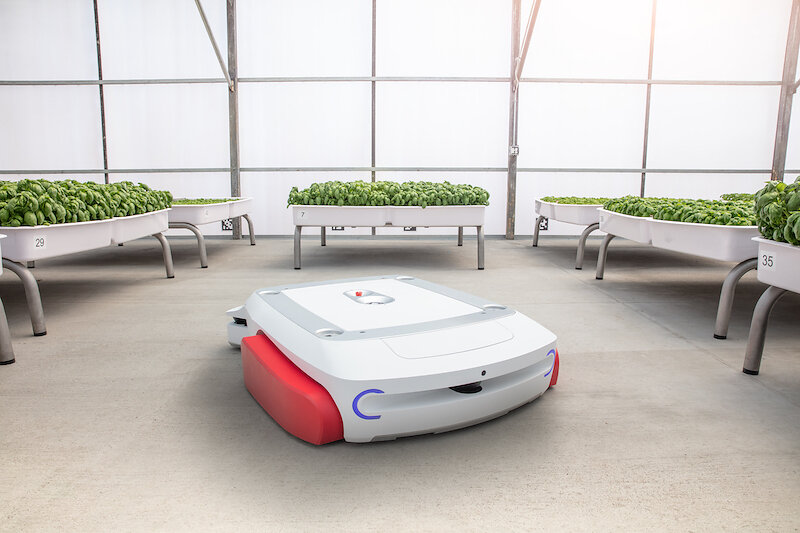
Greens and herbs grew in hydroponic trays under greenhouse light.
The robot lifted the water-heavy modules and carried them across the floor.
Scanning and sensors helped direct nutrients, water and harvesting.
The phrase “autonomous farm” suggested that people had vanished. They had not. Growers, plant scientists, engineers and operators remained essential, and in 2020 Alexander described the system as still requiring human seeding, pruning and inspection. The useful advance was narrower and more concrete: fewer repetitive moves, closer monitoring, and a growing system built to make those tasks easier to automate over time. A robotic arm could handle plants delicately; cameras could spot trouble before it spread. None of that made a tomato appear by software update.
The price of a beautiful greenhouse
Iron Ox's proposed scale jumped dramatically in 2021. It announced a 535,000-square-foot facility in Lockhart, Texas, with development costs expected to exceed $10 million. That September it raised a $53 million Series C led by Breakthrough Energy Ventures, bringing reported cumulative funding to about $98 million. In November it introduced Grover publicly. The company said the robot could move six-by-six-foot plant modules weighing more than 1,000 pounds and send them to a scanning booth for inspection before further care or harvest.
These numbers show both why Iron Ox was interesting and why it was difficult. A robot that can move that much water and biomass solves a real handling problem. But the greenhouse, its climate controls, engineering team and distribution network must be paid for by produce. A head of lettuce cannot charge extra because a LiDAR unit helped raise it. Iron Ox said its produce cost roughly what conventionally farmed produce did; it also said its hydroponic approach used substantially less water. Those claims described ambition and operating performance, not a public profit statement.
The customer was never just a robot buyer. At first it was a shopper reaching for greens on a shelf. The company sold through Whole Foods in California, as well as Bianchini's and Mollie Stone's; Texas-grown produce reached Austin-area Whole Foods stores and local delivery channels in 2022. That is more than a demonstration. It is also a famously unforgiving market. A grocer can admire a new way to grow basil and still compare every clamshell with the next supplier's price.
What broke before the robot did
The first clearly documented break was organizational. In November 2022, Iron Ox cut about 50 jobs, nearly half its staff. Chief legal officer Myra Pasek said the move was intended to extend the company's cash runway and that it would concentrate on engineering and technology. The cuts crossed departments. The company said at the time that it was not winding down. There is no public operating ledger that pins the decision on a single failed crop, component or customer. The evidence supports a narrower conclusion: the capital-heavy farm model needed a different path.
In May 2023, Iron Ox, Inc. changed its name to Inevitable Tech Inc. The new company shifted from growing and selling produce to offering agricultural hardware, software, data collection and diagnostics to other growers. It focused in part on propagation, the stage when young plants are started and mistakes travel forward into every later week of growth. Its first named client was greenhouse grower Revol Greens. By June 2024, financial adviser Armory Securities announced a restructuring of Inevitable Tech's assets. The original Iron Ox produce brand belongs to a particular chapter, rather than an ongoing promise on the grocery shelf.
The part worth copying
There is a useful principle inside this expensive experiment: design the workflow and the machine together. Grover made sense because Iron Ox standardized the module it lifted, the route it drove and the station it visited. A farm operator can borrow that thinking without buying a thousand-pound robot. Standardize trays, record crop conditions, measure handling time, and find the repetitive motion that actually constrains output. In some greenhouses, the right answer may be a cart, a better bench or a spreadsheet long before it is autonomy.
The limits are equally practical. If land is cheap, sunlight abundant and labor accessible, field growing may win on cost. If a crop is too low-value to pay for enclosed space and machinery, automation can make a beautiful loss more efficiently. If the grower cannot sell predictable volume near the greenhouse, local production loses much of its appeal. Iron Ox's move toward serving growers suggests a more portable idea: sell the intelligence where it improves someone else's established farm economics.
Grover could lift the lettuce. That was an achievement. The next question was always whether the lettuce could lift the business. Iron Ox's answer changed over time, and that change is the most useful thing it grew.