The Brooklyn rooftop experiment that grew into one of North America's largest greenhouse lettuce growers - profitably.
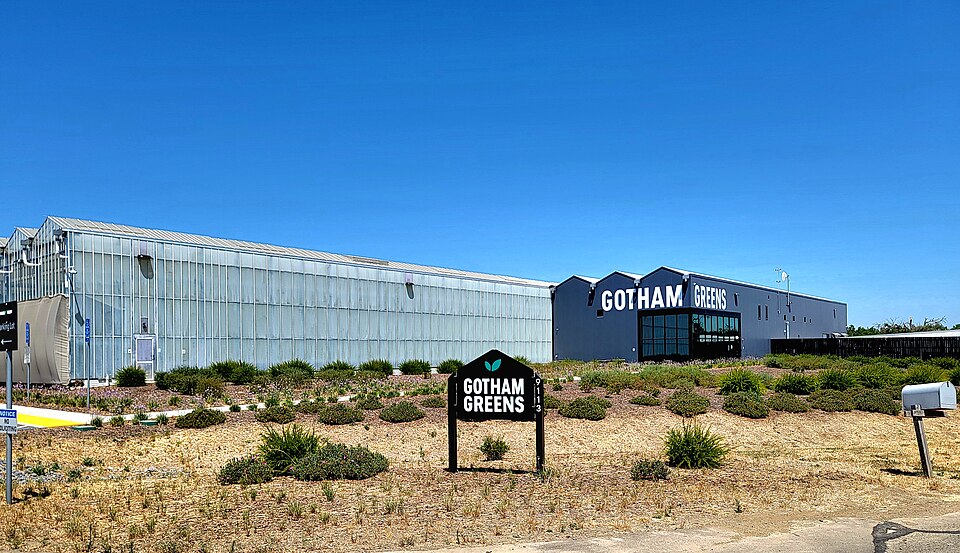
GOTHAM GREENS - A climate-controlled hydroponic greenhouse in Davis, California, where leafy greens grow year-round under glass. Photo via Wikimedia Commons.
The Dateline
In 2008, two friends living in New York - Viraj Puri, an environmental engineer, and Eric Haley, a finance man - started talking about building a green business together. Their idea was almost stubbornly simple: put a greenhouse in the middle of the city and grow food where people actually eat it. After three years of planning, in May 2011 they opened a 15,000-square-foot greenhouse in Greenpoint, Brooklyn, reported to be the first commercial urban rooftop greenhouse in the United States.
Fifteen years later, Gotham Greens is no longer an experiment. The company owns and operates more than a dozen high-tech hydroponic greenhouses across nine states, totaling nearly two million square feet, and grows roughly 100 million heads of lettuce a year. Its greens, herbs, salad kits, dressings, dips and cooking sauces reach more than 6,500 retail locations in all 50 states. And unlike much of the indoor-farming field, its greenhouses turn a profit.
What It Does
Gotham Greens is a vertically integrated fresh-food company. It doesn't just design farming technology and license it out - it owns the greenhouses, grows the crops, packs the products under its own name, and sells them straight to grocers, restaurants and foodservice distributors. Plants grow hydroponically, their roots fed a precise nutrient solution rather than soil, inside greenhouses where light, temperature and humidity are tuned for consistency.
The payoff is produce that is pesticide-free, available every month of the year regardless of weather, and grown close to the stores that sell it. Shorter distance means fresher greens and a longer life in the refrigerator. That last point is the quiet commercial engine of the whole operation: proximity, not novelty.
"Our greenhouses are profitable. We've demonstrated we can be really efficient stewards of our investors' capital."
Viraj Puri, Co-Founder & CEOProducts & Services
Pesticide-free butterhead, romaine and other lettuces, harvested and shipped year-round.
Greenhouse-grown basil and culinary herbs delivered to retail and foodservice.
Ready-to-eat kits pairing Gotham Greens lettuce with dressings and toppings.
Plant-forward dips, pestos and sauces extending the brand into the chilled aisle.
Fresh, minimally processed Avocado Lime Ranch and Italian Herb Vinaigrette, launched at Whole Foods.
Spinach added in 2024 as the company widens beyond its lettuce roots.
The Problem It Solves
Conventional field farming is thirsty and land-hungry, and it ships produce across the country before it reaches a shelf. Gotham Greens' greenhouses were built to attack all three costs at once. The bars below compare a Gotham Greens greenhouse to open-field growing of the same crops.
Figures are company-reported approximations comparing greenhouse growing to conventional open-field farming.
Who Buys It & Why It's Different
Customers. Gotham Greens sells to national grocery chains including Whole Foods Market, Kroger, Sprouts Farmers Market, Albertsons, Harris Teeter, Publix and Target, plus e-commerce grocers FreshDirect and Amazon Fresh. Restaurants and foodservice operators round out the base. In total, its products reach more than 6,500 retail locations across all 50 states.
The difference. The indoor-farming story of the last decade is littered with vertical-farm startups that raised enormous rounds chasing stacked LED towers, then folded. Gotham Greens took the less glamorous path: greenhouses that use natural sunlight, sited near major metro markets, run as disciplined, profitable operations. Rivals include BrightFarms, Little Leaf Farms, Revol Greens and Bowery Farming, along with conventional packaged-salad brands like Taylor Farms and Dole.
The Record
Viraj Puri and Eric Haley found the company with a plan to build greenhouses inside cities.
A 15,000 sq ft greenhouse opens in Greenpoint, Brooklyn - the first commercial urban rooftop greenhouse in the country.
Opens a greenhouse atop a Whole Foods Market in Gowanus, growing greens directly above the shop that sells them.
Adds greenhouses in Chicago, Rhode Island, Maryland and beyond, becoming a multi-state operation.
Opens its first California greenhouse and becomes a Certified B Corporation.
Raises $310 million and acquires Virginia grower FresH2O Growers to accelerate national growth.
Adds spinach, expands the Chicago footprint, opens a Texas greenhouse and launches national salad dressings.
Marks 15 years as one of North America's largest greenhouse leafy-greens growers.
Business & Backing
Led by BMO Impact Investment Fund and Ares Management funds, with Commonfund Capital, RockCreek, Kimco Realty and existing backers Manna Tree Partners and The Silverman Group. Capital funded greenhouses in Texas, Georgia and Colorado, expansions in Illinois and Rhode Island, and the acquisition of FresH2O Growers.
Gotham Greens earns revenue from branded fresh produce and value-added packaged goods sold through retail, foodservice and e-commerce. Margins are protected by siting greenhouses near big metro markets - cutting transport cost and extending shelf life. Annual revenue is estimated around $52 million.
The People
An environmental engineer with a background in sustainable development; the public face and strategic lead of the company.
Came from banking and finance and drives the business side of the venture, from capital to operations.
Joined in 2009 to lead greenhouse operations, shaping the horticultural science behind the crops.
The company's expertise sits at the intersection of controlled-environment horticulture, food safety and consumer packaged goods. It runs data-driven greenhouses where growing conditions are monitored and tuned, applies rigorous food-safety standards, and - as a Certified B Corporation - ties its operations to measurable social and environmental goals.
Where It Fits
Gotham Greens sits in the controlled-environment agriculture (CEA) segment - the slice of agtech that grows food indoors or under glass. Within it, the company represents the pragmatic wing: greenhouses over vertical LED farms, profitability over pure growth, national grocery distribution over direct-to-consumer novelty. As many high-profile vertical-farm ventures retrenched, Gotham Greens' steadier model left it as one of the category's most durable operators.
Worth Knowing
The name nods to the century-old nickname for New York City, where it all began.
Its early greenhouse sat on the roof of a Brooklyn Whole Foods - greens grown directly above the checkout.
Under climate control, the crops are unaffected by drought, frost or heatwaves - 365 days a year.
It chose sunlight-and-glass greenhouses over the flashier vertical farms that many rivals rode into collapse.
One facility can match the output of tens of field acres using a fraction of the water.
Heads of lettuce Gotham Greens grows in a single year.
Questions
Find Gotham Greens
Pass It On