The bees were a useful complication. Bowery Farming had built an agricultural world of sensors, cameras and carefully managed light. Then it brought bees inside to pollinate strawberries. Even in a warehouse designed to make nature more predictable, nature still had a job. The arrangement captures something easily lost in the company’s spectacular financing story: Bowery was trying to make better food, and the food was real.
- Indoor farms grew pesticide-free greens near urban customers.
- BoweryOS coordinated crop monitoring and growing conditions.
- A strawberry experiment asked shoppers to pay $14.99 for eight ounces.
- Operations ceased in November 2024; equipment later went to auction.
So was the ending. Bowery ceased operations in November 2024. The interesting question is how a company could produce an appealing answer to one problem - growing fresh food with greater control - while remaining exposed to another: making the arithmetic work at the checkout.
01A farm with the weather removed
Founded in 2015 by Irving Fain, David Golden and Brian Falther, Bowery put growing trays in stacked layers rather than stretching fields across acres. Hydroponic systems supplied nutrients; LEDs supplied light. Climate controls made a crop’s environment something a farmer could adjust. The location mattered too. Farms near cities promised a shorter journey between harvest and dinner.
The distinctive part was BoweryOS, the company’s proprietary operating system. Sensors and cameras collected information about plants. Software used that feedback to guide environmental adjustments and help farmers decide when to harvest. Records followed crops from seed to store. A growing recipe could become a shared instruction rather than knowledge confined to one experienced grower.
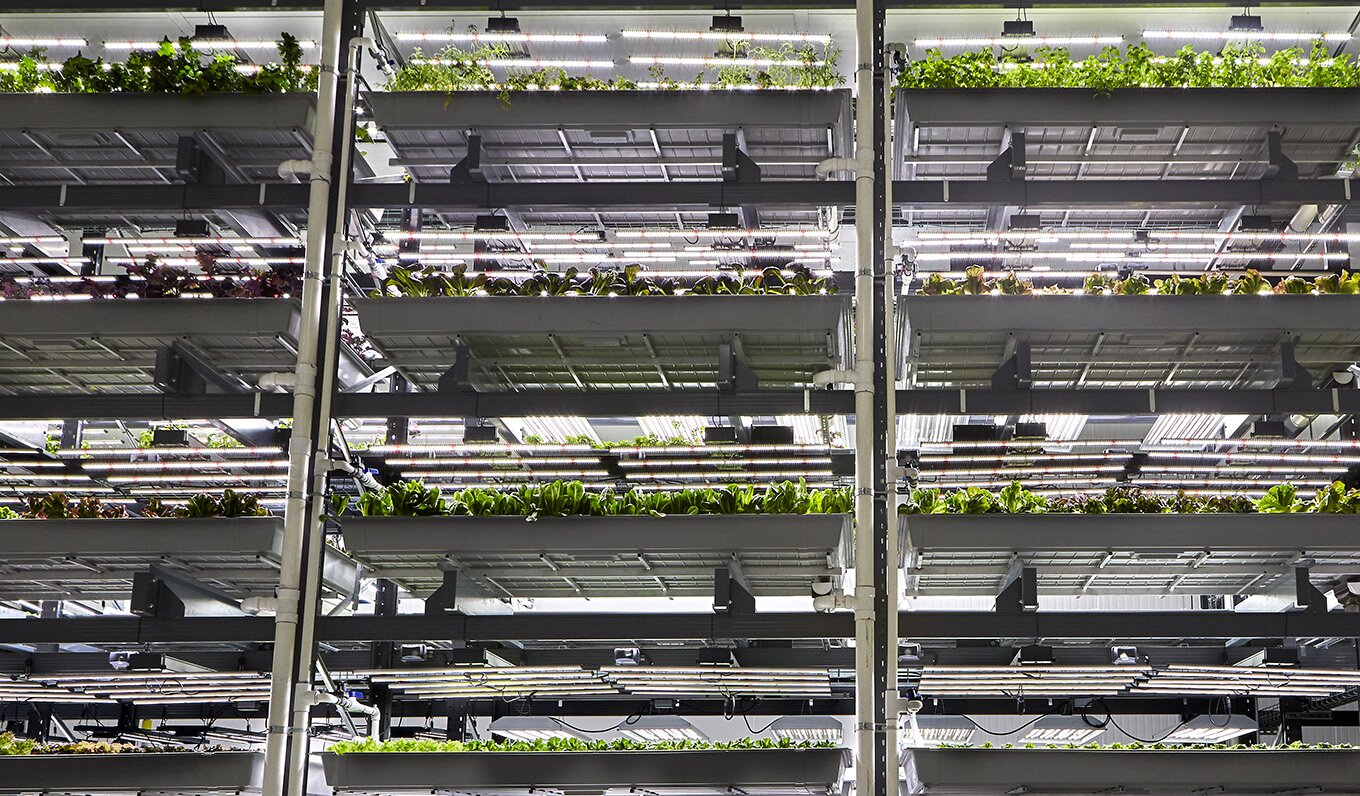
Think of the expertise this required: plant science beside software, mechanical systems beside farm operations. A warehouse could offer repeatable conditions, but someone still had to understand what a plant needed. Bowery’s ambition was to let every farm benefit from what the others learned.
Then observe again. Conceptual illustration of Bowery’s growing system.
02The supermarket was the real laboratory
Customers did not buy BoweryOS. They bought salad. Bowery sold branded greens and herbs through established grocery channels, including Whole Foods Market, Walmart and Amazon Fresh. Its business model tied sophisticated infrastructure to a familiar transaction: a shopper putting a package of produce in a basket.
The offer was practical. Pesticide-free growing, local production and year-round harvests addressed concerns about food sourcing and availability. Crispy Leaf, Baby Butter Lettuce and peppery Arugula gave the brand recognizable products. A shopper could use them in an ordinary lunch without learning anything about computer vision.
Bowery reported more than 1,000 grocery stores in May 2022. That was a meaningful distribution achievement. It also made the comparison unavoidable. Each package competed with other indoor growers, greenhouse brands and conventional produce. The shopper’s alternative was usually another leaf, not another operating system.
The distinction matters when discussing its place in the market. Bowery was a food producer with proprietary technology. Its returns depended on physical crops, retail demand and the costs of running farms. The technology could improve the process; the finished food still needed to earn its shelf space.
03Two berries, one awkward price tag
In March 2022, Bowery made that proposition unusually clear. Its Strawberry Discovery Duopack paired Garden and Wild berries for a side-by-side tasting. The announced price was $14.99 for eight ounces, with a limited release through selected New York City retailers and restaurants.

This was more interesting than a generic promise of sustainability. Two cultivars gave customers something they could compare with their mouths. Bowery’s indoor bees handled pollination; controlled growing conditions supported its flavor ambitions. The experiment treated variety as a reason to buy, rather than asking a worthy mission to do all the selling.
It also revealed the challenge. Premium produce needs customers who notice the difference and pay for it repeatedly. A tasting pack can demonstrate possibility. It cannot establish that a network of farms will recover its costs. The berry was a persuasive little salesman, but it could not negotiate with the electricity supplier.
04The money arrived before the margin
Investors supplied considerable runway. Bowery’s May 2021 financing announcement put its valuation at $2.3 billion. In January 2022, it announced a $150 million credit facility led by KKR-managed accounts, intended to support expansion including Georgia and Texas. Capital was financing the next set of farms as well as improvements to the system.
“To build a generational company takes time, patience, resilience, and relentless focus”
Irving Fain, May 2021 founder letter
Indoor agriculture makes a particular bargain. It reduces exposure to weather while taking responsibility for supplying light and maintaining climate. Those controls require equipment and energy. Water efficiency and shorter delivery routes may be valuable, but neither automatically proves a profitable harvest. The relevant calculation is what remains after producing and selling it.
May 2021 announcement
January 2022 announcement
March 2022 launch price
Company announcements. Valuation, borrowing capacity and retail price measure different things.
The first visible retreat in this account was financial. During 2023, layoffs and delayed project openings signaled an effort to slow cash consumption. Reporting on the closure described attempts to obtain financing or sell the company. Neither produced a rescue. The documented change was from building more capacity to trying to preserve the business.
05The second life of a first attempt
By June 2025, Bowery’s Bethlehem equipment was heading to auction. An auctioneer described earlier Kearny buyers including vertical farming startups, greenhouse growers and cannabis cultivators. Machines developed for one company could work for another, at a different purchase price.
There is something concrete to copy here: connect observations to growing decisions, keep traceability useful, and offer customers a difference they can taste. My reading of the business lesson is equally concrete. Test one farm’s saleable harvest against its full costs before assuming replication improves the result. Expensive power, weak pricing or dependence on another financing round can undo an elegant system. The bees could do their part. Every other participant needed an equally workable bargain.
Bowery’s website · Company news archive · LinkedIn · X · Instagram · Facebook
Watch: Irving Fain at Talks at GS - recorded in October 2022, before the closure.