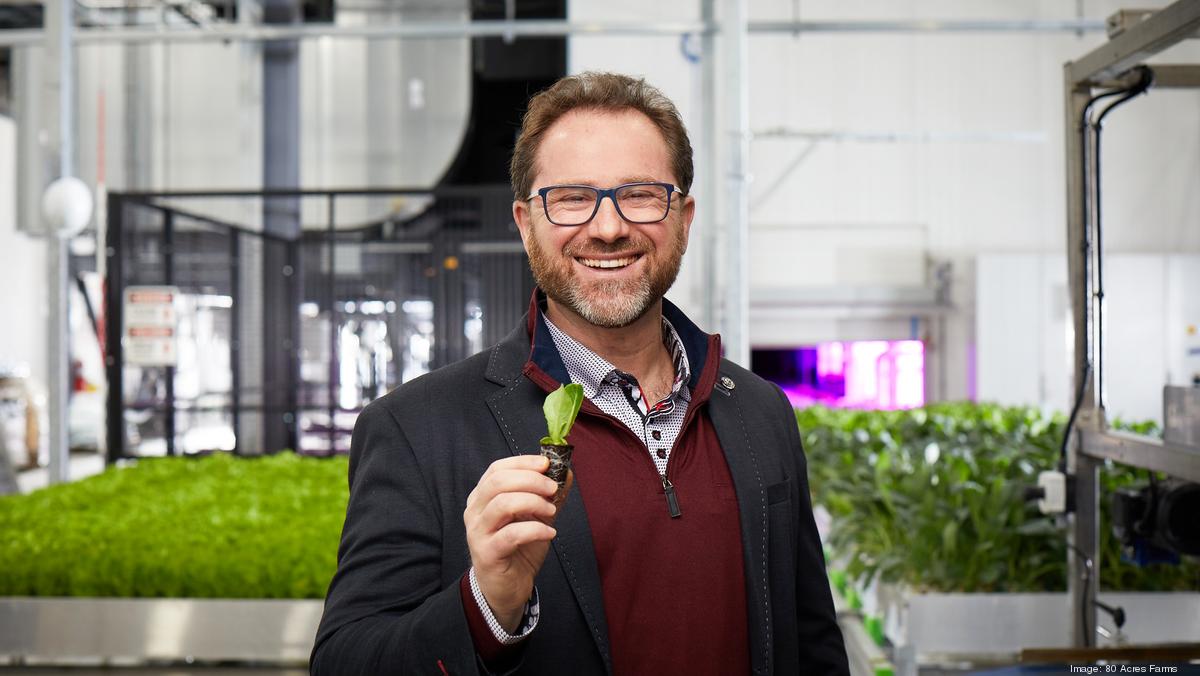
A lettuce plant is a poor factory worker. It takes no instruction, observes no shift schedule and remains serenely indifferent to quarterly targets. Mike Zelkind knew all of this when he began treating agriculture like an operations problem. His wager was that the plant could keep its mysteries, provided everything around it became measurable: temperature, humidity, light, airflow, nutrients, water and time.
That wager became 80 Acres Farms, the Cincinnati-area indoor-farming company Zelkind founded with Tisha Livingston in 2015. It started in a shipping container, grew into a highly automated farm in Hamilton, Ohio, and eventually reached seven farms across six states. By June 2026, the company said it had more than one million square feet under cultivation and supplied more than 18,000 retail locations.
Two months later, the arithmetic stopped working. A prospective acquirer withdrew on August 2. Without the expected transaction proceeds or another source of capital, 80 Acres announced a wind-down and facilities closed across several states. Hundreds of jobs disappeared. A decade spent controlling variables ended with a reminder that money is also part of the climate.
The paperboy learns operations
The orderly mind arrived long before the farm. Zelkind moved with his family from Russia to St. Paul, Minnesota, at 12, speaking no English. His parents attended night classes to learn the language. He delivered four paper routes to help buy groceries and save for a stereo, then recruited his younger brother and sister as helpers. It was a child's version of a distribution network, complete with labor, routes, customers and a manager who still had homework.
He later said the work taught him management, sympathy and empathy. It also supplied a sentence that sounds less like corporate guidance than a private rule: “It helps you never forget where you came from.” At the University of Minnesota, he studied electrical engineering and worked about 30 hours a week at Honeywell to pay his way. He was also, according to his TED biography, a professional chess player in his late teens. One can see the attraction: limited resources, interdependent moves and consequences that arrive several turns after a decision.
After graduating in 1990, Zelkind joined General Mills in engineering and plant-supervision roles. He completed an evening MBA at Emory University's Goizueta Business School in 1996, finishing first in his class and receiving its John Robson Scholar recognition and leadership award. Consulting at A.T. Kearney followed, then a long procession through the machinery of American food: ConAgra, 99 Cents Only Stores, Bumble Bee Foods, AdvancePierre Foods and Sager Creek Vegetable Company.
“Genuine curiosity and introspection, not ego and grandstanding, always get you to the right answers.”Mike Zelkind
These were not pastoral apprenticeships. They were lessons in inventory, plants, procurement, merchandising, turnarounds and the unlovely distances between raw ingredients and a finished product. Zelkind has said his work with private equity created more than $3 billion in shareholder value. The figure says something about scale; the more revealing detail is that he learned to look at a food company and see a system that could be rearranged.
The problem hiding in the weather
At Sager Creek, where Zelkind became president and CEO, he and Livingston worked with vegetable growers across the eastern United States. Ask six farmers about their hardest season and the complaints may sound contradictory: too much rain, too little rain, heat at the wrong moment, cold at the wrong moment. Pull back, Zelkind observed, and the stories converge. The farmer cannot control the environment.
80 Acres was their answer. The name came from an early Cincinnati facility where roughly a quarter-acre of indoor growing space was said to produce the equivalent of 80 outdoor acres. Plants sat in stacked levels under tuned LEDs. Water and nutrients arrived hydroponically. Cameras inspected leaves. Software refined “recipes” for crops. Machines helped seed, transplant, move and harvest. Farms could sit near grocery distribution centers, allowing greens to reach shelves within a day or two rather than enduring a cross-country ride.
Zelkind and Livingston came from food processing, not the fashionable end of software. That difference mattered. They thought in food-safety standards, yields and saleable product. Livingston led technology development through Infinite Acres, a venture formed with the horticultural-controls company Priva and online grocer Ocado. Zelkind served as the merchant-operator, translating between growers, retailers and capital.
Their pitch rested on a consumer truth hiding in plain sight. Much produce is bred and picked to survive transport. A leaf that needs to cross a continent must value durability over delicacy. Move the farm closer to the eater and a grower can select for flavor, texture and nutrition. Shorter travel can also mean more days in the refrigerator before the bag becomes a small compost project.
A factory where the machines are alive
The seduction of indoor farming is control. The discipline is admitting what control cannot do. Zelkind was unusually plain about that tension. “Food doesn't grow itself no matter how many vision systems you put around it,” he said in 2020. Plants still need growers who can notice when a technically correct environment feels biologically wrong.
The company's newest farms became about 80 percent automated. At the Hamilton facility, ten growing levels were stacked through a building slightly larger than a football field. A transplanter moved seedlings in minutes instead of hours and rejected plants unlikely to thrive. Cameras found spots before human eyes could. The building was less a replacement for agriculture than a highly instrumented negotiation with it.
Resources used, compared with a conventional farm baseline
Illustrative rendering of company-reported claims: up to 95% less water and roughly 1% of the land footprint. “Local” varied by market and facility.
The ambition expanded. A $160 million Series B arrived in 2021. A Kentucky farm opened in 2023 after a reported $95 million investment. In 2024, Goldman Sachs named Zelkind among its Most Exceptional Entrepreneurs. In early 2025, the company raised more capital and acquired three former Kalera farms in Georgia, Texas and Colorado, wagering that retrofitting existing buildings could beat starting from concrete. It later combined with Soli Organic, adding a broader indoor-growing network.
Scale promised purchasing power, national retail relationships and better use of central technology. It also multiplied fixed costs. Indoor farms require expensive buildings, lighting, automation and energy before the first leaf is sold. The crop may be close to the customer, while the business remains tethered to distant capital markets.
“There will be winners and losers and there will be losers with very big names.”Zelkind on vertical farming, 2021
The last uncontrolled variable
Zelkind's warning was aimed at an industry awash in nine-figure rounds and extravagant promises. Several indoor-farming companies later failed or restructured as energy, borrowing and construction costs collided with grocery-store margins. 80 Acres argued it had learned the lessons: sell the output, operate with discipline, improve the unit economics, then build.
By June 2026, an Iowa PBS crew found the company near the edge of profitability. Zelkind stood among the grow rooms and described small adjustments that could improve yield, flavor, shelf life and nutrition. “Little changes make a big difference,” he said. In agriculture, the phrase works in both directions.
The wind-down began with a large change. Company notices said a potential acquisition would have supplied the funding needed to continue. The buyer withdrew on August 2. On August 3, closures followed. Zelkind said the team had spent a decade proving vertical farming could operate at scale and feed customers nationwide, but could not secure the capital required to keep doing it.
Zelkind and Tisha Livingston found 80 Acres Farms.
The automated Hamilton farm opens and the company raises a $160 million Series B.
Three former Kalera facilities join a fast-growing national footprint.
The network reports seven farms serving more than 18,000 retail locations.
A proposed acquisition collapses; 80 Acres announces its wind-down.
It is tempting to make an elegant moral from the wreckage. Elegance would be dishonest. The company's closure does not erase crops grown, systems developed or people trained. Nor do technical achievements erase layoffs and capital consumed. 80 Acres leaves both evidence and questions: where indoor growing can compete, how large a facility should be, which crops justify the energy, and whether patient infrastructure finance can coexist with venture expectations.
What the wager leaves behind
Zelkind once said he wanted 80 Acres to become “the Google of food,” making clean, local and nutritious produce available everywhere. The line was grand. His better lines were earthier. Indoor farms should complement greenhouses and fields. Automation is only part of the solution. Plants demand growers. These statements survive the company because they acknowledge a food system too large for any single technique.
His own story also resists a tidy ending. The immigrant paperboy became an electrical engineer, then a factory operator, turnaround executive and indoor farmer. Each chapter involved learning a complicated system quickly enough to change it. The final corporate chapter arrived faster than expected, yet it does not settle the broader argument.
A farm without weather remains an appealing proposition in a world of drought, fire, lost farmland and fragile supply chains. It is also a power-hungry building full of living things, staffed by people and financed by institutions with clocks of their own. Zelkind spent ten years trying to reconcile those truths. The crop was lettuce. The real harvest was knowledge, expensive and perishable, waiting for whoever plants next.