The revealing detail in Hadrian’s story is a refund. Before Chris Power built automated factories, he tried the respectable approach to fixing American manufacturing: raise money to buy existing machine shops. Talk to enough owners, combine enough businesses, introduce better systems. It sounded reasonable. Then he returned his early investors’ capital.
- Hadrian sells precision parts, dedicated manufacturing cells and entire factory capacity.
- Its Opus software connects production and inspection; Atlas handles supplier procurement.
- A seven-year Lockheed Martin agreement brings the model inside a customer’s factory.
According to investor Andreessen Horowitz’s account, conversations with hundreds of shops and machinists changed Power’s diagnosis. Consolidation could rearrange ownership. It could not, by itself, teach a new generation to manufacture aerospace hardware or make production substantially faster. The factory’s operating method needed changing. Hadrian, founded in 2020, became his attempt to do that.
01 / The part that holds everything up
Aerospace invites us to admire the finished object: the rocket, the satellite, the missile. Hadrian works further down the bill of materials, among the precision components those objects require. Here, an engineer’s elegant design meets a more prosaic question: who can make the parts, to specification, on the required schedule?
The alternatives include specialist machine shops, established component suppliers, sourcing networks and the customer’s own production floor. Each can be sensible. Hadrian’s proposition is to take responsibility for more of the system surrounding the part. A customer can order components, reserve manufacturing or inspection cells, or arrange a dedicated factory designed and operated by Hadrian.
That changes the purchase. A defense contractor buying a part is managing a supplier. A contractor buying committed capacity is also deciding who should design the production system, train its operators and expand it when demand rises. For a buyer, the potential value extends beyond the quoted price per component. Coordinating suppliers consumes engineering time, and uncertainty about delivery complicates the rest of a program. Moving that coordination into a manufacturing partner can therefore change the work left inside the customer’s organization. Hadrian wants that second conversation.
02 / Software with metal shavings
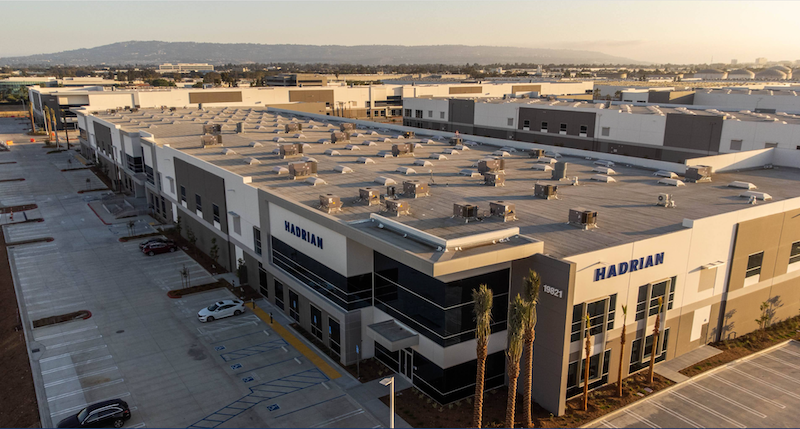
The connective tissue is Opus, Hadrian’s proprietary factory platform. The company describes it as interpreting legacy designs and automating manufacturing and inspection. Its expertise sits across process engineering, software, robotics and quality control. Owning those pieces together gives it a way to change the workflow rather than waiting for several suppliers to coordinate improvements.
There is a human consequence. Hadrian says its system can train new factory technicians in 30 days or less. Read that claim carefully: learning to perform a supported production role differs from mastering every judgment an experienced machinist makes. The interesting idea is that software and engineered processes can make a defined job accessible to more people.
Opus powers the Hadrian production system.
Its recruiting material puts machinists, software developers, automation engineers and operators inside the same national manufacturing mission. The company has also announced broader access to technician equity. That is a consequential cultural choice for a venture-backed manufacturer: the people running the equipment can have a stake in the enterprise they are helping expand.
03 / The prototype is a different animal
A factory optimized for repeatable production has an awkward relationship with a startup changing its design every week. Hadrian’s Atlas program, introduced in an invite-only beta in January 2025, addresses that earlier stage. It combines vetted suppliers with procurement and design-for-manufacturing support, giving young hardware companies help before their orders fit a scaled production line.
That makes Hadrian useful at different moments. A startup can seek sourcing and manufacturability help. An established program can seek repeat production. A contractor facing sustained demand can discuss dedicated capacity. In August 2024, Hadrian also announced a Dirac partnership intended to connect its platform with software that generates assembly instructions from CAD files.
In January 2026, the company announced Hadrian Additive, extending the model toward production with additive manufacturing. Its stated emphasis was qualification, repeatability and sustained throughput. That is a useful distinction for buyers: printing a successful sample and supplying a program repeatedly involve different demands on the production process.
04 / Bring the factory to the customer
Lockheed Martin supplies the clearest example. In December 2025, the companies announced an agreement in principle for an automated machining and inspection cell inside a Missiles and Fire Control site. CNC equipment, robotics and Hadrian’s manufacturing software would work together on parts for missile programs.
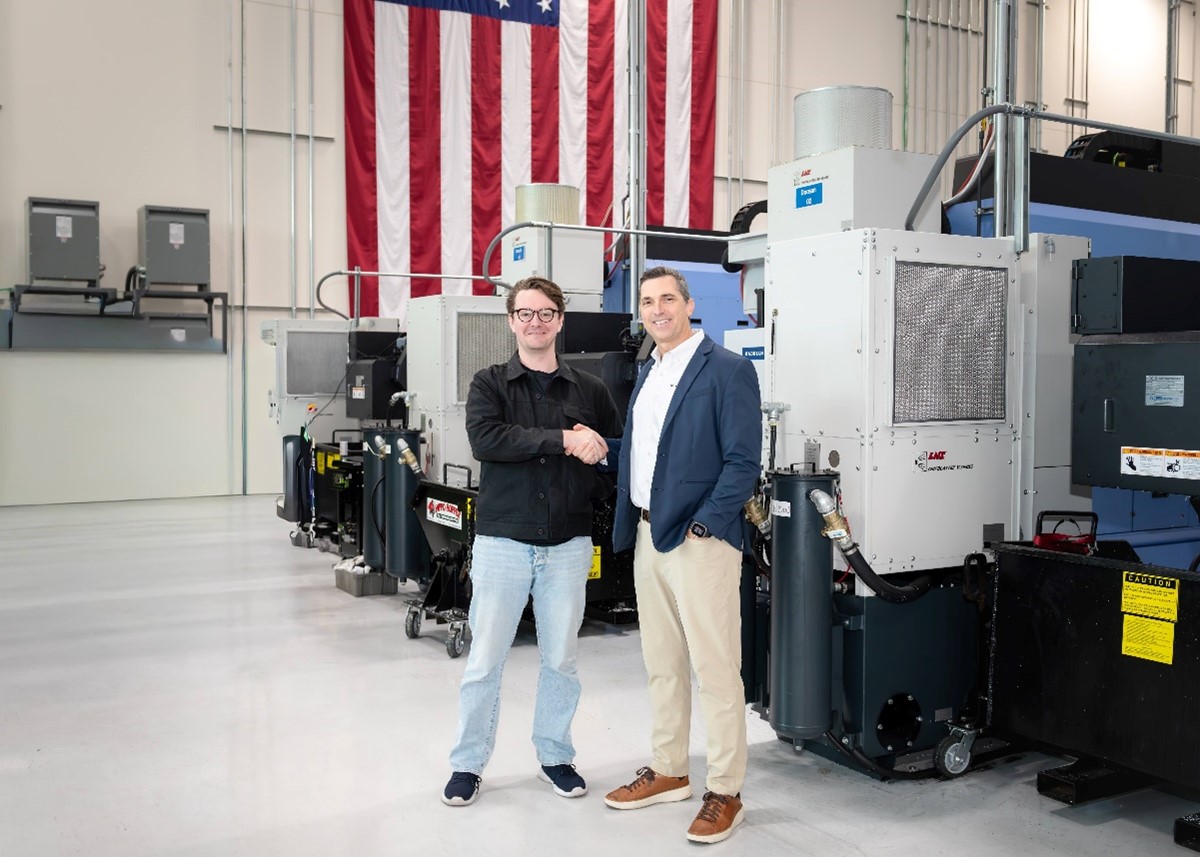
On October 14, 2026, that relationship became a seven-year agreement for Grand Prairie, Texas. Commissioning is scheduled to begin in early 2027, with cells phased in over the contract. The arrangement supports programs including PAC-3 MSE, THAAD, PrSM and GMLRS, while retaining access to Hadrian’s wider manufacturing network. It is a deployment plan, with production still ahead.
05 / The expensive part is quite literal
Physical capacity demands physical investment. Hadrian announced $1.37 billion in Series D equity in August 2026, at a $7.87 billion valuation. Eight days later came a separate $360 million revolving credit facility for manufacturing infrastructure and equipment. Equity, borrowing capacity and company value measure different things; none is a delivery receipt.
August 6, 2026
August 14, 2026
The Navy partnership makes the scale tangible. Factory 4 opened in Cherokee, Alabama, in March 2026 at a 2.2-million-square-foot site intended to make submarine components. The announced maritime program combines more than $1.5 billion in private capital with $900 million in Navy funding. Opening a building begins the harder work of qualifying processes and delivering output.
“Production is now the frontline of deterrence.”
Chris Power / August 2026
06 / What travels beyond defense
There is a practical lesson here for anyone building hardware: bring manufacturing judgment into design early. Ask about inspection, repeatability and supplier capacity while changes remain cheap. Hadrian’s broader bet is that making those decisions part of one operating system can reduce the coordination burden on the customer.
The economics still require demand to keep equipment busy, qualification standards that processes can meet, and enough capital to install capacity before it earns its keep. A constantly changing prototype may suit a flexible supplier better than a dedicated line. Hadrian’s promise becomes credible one qualified process at a time. The useful question is whether the next required part arrives when the customer needs it.