The revealing object in Machina Labs’ story is a left nose panel. It belongs to a C-17, an aircraft whose continued usefulness depends on an unglamorous question: when something breaks, can someone still make the replacement? On July 30, 2026, a repaired C-17 returned to flight carrying a panel made with Machina’s robotic forming system. A new manufacturing process had met an old aircraft’s very particular needs.
- Two robots shape sheet metal without a dedicated die for every design.
- The buyers have expensive reasons to want variety: aircraft repairs, defense structures, custom vehicle panels.
- The real test is repeatable, qualified production. A persuasive shape is only the beginning.
The repair involved the Air Force Rapid Sustainment Office, the University of Dayton Research Institute and Boeing. Panel production began in March and finished in May; the aircraft flew in July. Those dates deserve their own little spotlight. They describe a repair program, with the work between fabrication and flight included, rather than a stopwatch attached to a robot.
- MARProduction begins
- MAYPanel completed
- 30 JULC-17 flies again
Reported sequence for this repair. Calendar milestones, not robot cycle times.
An old aircraft, a new nose
Aircraft can outlive the production arrangements that made them. Machina describes the resulting choice as expensive tooling for a single repair or scavenging a retired aircraft. The panel becomes a small hostage to a much larger industrial system. That is where this Los Angeles company, founded in 2019 by Edward Mehr and materials specialist Babak Raeisinia, finds its opening.
Its RoboCraftsman uses paired industrial robots to deform sheet metal incrementally along programmed paths. RoboForming is the shaping process; the cell also scans, trims and drills. Machina’s published specifications include parts up to 12 feet long and sheet stock up to a quarter-inch thick. The product is meant for engineers who need large, complicated metal shapes without first commissioning a tool that knows only one shape.
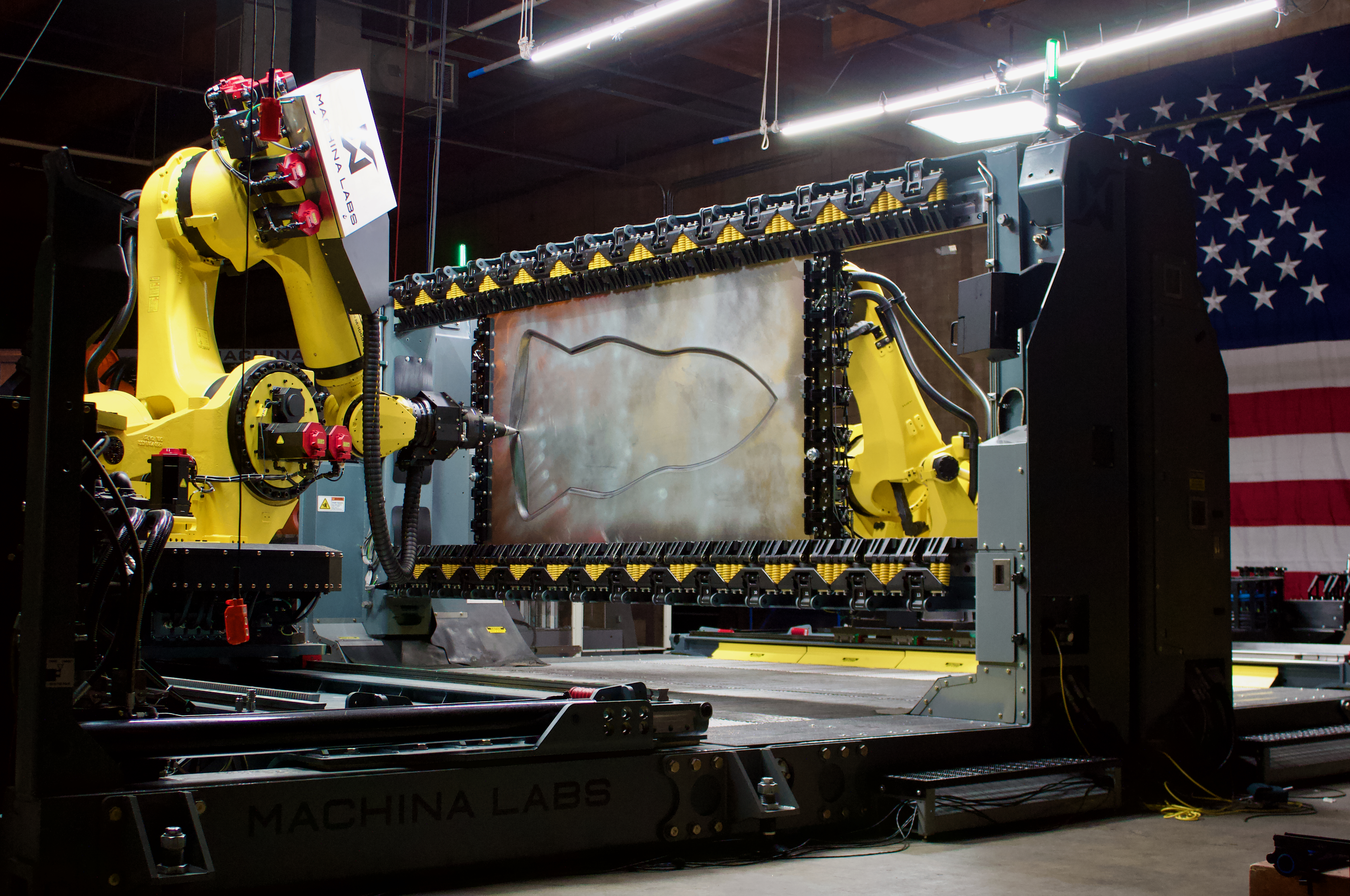
The die has expensive opinions
A die is a bargain when you can spread its cost across enough identical parts. It is a less agreeable companion when you want another curve, another variant, or twenty replacements for an aircraft nobody builds anymore. Stamping and hydroforming remain sensible alternatives for repeat production. Machina competes where tooling lead time and the price of variation make those familiar methods uncomfortable.
Toyota offers a tidy example. In September 2025, Machina announced a pilot with Toyota Motor North America to customize production body panels. The demonstration included a Tacoma tailgate. Toyota’s investment arm, Woven Capital, backed the company. The pilot’s goal was automotive quality and throughput in low-volume work; a handsome demonstration panel should not be mistaken for a fleet of customer vehicles.
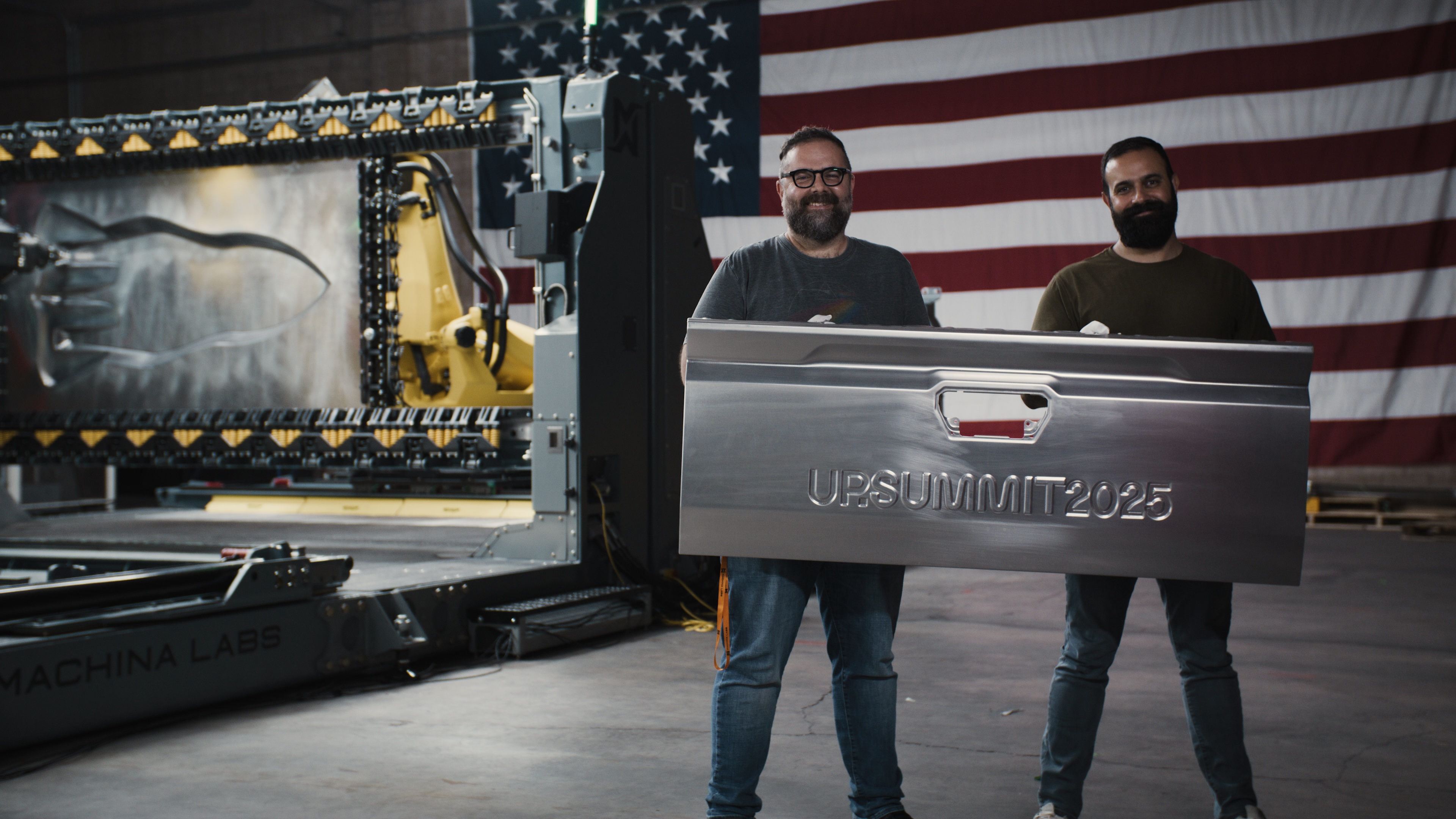
Raeisinia has argued for on-demand tooling rather than costly inventories. A company can spend money making the tool, storing it and preserving the ability to use it long after the original production run. Machina’s pitch is that the next variation can live in a digital recipe. Whether that saves money depends on the work, the volume and the quality demanded.
“Keeping inventory of tooling is expensive.”
Babak Raeisinia / co-founder / 2023
There is another illustration with fewer cupholders. In June 2026, Machina and computational design company nTop described a UAV airframe project that evaluated eleven structural variants and fifteen aerodynamic simulation cases. Machina reported completing the assembled structure two weeks after final design lock. The useful idea is keeping design exploration affordable enough that engineers can explore.
Metal remembers. Sensors can be fooled.
Shape is only one requirement. Forming leaves residual stresses, and parts can distort when released or handled. Machina’s May 2026 engineering account describes an attempt to bring thermal stress relief onto the robotic cell, keeping the part clamped while a heated tool traverses its surface. Industrial hot air won the team’s comparison of possible heat sources on practical grounds including safety and simplicity.
Then came the measuring problem. Reflective aluminum can make an infrared camera see its surroundings rather than the metal’s temperature. The team used graphite coating and calibration to improve readings. It also disclosed unresolved movement tracking and incomplete camera coverage on complex shapes. These are useful details for anyone buying industrial AI: the sensor reading needs interrogation before the algorithm deserves confidence.
Compare the physical part with the intended geometry. Adjust the process. Preserve what worked.
Mehr’s own account of the company’s beginnings contains a similarly practical adjustment. He initially expected an opportunity in 3D printing; customer conversations pointed him toward other needs. He sought paid development commitments and kept humans closely involved while the systems gathered process data. The lesson is available without purchasing a robot: find a problem worth paying to solve before demanding complete automation.
The published company values emphasize craftsmanship, measured decisions and accountability. Its annual Hack Week supplied the thermal-imaging proof of concept. The attractive detail is the willingness to publish what still needs work.
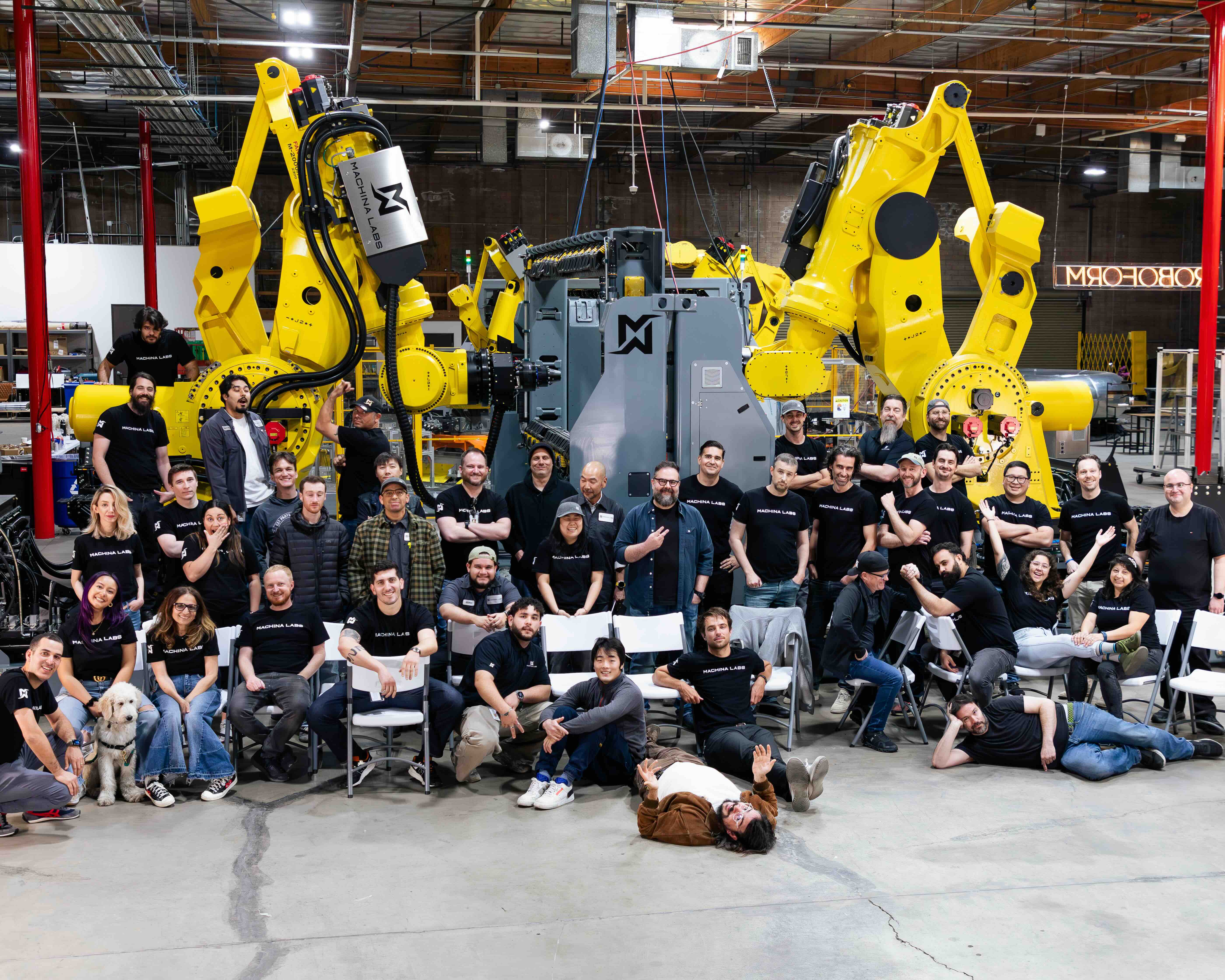
The price of a factory that changes its mind
The business sells manufacturing capability in two forms: production in Machina’s facilities and robotic systems deployed to customers. The Air Force’s second RoboCraftsman purchase, announced in April 2025, is evidence of the latter. NASA’s donut-shaped tank demonstrator illustrates development work. Neither relationship makes this a consumer tool; buyers need engineering expertise, suitable materials and a qualification path.
Capital raised. The factory’s eventual cost and individual system prices are separate questions.
The financing is concrete. A $32 million Series B in 2023 brought backing from NVentures and Innovation Endeavors. The February 2026 Series C raised $124 million from investors including Woven Capital, Lockheed Martin Ventures, Balerion Space Ventures and Strategic Development Fund. Machina announced a 200,000-square-foot factory designed for up to fifty cells. Those are plans for capacity, rather than a count of machines already producing.
In July, the company created Machina Bellator for defense work and announced a Lockheed Martin qualification contract for a JASSM assembly. Entering qualification matters; completing it is a further milestone. The C-17 panel offers a more immediate ending: one aircraft flew again. For all the talk of factories changing through software, usefulness still arrives in a physical object, inspected and put to work.
Watch the metal move
Start with the shop floor, then follow the projects.