Company Dossier · Additive Manufacturing
Impossible Objects
It stopped melting plastic. It started stacking carbon fiber. The Northbrook company that printed itself a different rulebook.
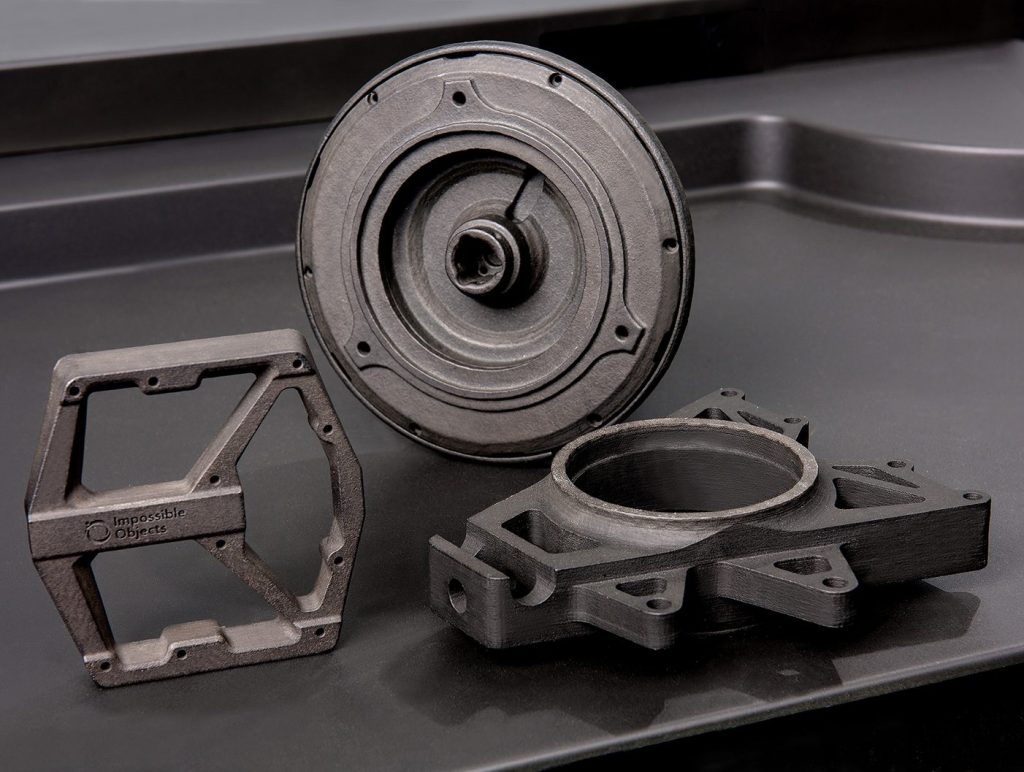
It stopped melting plastic. It started stacking carbon fiber. The Northbrook company that printed itself a different rulebook.
In a low industrial building off Commercial Avenue in Northbrook, Illinois, a machine is feeding itself sheets of carbon fiber like a printer feeds paper. It inkjets a fluid onto each sheet, dusts it with polymer powder, and moves on - a sheet every few seconds. Stack them, press them, bake them, and out comes a part strong enough for an aircraft. Impossible Objects calls the process CBAM. Most people just call it fast.
The company is small. Around thirty people. The revenue is modest. And yet its customer list reads like an industrial who's-who: Ford, Jabil, the United States Air Force. That gap - tiny company, enormous customers - is the whole story. It exists because of one stubborn belief: that 3D printing had been doing it wrong.
"The only additive process that combines long-fiber fabrics of carbon fiber or glass with high-performance thermoplastic matrix materials."
- How Impossible Objects describes CBAMFor two decades, additive manufacturing sold a beautiful promise and quietly under-delivered. The classic method squeezes melted plastic through a nozzle, one thin bead at a time. It is wonderful for a prototype on a Friday afternoon. It is hopeless for a factory that needs ten thousand parts that won't snap under load.
Two problems, really. Speed - extrusion printing crawls. And strength - a part built from stacked plastic beads tends to fail along the seams between them, like pulling apart a stack of wet napkins. Engineers wanted the one material that solves the strength problem outright: composites, the carbon fiber and fiberglass that make jets light and tools tough. The trouble was that nobody had figured out how to 3D print real long-fiber composites at any useful speed.
So the industry did what industries do when a problem is hard. It changed the subject and talked about something else, beautifully.
Everyone agreed composites were the answer. Everyone also agreed they were impossible to print at speed. One of those two ideas had to give.
- The bet at the center of the companyRobert Swartz is not a man with one career. Before Impossible Objects, he built a software company that wrote Unix and C compilers, ran an advertising-display manufacturer, started a telephony company, and consulted for the MIT Media Lab on intellectual property. In 2009 he turned to a different question: why does 3D printing insist on building parts the slow way?
His answer flipped the problem inside out. Instead of slowly extruding material into a shape, CBAM - Composite-Based Additive Manufacturing - starts with full sheets of carbon fiber or fiberglass already woven and strong. The printer inkjets a fluid in the exact 2D shape of each layer onto a sheet. Polymer powder is flooded across it and sticks only where the fluid landed. The excess is swept away. Repeat for every layer, stack the sheets in order, then compress and heat the whole block until the polymer melts and fuses everything into one solid composite part. A final automated sandblaster strips off the bare, uncoated fiber.
It is, in a sense, printing in two dimensions to build in three. The slow part of conventional printing - laying down material point by point - simply disappears.
"CBAM prints parts up to 15x faster with better dimensional accuracy than any technology on the market."
- Impossible Objects on the CBAM 25Swartz stayed on as Chairman and Founder. The leadership he assembled around the idea is not a group of first-timers: CEO Steve Hoover ran Xerox PARC and was Xerox's CTO; Chief Commercial Officer Jeff DeGrange came from Stratasys and Boeing; Chief Composite Scientist Dr. John Bayldon arrived from UK defense research. People who had seen, up close, exactly why the old way didn't scale.
Robert Swartz begins developing the CBAM process - 3D printing built on stacked fiber sheets rather than extruded plastic.
OCA Ventures leads, joined by IDEA Fund Partners and others, as interest in the Model One printer grows.
Next-generation printer unveiled, a carbon fiber-PA6 partnership with BASF announced, and a fresh funding round closed.
Joint development agreement with the fiberglass giant to produce new high-performance materials for CBAM.
The machine the company calls the world's fastest carbon fiber 3D printer debuts ahead of RAPID + TCT.
Steve Hoover, former CTO of Xerox and CEO of Xerox PARC, is named Chief Executive Officer.
A printer is only as good as what it can make. The CBAM 25 - the flagship - runs at 25 feet of fiber sheet per minute and finishes each layer in under four seconds. But speed alone is a parlor trick. The point is what comes out: parts built from long-fiber carbon or glass bonded with high-performance polymers like PEEK and nylon, with chemical and temperature resistance that leaves ordinary engineering plastics behind, at tolerances the company puts around 100 to 125 microns.
What can you actually do with it? The mundane and the dramatic, side by side. On the mundane end: wave-solder pallets and tooling fixtures for electronics assembly - flat, precise, heat-resistant parts that factories burn through. On the dramatic end: lightweight aerospace and drone components, automotive parts, and carbon fiber replacement parts for military aircraft. No resins. No special storage. No hazardous waste. The leftover carbon fiber gets blasted off and that's the worst of the mess.
Wave-solder pallets and assembly fixtures - flat, accurate, and able to take the heat of a solder line.
Lightweight drone parts and carbon fiber/thermoplastic replacements for military aircraft, via partners like UAMMI.
Lightweight composite parts where strength-to-weight ratio is the entire point.
Parts made to order without tooling, in materials that resist heat and chemicals.
The company's central claim is throughput: that CBAM moves at a pace conventional composite and extrusion methods can't touch. Relative speed, as the company presents it:
Numbers are easy to print. Customers are harder. Ford, Jabil, and the U.S. Air Force put CBAM parts to work, and Ricoh 3D carries the machine into Europe. Two industrial heavyweights - BASF and Owens Corning - signed development deals to make materials for the process. When a chemical giant and a fiberglass giant both want in, the technology is doing more than printing brochures.
When BASF and Owens Corning both agree to make materials for your process, you are no longer the underdog with a clever idea. You are a supply chain.
- On the weight of those partnershipsThe dividing line in 3D printing has always been the factory door. Inside the R&D lab, additive manufacturing is a beloved tool for prototypes and one-offs. Past the factory door, where parts are counted in the thousands and measured against injection molding, it has mostly been a guest, not a resident.
Impossible Objects' mission is to move across that line: to make composite 3D printing fast, strong, and precise enough to compete with traditional manufacturing on its own turf - production volume, real materials, real tolerances. That is a narrower and more honest goal than "change everything." It is also harder, because the competition is a century of refined molding and machining that already works.
The goal was never to replace the factory. It was to be invited inside it - and stay.
- The mission, in one lineThe case for printing real composite parts on demand stopped being academic the moment global supply chains started to wobble. A defense program waiting eighteen months for a tooled replacement part has a very different view of a machine that can print one this afternoon. Lightweighting in aerospace and automotive isn't a trend; it's physics meeting fuel cost. And electronics manufacturers will always need more tooling, faster.
None of this is guaranteed. The 15x claim is the company's own, not an independent benchmark. The competition - Markforged, Continuous Composites, and others chasing fiber-reinforced printing - is real and well-funded. Thirty people and $16 million is a slingshot, not an arsenal. But the bet is clear, and the early customers are not the kind who buy science projects.
Return to that machine in Northbrook. It is still feeding itself carbon fiber, still inkjetting fluid, still dusting on powder, sheet after sheet. Nothing about it looks revolutionary. That is rather the point. The revolution Impossible Objects is after is not a louder machine - it is a faster, quieter one that a factory manager would actually buy.
The company is small, the revenue is modest, and the biggest claims still wear the word "claimed." But the parts are real, the customers are named, and the chemistry giants have signed on. Sixteen years ago, printing strong composites at speed was filed under impossible. The machine on Commercial Avenue is busy refiling it.
The name was a dare. The machine is the answer.
- Impossible Objects, Inc.