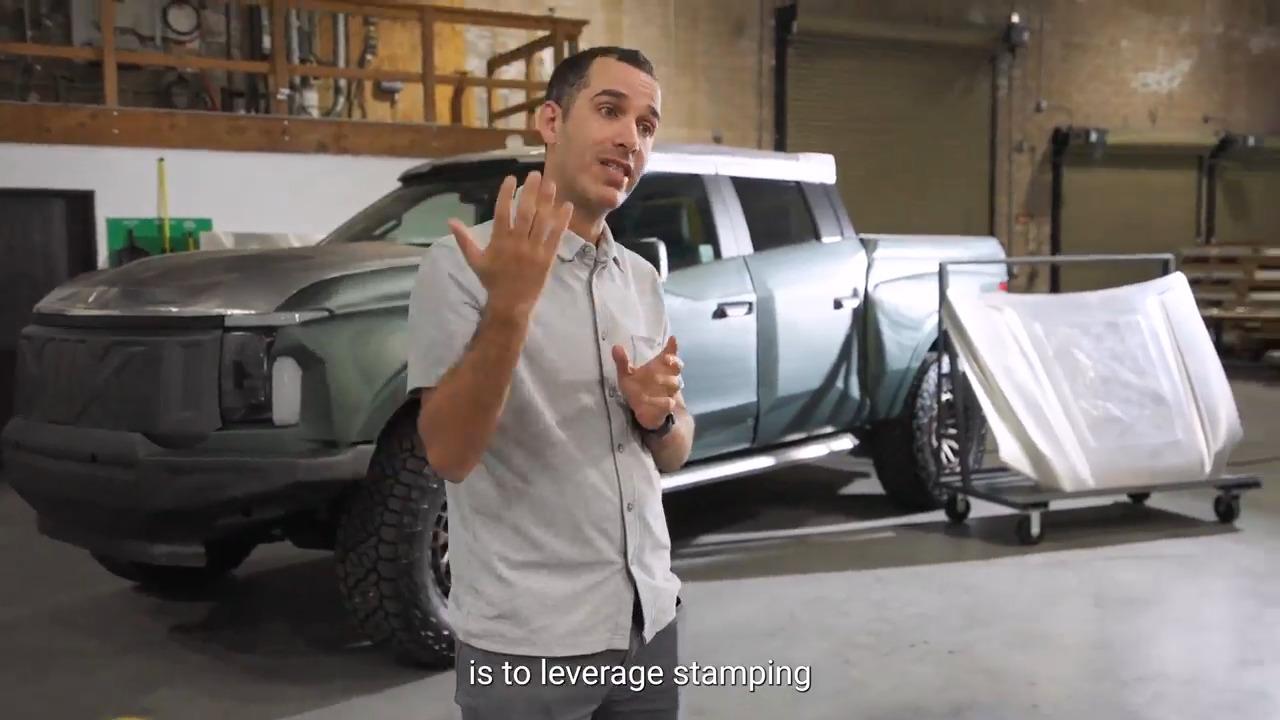
The robots work a sheet of metal from opposite sides. One presses, the other counters; scanners watch the surface change. There is no giant die backstage, no steel mold built for this single curve. The shape arrives through many small decisions, each one informed by the last. Standing beside a radically re-bodied Ford F-150 in a Machina Labs factory, Ronen Lebi explains the commercial consequence in the practical vocabulary of an operator: stamping is rigid, tooling costs a fortune, and changing a design can mean buying the expensive thing all over again.
Lebi is not the inventor at center stage. As chief business officer, he has a role less cinematic and perhaps more revealing. He must connect the factory's intelligence to the outside world's caution. Strategy, sales, marketing, operations and partnerships report into his brief. Each discipline asks a version of the same question: can a remarkable machine become a dependable way of making things?
It is a question that has followed him from digital maps to dental printers to robotic metal forming. The materials keep changing. The job does not. Lebi has spent much of his career making new technology legible to customers, then building an organization that can deliver what the demonstration promised.
A map is a promise about the world
Before the factory, there was Waze. Lebi was an early employee at the navigation company, leading the quality-assurance team responsible for its global mapping infrastructure. This was a useful education in the social life of data. A map may be stored as software, but every wrong turn is physical. Streets move, drivers improvise, and an elegant system is judged by whether it gets somebody home.
His route there was not the familiar engineering-school express lane. Lebi studied agricultural economics at the Hebrew University of Jerusalem, then completed a joint MBA program through the Interdisciplinary Center in Israel and the Wharton School. He began in management consulting and investment banking. He was raised and educated across Israel, Britain, the Netherlands and the United States, a biography that made crossing professional and national boundaries ordinary rather than ornamental.
The Waze chapter also established a pattern. Quality assurance lives in the gap between what a system believes and what reality permits. Machina's robots face a related gap. Software describes an ideal geometry; metal bends, springs back and carries the memory of heat and force. Sensors read the disagreement. The process adjusts. Different industry, same respect for feedback.
The useful loop
The years of making applications matter
Lebi joined Stratasys in 2015 as vice president of corporate development. During that phase he led more than $300 million in acquisitions, investments and joint ventures spanning metals, composites and polymers. The numbers suggest finance; the portfolio suggests curiosity with a deadline. New manufacturing processes are only useful when someone can name the part, the customer and the economics.
He moved closer to that test by leading the company's P3 production business. The unit deployed next-generation systems to major aerospace and automotive customers and generated more than $20 million in its first year. In public remarks about the Origin One platform, Lebi emphasized materials, workflows and customer access. He spoke less about the romance of printing than about the ecosystem required to make printing productive.
Then came teeth. As vice president and head of Stratasys Dental, he launched a global business unit and its go-to-market plan. The result was 35 percent year-over-year growth and a tripling of revenue from new accounts. Dental laboratories offered a wonderfully unforgiving market. The objects were small, the geometries difficult, the need for fit obvious, and the technicians understandably uninterested in technology for technology's sake.
Lebi framed the products around the work they removed. A multi-material printer could produce several dental applications in one tray. A monolithic denture could emerge as one personalized piece instead of requiring extensive manual assembly. Digital records could make replacements faster. In 2024, discussing donated printed dentures, he focused on the impact on patients and the ability of laboratories to serve more people in less time. It was technology described from the receiving end.
A former colleague, Fabio Esposito, offered a compact portrait of Lebi's operating manner: he grasped the nuances of a new business quickly and built unusual trust with colleagues and customers. The comment matters because commercializing an industrial platform is a prolonged exercise in borrowed confidence. The customer must believe the machine, but first somebody must believe the people standing behind it.
Back to metal, without the monument
In August 2024, Lebi joined Machina Labs. The company was five years old and had built a platform called RoboCraftsman, a name that sounds like a pulp hero but describes a sober proposition. Robot arms form, scan, trim, drill, weld and assemble metal. Machine-learning models and closed-loop controls guide the work. A new part does not require a dedicated die, which can weigh many tons and take months to procure.
The absence of a die changes the argument. Traditional tooling makes sense when a factory will stamp the same panel an enormous number of times. It becomes awkward for replacement aircraft parts, prototypes, restricted production runs and personalized vehicle panels. Machina's pitch is that a software-defined cell can change with the file, then use measurement and process knowledge to arrive at the required shape.
In automotive work, the contrast is almost playful. Machina rebuilt the exterior panels of a Ford truck from digital designs and formed a topographic pattern into a production Toyota Tacoma hood. Customization, once confined to paint, trim or an artisan's hammer, can move into production-quality sheet metal. Lebi talks about this market as expression at scale. The phrase joins desire to a manufacturing constraint, which is where business cases usually hide.
Defense and aerospace bring a graver test. A flexible process is valuable only if a part qualifies and performs. The public milestones since Lebi arrived therefore read less like spectacle than a sequence of permissions.
A Toyota pilot applies RoboForming to customized production body panels.
Machina raises $124 million and announces a 200,000-square-foot factory planned for up to 50 RoboCraftsman cells.
A Machina-made assembly enters qualification work for Lockheed Martin's JASSM program.
A damaged C-17 returns to flight carrying a RoboFormed structural repair.
When a part leaves the press and enters the world
The C-17 repair gives the thesis a plot. When an aircraft is no longer in production, replacing a damaged structural panel can mean rebuilding tooling for a single part or taking one from a retired plane. Machina deployed a RoboCraftsman at the Air Force Rapid Sustainment Office. Work on a left nose panel began in March 2026 and finished in May. The repaired aircraft flew on July 30.
The accomplishment belonged to a group that included the Air Force, the University of Dayton Research Institute, Boeing and Machina. Lebi's public reaction was characteristically collective: pride in the team and partners, delight that an improbable qualification had been cleared, then forward motion. The machine formed the metal; the partnership formed the permission.
That summer, Machina also established a dedicated defense subsidiary and received a Lockheed Martin qualification contract supporting the JASSM missile program. Meanwhile, the company was preparing its third factory, a 200,000-square-foot facility designed to house as many as 50 robotic cells. The $124 million Series C backing that expansion included investors connected to Toyota, Lockheed Martin, Balerion Space Ventures and the Strategic Development Fund.
Scale introduces a useful irony. Machina's technology is meant to escape rigid, single-purpose factories, yet its success will depend on discipline: certification, process control, scheduling, customer support and a thousand repetitive acts done correctly. Flexibility is not the absence of structure. It is structure that can survive a change of plan.
The translator on the factory floor
Lebi's career can look eclectic when read as a list: agricultural economics, banking, maps, polymers, dentures, robots and aircraft. Read as a sequence of translations, it becomes coherent. He translates technology into an application, an application into a market, and a market into an operating system. The work calls for fluency in engineering without pretending to be the engineer, and fluency in finance without mistaking a spreadsheet for a factory.
He also arrives at a moment when manufacturing has become a strategic subject again. Supply chains, aircraft readiness and the ability to produce specialized structures are no longer background concerns. Software has made design faster. Production remains stubbornly physical. Metal still has opinions.
Machina's answer is a factory that learns enough to forget its old tools. Lebi's contribution is to make that answer credible beyond the factory door. The next proof will not be a single beautiful panel. It will be a system that earns repeat orders, changes jobs without losing control, and turns a digital intention into trusted hardware on an ordinary Tuesday.
That outcome is less glamorous than a robot pressing steel under bright lights. It is also the point. The history of industry is full of ingenious machines. The useful ones acquire customers, routines and a place in the world. Ronen Lebi has made a career in that final, difficult conversion.