He doesn't sell you a 3D-printed part. He sells you the factory that prints it - then proves it with a hypercar that humbles Koenigsegg.
Walk into Divergent's plant in Torrance and you won't find a single welding jig built for a single car. That absence is the whole idea. Lukas Czinger runs a company whose machine doesn't make a car - it makes whatever you hand it. Feed in a digital design, and AI optimizes the geometry, metal printers grow the structural nodes, and robots glue the skeleton together with adhesive that cures in two or three seconds instead of sixty. Change the design tomorrow and the same line builds something else. No retooling. No fixtures. That is the Divergent Adaptive Production System, and it is the answer to a question most of manufacturing forgot to ask.
The day job sounds invented. A typical week, by his own account, runs through robotics, 3D printing, metallurgy, artificial intelligence, lasers, military drones and high-performance engines - seven days of it. He talks about all of it in plain English, which is rarer in this industry than the technology itself.
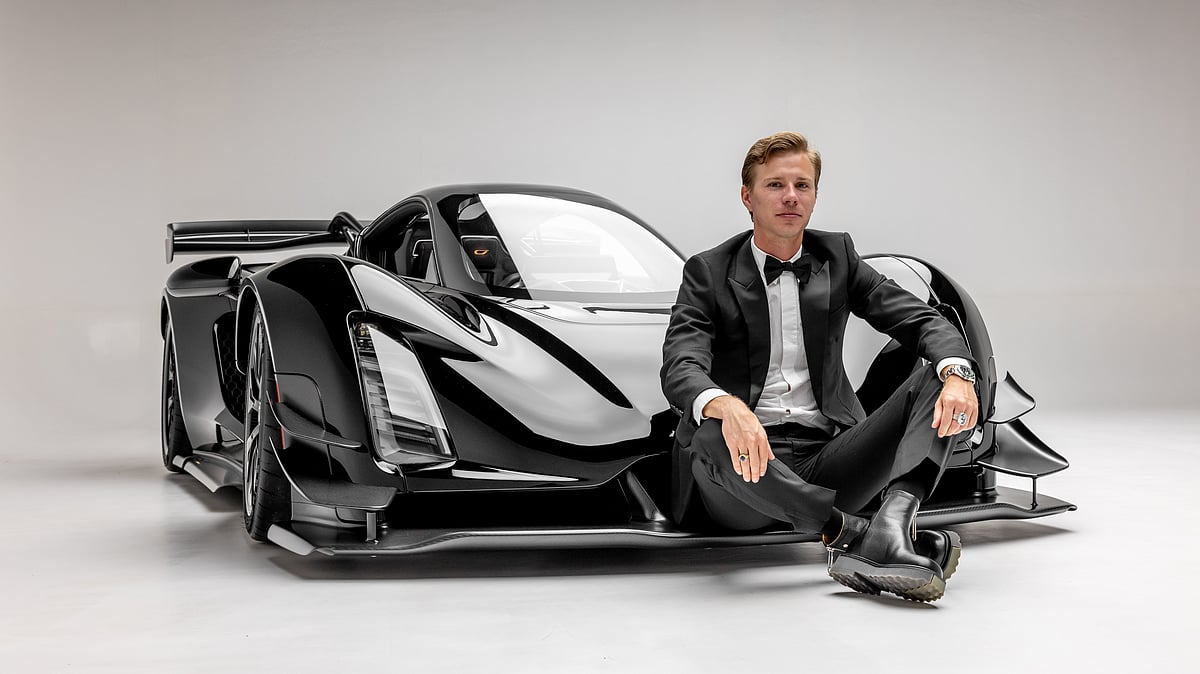
To prove the platform could do something the giants couldn't, the Czingers built a car. The 21C is a 3D-printed hybrid hypercar, roughly $2.3 million, capped near 80 units, with a 2.8-liter V8 spinning out 900 bhp - described as the most power-dense production engine in the world. In December 2024 it lapped Laguna Seca in 1:22.30, beating Koenigsegg's Jesko by close to two seconds. The car is gorgeous. It is also a sales brochure with a steering wheel.
His father Kevin founded Divergent in 2014, the year before Lukas finished Yale, where he studied electrical engineering and played varsity soccer. Lukas had a banking seat at Centerview Partners and a clear shot at a comfortable career. He wanted the startup instead - but he knew exactly how it would look to walk in as the founder's son.
So he didn't. He joined in 2016 at the most junior level and the lowest salary in the entire company, then climbed on results that didn't carry his last name's discount. By his late twenties he was running operations and co-founding Czinger Vehicles. Kevin has since moved to executive chairman; Lukas runs the day-to-day as CEO. A father-son company, structured so the son had to earn it.
The thinking shows up in how he talks about decisions. He breaks them into three parts - get accurate information, analyze it well, execute efficiently - and he builds a bench where, in his words, each executive could run a company alone. The operating creed is borrowed from sport and Zen in equal measure.
Commit to the result, and your best effort will follow. If you only commit to your best effort, you may never find your full potential.
Design it anywhere. Print it locally. Hold the finished part in days.
DAPS - the Divergent Adaptive Production System - turns a digital design into a finished metal structure with no part-specific tooling. The line doesn't care what you ask it to build.
Close to 60 personal patents in robotics, printing and assembly. Across Divergent and Czinger, the count tops 600.
The 21C holds multiple production-car track records, headlined by a 1:22.30 at Laguna Seca that toppled Koenigsegg.
A 2.8-liter V8 making 900 bhp - billed as the most power-dense production engine on the planet.
McLaren, Bugatti and Aston Martin all tapped the Divergent platform. The supercar elite outsourced their structures.
Robotic assembly said to run ~20x more precise than standard robotics, with UV-cured adhesive bonding replacing welds - lighter, stronger, faster.
The hypercar was always a means. The end is bigger and quieter: a world where a small team - or a single engineer - designs a structure, sends it to a nearby factory, and receives a finished, optimized part within days. No tooling lead times. No offshore supply chains. Just design, print, assemble, repeat.
That ambition now points at aerospace and defense, with U.S. manufacturing capacity as the prize and roughly 30 facilities as the shape of it. Czinger, meanwhile, he wants remembered in ten years as America's performance car brand. Two companies, one bet: that how we make things is overdue for a rewrite, and software gets to hold the pen.