At a Y Combinator alumni event, Shan Mohta pitched the first version of Vendra to a founder he respected. The response was brief enough to remember for years: “Shan, this is a tarpit idea.” It is a difficult sentence to put in a company scrapbook. Mohta eventually put it in his account of how the company found its way.
The founder was Sanjay Dastoor. In Mohta’s telling, the criticism became the beginning of a useful relationship. Dastoor became a mentor, helped the founders think about what customers needed, and offered something more valuable than the polite encouragement they were already receiving. Vendra’s first version closed. The company changed direction repeatedly.
There is a particular inconvenience to being an experienced engineer with a startup idea. Experience gives the idea credibility. It can also make it harder to put down. Mohta had built hardware at Microsoft, Apple, and Skydio. He knew the work. The question that followed him into Vendra was which part of that work someone would pay a new company to take over.
“Shan, this is a tarpit idea.”
Sanjay Dastoor, as recalled by Shan Mohta
The engineer at the other end of the email
Before Vendra, Mohta had been the customer he now wants to serve. He remembers contacting multiple shops to find one that could meet his requirements, then spending months on site with suppliers trying to get parts made on time. A supplier search could continue long after an engineer had done the ostensibly difficult work of designing the thing.
His list of familiar failures is specific: parts arriving outside specification, delivery dates moving, a supplier accepting a job and discovering halfway through that it could not do the work. Each failure demands another decision. Can the design change? Can another shop take over? Which promise is dependable enough to build a schedule around?
Those experiences help explain why Mohta’s account of manufacturing keeps returning to judgment. A list of suppliers is useful. Knowing which supplier can handle a particular requirement, with capacity available at the moment it is needed, is a more demanding service. The difference becomes visible when a drawing has to turn into something an engineer can hold.
Mohta describes Vendra as the company he wished had existed during those earlier jobs. That is an understandable starting point for a founder. It also leaves a surprisingly large design space. A person frustrated with suppliers might build communication software, project management software, a directory, or a business that takes responsibility for getting the order made. Vendra had to discover where it belonged.
A childhood friend, a different product
He began the company with Anish Bhardwaj, a childhood friend who became its CTO. The two entered Y Combinator’s Summer 2024 batch. In his retrospective, Mohta remembers moving into their San Francisco office, building the first version, and promptly changing course. An accelerator supplies a calendar; customers are under no obligation to fit their enthusiasm into it.
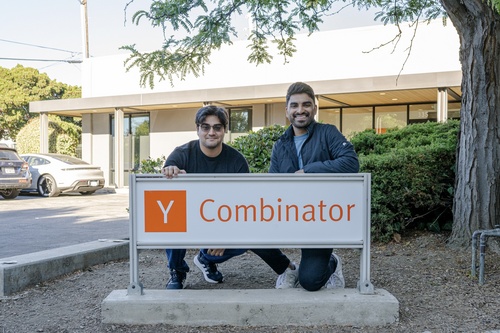
By the end of 2024, Mohta could list unfamiliar skills he was acquiring: product architecture, sales calls, raising capital. He also had the odd pleasure of seeing Vendra on a Times Square billboard arranged by Brex. The company had become visible in a very literal way. Finding the right business remained its own task.
Bhardwaj remembers a stretch of 200 investor meetings in which everybody said no. His account includes a useful concession: they did not yet have a product and customers. He and Mohta asked whether they wanted to continue and where they should go next. They chose another product and another attempt.
That detail keeps the story from becoming a fable about persistence alone. Repeating an unsuccessful pitch is one kind of persistence. Altering the proposition asks more of the people who made it. Mohta and Bhardwaj had to preserve their willingness to work together while giving up versions of the work.
Mohta dates the first real customer in his two-year retrospective to January 2025. His aside about easy 2024 taxes is a small joke with an entire startup year tucked inside it. The office, the batch, the billboard, and the customer were different milestones. Only one of them put a manufacturing relationship into motion.
Getting closer to the part
The company that emerged handles custom-part manufacturing through American suppliers. A customer submits a request for quotation, or RFQ. Vendra routes the technical requirements to suitable shops, gathers quotes, and manages production through delivery. The company lists aerospace and defense customers including Anduril, Mach Industries, Relativity Space, and Planet Labs.
The route Vendra is built to coordinate
For Mohta, the software has become a means of coordinating physical work. In his October 2026 conversation on Manufacturing the Future, he described the importance of information about equipment, capacity, and certifications. His argument is that American manufacturing has useful capacity that is difficult to discover and deploy. Better information can help connect a job with the shop able to do it.
It is a practical ambition with an unromantic middle. Before a customer can celebrate a delivered part, somebody has to understand what is required and arrange the people who can meet it. The same shop can be a good answer one week and unavailable the next. Matching is a decision that expires.
By June 2026, a podcast appearance described Vendra as having three operations engineers managing more than 250 US suppliers. The interesting part of that reported figure is the coordination burden. Each additional supplier offers more possibilities and more information to keep current. Software earns its place if it helps a small team handle that expanding set of decisions.
Can a small team keep a large supplier network useful?
The phone still rings
Mohta’s description of customer service is considerably less abstract. Customers text when something is urgent. They ask questions, share wins, and ask his advice. He says he is proud of that access and wants it to remain part of the company as it grows. A platform can have an interface and still need somebody willing to answer.
That commitment fits the engineer who remembers being dependent on other people’s production promises. Urgency looks different from the side of the desk where a part is missing. A customer may appreciate a clear status page; a difficult order can also demand someone prepared to investigate and make a decision.
Growth introduces its own test. In an update about August 2026, Mohta reported that Vendra had crossed seven figures in monthly revenue and reached its target with four days remaining. He described a whiteboard updated at six every evening, a goal the whole team knew, and plenty of phone calls. For a company built around software, the office equipment in this account is pleasingly ordinary.
The revenue milestone belongs to his account of the business, rather than a measure of his personal wealth. Its significance within this story is the workload behind it. More orders give a founder more opportunities to disappoint somebody unless the company learns to make decisions beyond the founder’s desk.
Learning to let the team decide
Mohta has begun describing that change in his own job. In a conversation about leadership, he explained that Vendra’s software engineers learn to read technical drawings and understand how parts are made. They do not all need to become manufacturing specialists. They do need enough context to recognize the problems their software is meant to address.
His approach includes discussing requirements with colleagues and working through possible solutions. Over time, he wants that shared understanding to let people make consequential decisions themselves. The founder’s experience becomes more useful when other people can apply the reasoning behind it.
There is a connection here to the early criticism of Vendra. Mohta benefited from somebody who could challenge his answer and help him examine the problem. Now he is trying to create a team that can reason through problems without waiting for his answer every time. Delegating the task is easier than teaching the judgment. He is working on both.
The things he still fixes
Outside work, Mohta races cars and repairs them. A track day at Laguna Seca left him with worn-out brakes and another mechanical job. He likes working with his hands; friends also send questions about their cars. His leisure has a habit of generating its own service queue.
Born in India and raised in the Bay Area, he studied mechanical engineering at USC. He has described entrepreneurial parents, a long-term partner, dogs, and a renewed appetite for fiction. His reading recommendations include Founding Sales and Project Hail Mary. Sales instruction and a space adventure make an apt pairing for this particular founder’s bookshelf.
The car repairs offer a modest ending to a story full of changed plans. Something breaks, it demands attention, and an idea about the fix eventually has to face the machine. Mohta’s company has followed a version of that process. The first design could be discarded. The wish to help people build survived.