A mechanical part can be complete on a screen and nowhere close to existing in the world. The CAD model sits there, obedient and exact. Outside the monitor begins a relay race of drawings, manufacturability checks, emails, quotes, sourcing, programming, setups and inspection. Each baton pass is reasonable. Together they consume a calendar.
Revanth Bodepudi has spent enough time around engineering teams to be irritated by that calendar. In March 2026, he introduced Prototyping.io, the San Francisco company he founded with CTO Prerit Oberai. Its proposition is direct: analyze designs for manufacturability, automate the work between CAD and production, and help hardware teams receive mechanical parts with fewer delays and fewer expensive choices among speed, cost and quality.
The company arrived in Y Combinator's Spring 2026 batch, but Bodepudi's route to it began far from the startup habit of adding artificial intelligence to a noun and waiting for applause. His record is full of real materials and their refusal to behave conveniently: adhesive joints, composite laminates, silicon particles, germanium nanowires, battery housings. Matter, unlike a pitch deck, cannot be persuaded.
First, learn where things fail
At the Indian Institute of Technology Bhubaneswar, Bodepudi studied mechanical engineering. His early research dealt with the intimate dramas of materials under stress. One project examined composite panels reinforced with shape-memory-alloy wire mesh for ballistic applications. Another, published in the International Journal of Adhesion and Adhesives, evaluated reverse-bent bonded joints, the sort of problem in which geometry decides how force travels and where a structure gives way.
He graduated in 2016 with a B.Tech. (Honours) and the institute's silver medal, awarded for the highest GPA among the graduating mechanical-engineering students. The medal is a tidy credential. The more revealing detail is the subject itself. Mechanical engineering trains the eye to look for loads, tolerances and hidden failure modes. It also teaches a comic truth: the thing that appeared easy in a sketch has usually made other arrangements.
Bodepudi moved from India to the University of Texas at Austin after professor Kenneth Liechti recruited him. As a graduate research assistant in an NSF materials-research program, he worked on germanium nanowire membranes and aerogels. These structures were extraordinarily thin and hard to test using existing techniques. So he developed a bulge-test experiment to measure the elastic properties of porous nanonetwork structures, membranes and nanocrystal films.
“Measuring the mechanical properties of porous nanomaterials is extremely difficult using the current techniques and the experiment setup that I developed can solve this problem!”Revanth Bodepudi, speaking as a UT Austin graduate researcher in 2019
The setup mattered because measurement comes before confident use. Bodepudi discussed possible applications in water purification, electronics and batteries. He completed his master's in aerospace engineering in May 2019. Outside the lab, he served as a career-development co-chair in the center's student leadership council and played collegiate table tennis for UT Austin. His surviving tournament record is pleasingly concise: five singles matches, five wins.
UT Austin reported at graduation that he planned to join Schlumberger in Houston. Later public filings name him as an inventor on Kubota patent applications concerning electric work vehicles, including battery-housing airflow and layouts for high-voltage electrical components. The corporate résumé between lab and startup is only partially visible in public. The technical direction is not. His work kept circling physical systems in which placement, heat, force and sequence all matter.
From small structures to large workflows
Conceptual scale map based on his public research, patents and company work. Bar lengths are illustrative, not measurements.
The queue hiding behind the drawing
Across several years and several industries, Bodepudi kept meeting a broader problem. Hardware development moved more slowly than the people doing it. Engineers spent hours making drawings and explaining design intent. Manufacturers spent days on design-for-manufacturability analysis, production planning, sourcing and machine setup. A finished design could wait for days before anyone began cutting metal.
“The process of building hardware is still much slower and more fragmented than it should be,” he wrote when announcing Prototyping.io. The irritation had lingered until he decided to work on a solution. It grew into a company.
The route from digital intent to physical part
The workflow above is Prototyping.io's terrain. The company says its system inspects CAD models, captures design intent, selects suitable production routes and coordinates the journey toward finished components. The range can include CNC machining, sheet-metal fabrication, 3D printing, injection molding, extrusion and die casting. Its longer view extends toward robotics and more automated production systems.
There is an appealing symmetry here. In graduate school, Bodepudi built an instrument for a material that existing methods struggled to characterize. In manufacturing, he is building a system for work that existing organizations struggle to coordinate. One problem was extremely small. The other stretches across factories. Both begin by making a troublesome process more legible.
A company built from accumulated annoyance
In announcing the company's YC acceptance, Bodepudi reduced the hardware buyer's predicament to three arrows. Need parts fast, overpay. Optimize for cost, wait. Push for quality, watch everything slow down. The rhetorical economy is useful because the operational problem is anything but. A mechanical part is not a food-delivery order. Geometry, material, finish, tolerance and quantity alter the route. A late surprise can mean another drawing, another quote or another setup.
Prototyping.io argues that many of those decisions can be analyzed earlier and much of the relay can be automated. Its YC launch says the company has helped customers compress hardware iteration cycles from weeks to days. A YC announcement shared by Bodepudi in mid-2026 said the business was generating $400,000 in monthly revenue. Those are company-reported figures, and they place a commercial marker beside the technical thesis.
By August, Bodepudi said he had spoken with more than 50 hardware teams, from startups to multibillion-dollar businesses across robotics, automotive, defense, data centers and other sectors. He heard a common complaint: obtaining complex, high-quality mechanical parts quickly remained painful. Offshore supply could lower prices while introducing shipping delays, tariffs and supply-chain exposure. Domestic manufacturing was attractive, but customers still wanted speed, quality and cost to coexist.
“Our goal is simple: help hardware teams move from idea to real products faster and more reliably.”Revanth Bodepudi, introducing Prototyping.io
“Simple” is doing strenuous work in that sentence. Software may automate a decision, but a part must still be fixtured, machined or formed, inspected and shipped. Factories contain legacy equipment, variable capacity and the occasional bolt that falls somewhere inaccessible and develops diplomatic immunity. The physical world keeps its veto.
That is precisely why Bodepudi's background fits the attempt. He is not approaching manufacturing as a metaphor. His published work has required materials to survive impact, joints to carry load and experimental rigs to produce trustworthy measurements. His patent record deals with airflow around battery systems and the arrangement of electrical components in working vehicles. The details are not ornamental. They are the work.
The founder as translator
Oberai joined as cofounder and CTO, bringing the software side of the pairing. Bodepudi's role sits at the boundary: mechanical engineers on one side, computational systems and production networks on the other. A founder at such a boundary must translate drawings into constraints, customer frustration into product requirements, and a software promise into something that arrives in a box with the correct holes.
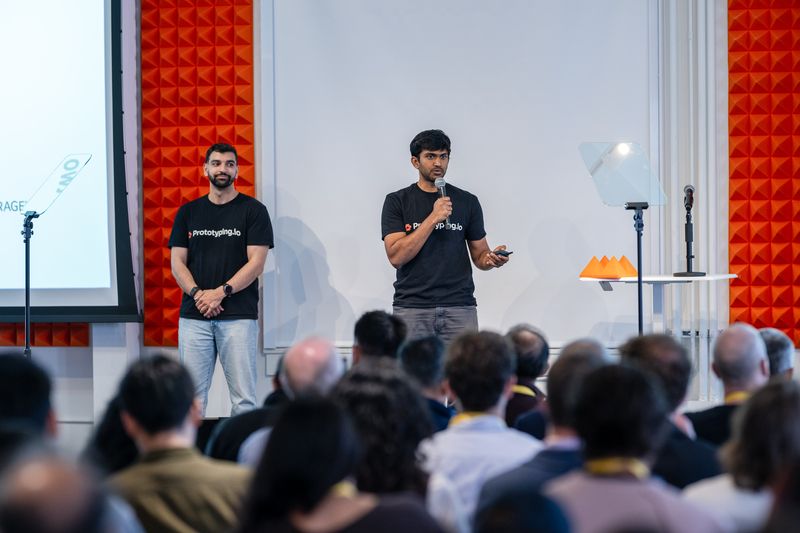
Their Demo Day photograph captures the arrangement neatly. Oberai stands to the left. Bodepudi holds the microphone, a slide just out of frame, an audience waiting. Onstage, the factory becomes a story. Offstage, the story has to become a part.
Bodepudi's public arc is still short enough to see its joins. An honors degree in mechanical engineering. A master's thesis on an almost impossibly delicate membrane. Research papers. Industrial work. Vehicle patents. A persistent annoyance with slow hardware. Then a company whose product is, essentially, a better joint between design and manufacturing.
The useful lesson is quieter than the fashionable phrase “autonomous manufacturing.” Study the handoff. Watch where information waits, where intent is translated badly and where skilled people repeat administrative work before a machine can begin. The opportunity may not sit inside any single step. It may be the connective tissue among them.
His 2026 recruiting notice makes that connective ambition tangible. The early roles were not variations on one discipline: a manufacturing-operations lead, an AI software engineer and a prototype machinist. The list reads like the company in miniature. One person coordinates the system, one writes the intelligence and one knows what actually happens when tool meets stock. Bodepudi asked applicants to show proof of impact through two projects they were proud of, explain why the work mattered and identify their own contribution. For a founder selling a shorter route between intention and result, it is a fitting way to ask who can help build it.
Bodepudi once designed a test to understand how a porous material stretches under pressure. Prototyping.io applies a similar instinct to an industry under pressure to build faster. Find the hidden load. Measure the delay. Redesign the path. Then, finally, make the part.