There is a pleasing modesty in describing a spacecraft as a delivery truck. The vehicle may cross the edge of space at several kilometres per second, endure a violent atmospheric return and land with cargo made in microgravity. Still, the job is recognisable: pick something up, protect it in transit and bring it to the customer. Payton Case, the aerospace engineer who co-founded Dispatch, has built his new company around that plain-language assignment.
The premise begins with an imbalance. Rockets have made the journey to orbit more available, but the return trip remains constrained. A manufacturer might use microgravity to grow an unusual crystal, develop a semiconductor or work on a biological product. The experiment can go up. Turning that experiment into repeatable production requires a reliable route down, scheduled for the manufacturer rather than around the calendar of a crewed space station.
Dispatch plans to supply that route with Spark-1, a refurbishable autonomous reentry vehicle. Its first flights are scheduled to begin in mid-2027. The initial version is designed around 30 kilograms of payload. Beyond it sits a larger idea: permanent, high-power stations in orbit, built for automated manufacturing and serviced by return vehicles. Factory above, delivery fleet below. It sounds obvious after someone has said it, which is often the mark of an interesting startup idea and never evidence that execution will be easy.
Send payload
Make in orbit
Bring it home
Cold computers, hot arguments
Case arrived at orbit by way of Purdue University, where he studied aerospace engineering and entertained another possible future: patent law. As a freshman, he competed in parliamentary and Lincoln-Douglas debate. He told Purdue that debate scratched a competitive itch and sharpened a skill engineering courses did not always demand so explicitly - persuasion.
“If you're a good debater, you're a better communicator.”Payton Case, as a Purdue student
The comment has aged well. Aerospace founders must move between equations, machine shops, customers and capital. A thermal model does not care how charming its designer is; almost everyone else does. Dispatch's public story turns a dense stack of engineering into a visual anyone who has waited for a parcel can understand. The station is a factory. The capsule is the truck. Reentry is the route.
Case's undergraduate research showed the other half of his temperament. He built a test bench to study computer performance under extreme cooling. With water cooling, his early results suggested a relationship between added cooling capacity and faster benchmark completion. Then the rig received liquid nitrogen. Below 150 kelvin, the reported stable CPU frequency climbed from 4.0 to as high as 6.3 gigahertz, with a 32.3 percent improvement in mean benchmark completion time.
It was an undergraduate project with a hobbyist gleam and a spacecraft engineer's concern for thermal limits. Cooling, stability, test conditions, performance: these would remain familiar nouns. At The Aerospace Corporation, Case worked in the thermal group and supported the Lunar Gateway program. A 2022 technical presentation also lists him among authors examining additively manufactured heat pipes, a technology intended to move heat through spacecraft hardware.
Learning the factory
Case then spent four years at Astranis alongside Andrew Mello, who would become Dispatch's co-founder and chief technology officer. Astranis builds geostationary communications satellites, and Case's work stretched from spacecraft architecture to production and critical mission operations. Dispatch's own biography says he led the company's next-generation geostationary spacecraft design in the Office of the CTO.
In 2024, as Astranis prepared to manufacture its Omega satellites at an unusual rate for geostationary spacecraft, Case described the shift in industrial terms. The company was taking the “arts and crafts” out of satellite manufacturing, he said, and designing for production at scale. It is easy to see the connective tissue. Dispatch is not simply proposing a capsule. It is proposing repeatable hardware for repeatable industry.
Mello brought his own history across avionics, electrical systems and software. The pair had already spent years building spacecraft together. That matters in hardware, where co-founder chemistry is tested not only by opinions but by deadlines, suppliers and devices that can express disagreement by catching fire. Dispatch was founded in San Francisco in 2025 and entered Y Combinator's Spring 2026 batch.
Purdue aerospace engineering, with parliamentary and Lincoln-Douglas debate.
Cryogenic-computing research moves from water cooling to liquid nitrogen.
Thermal work at The Aerospace Corporation supports Lunar Gateway.
Spacecraft design, manufacturing and mission operations at Astranis.
Dispatch begins building the route home for orbital manufacturing.
An apartment, a rocket engine, a result
The young company's signature anecdote has the good manners to contain both domestic comedy and real flame. Dispatch says the team built its first full-scale reentry heat shield in an apartment for a fraction of conventional competitor costs. Then it took the shield to the Mojave Desert and held it behind a rocket engine to reproduce part of the thermal punishment of atmospheric return. The test article performed as designed.
A successful ground test is not a flight, and a flight is not a fleet. Dispatch's plan acknowledges that progression. First comes a subscale vehicle and a 2027 demonstration. Larger return vehicles follow. The longer-range station concept targets 100 kilowatts of power and would support vehicles carrying as much as 300 kilograms. Each stage has a harder verb: test, fly, return, reuse, scale.
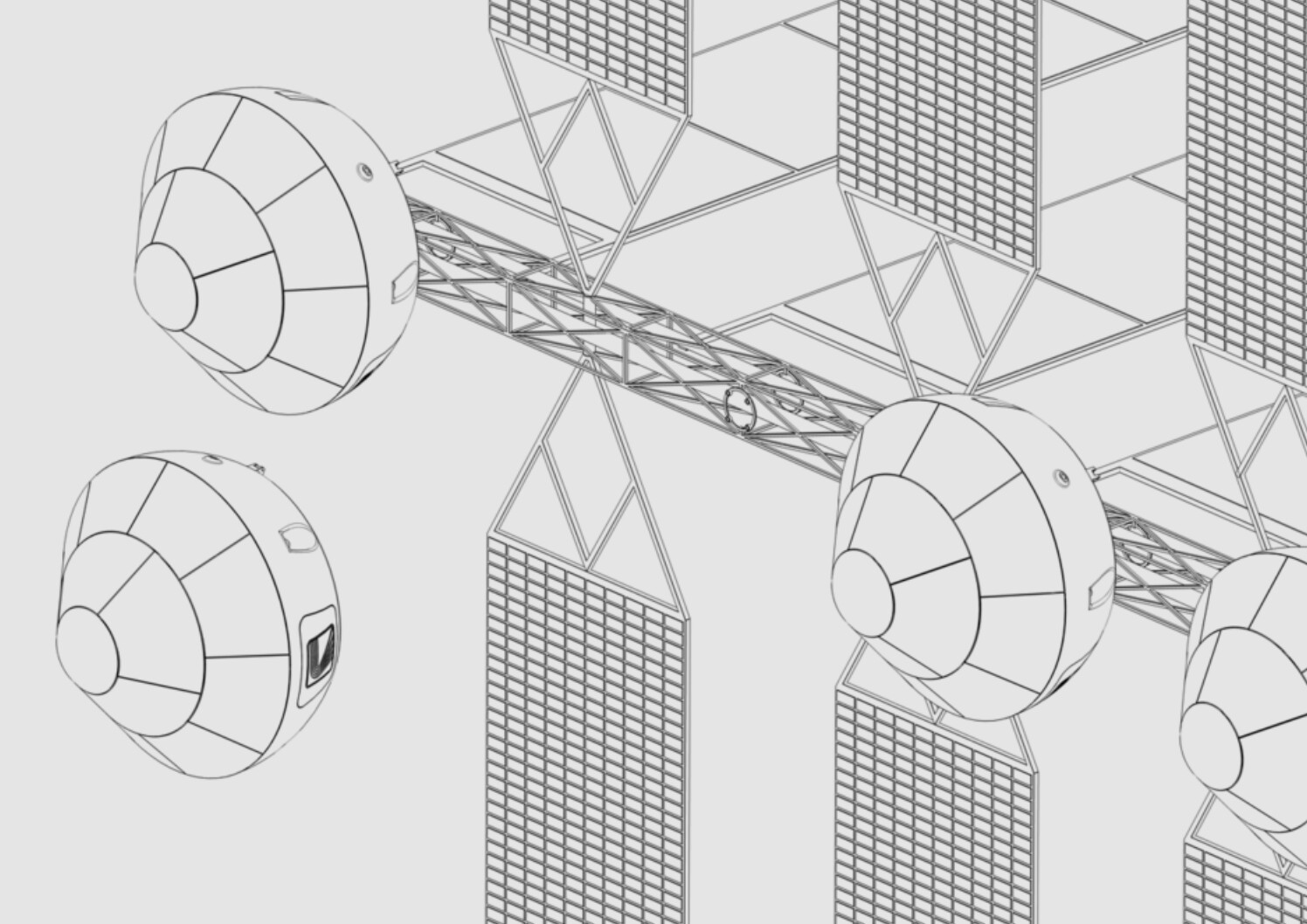
The station is where Case's thesis becomes more than transportation. Human spaceflight carries a long invoice: life support, environmental controls, escape provisions and extensive safety systems. Cargo has simpler tastes. Dispatch intends its station to operate without a resident crew, directing its mass, power and cooling toward industrial payloads. Case has said he expects much of future space activity, especially manufacturing, not to involve people.
That absence is a design choice, not a philosophical campaign against astronauts. A research station built for people and a factory built for products answer different requirements. The former must keep its residents safe through every ordinary hour and ugly contingency. The latter can be arranged around kilowatts, thermal rejection, automation and the physical needs of the process. On Earth, nobody asks a semiconductor fab to double as a hotel. Dispatch is applying the same division of labour above the atmosphere.
It also changes the rhythm. Launching a fresh factory for every production run means repeatedly paying to send the structure, power system and supporting equipment uphill. Leaving infrastructure in place turns those fixed systems into something closer to a utility. A return craft docks, accepts the finished payload and departs. A new input arrives. The expensive part stays useful. That is why the company's capsule and station should be understood together, even while the capsule must prove itself first.
“If you're going to be manufacturing in space at scale, why launch the factory every single time? Just have delivery trucks take things there and back.”Payton Case on Dispatch's premise
The return lane
The attraction of Case's idea is not that it makes orbit feel fantastical. It makes orbit sound bureaucratic. Manufacturers care about schedules, throughput, power, temperature and whether a product arrives intact. A mature space economy will need launch providers, certainly, but it will also need routes, depots, standards and the equivalent of a tracking number. Romance may open a frontier. Logistics keeps the appointment.
That customer view guards against a common temptation in space ventures: beginning with a splendid vehicle and looking for a reason it should exist. Dispatch begins with payload questions. How much mass? How much power? What temperature? How long must the manufacturing run last? When does the product need to return, and will the customer need another flight? The vehicle is the answer formed around those constraints. Case's earlier work across architecture and mission operations is relevant here because a spacecraft is never merely its drawing. It is also the production plan, the test campaign, the operations manual and the moment a customer expects it to work.
The milestones remain stern. A heat-shield test demonstrates a piece of the system in a controlled setting. Orbital flight adds launch integration, guidance, communications and recovery. Reuse asks the hardware to do it again without becoming a bespoke restoration project. Regular service adds schedule discipline and economics. Dispatch's cheerful truck metaphor contains all of these demands. The ordinary truck is useful precisely because generations of engineering have made its extraordinary coordination disappear from view.
Case's biography contains an almost suspiciously neat progression toward this job. Debate supplied the habit of making a complicated case clearly. Cryogenic computing supplied an appetite for experiments at thermal extremes. Lunar Gateway supplied deep-space context. Astranis supplied the practice of designing and producing satellites as repeatable machines. Dispatch gathers those experiences around one constraint: the return trip.
He also keeps a small joke in his professional biography: “Enjoys long walks in space.” It is a useful line because the rest of the work is heavy with heat flux, power budgets and unforgiving schedules. The ambition can carry a little levity. After all, Dispatch is trying to turn orbital manufacturing from a heroic expedition into an industrial service. If it works, the grand achievement will eventually feel ordinary. The truck arrives. The cargo comes home. Someone signs for it.