The package had a ticket to space. Getting it across Earth was the troublesome part. Matija Milenovic's first startup had been given 24 hours to put its satellite propulsion hardware in the hands of a mission integrator. FedEx and UPS would not guarantee the deadline, so the aerospace engineer became the courier. He made the 23-hour trip himself, guarding hardware built for orbit through the slow rituals of terrestrial travel.
The return journey left plenty of time for a vexing thought: a small satellite could circle the planet in roughly 90 minutes, yet its components still moved through warehouses, timetables and handoffs measured in days. Aerospace had learned to build astonishing machines. Logistics still had a fondness for waiting.
That mismatch sits at the center of Hop Aero, the company Milenovic founded with veteran aerospace integrator Jacob Balaj in 2024. Its proposed vehicle, Rook, is an autonomous rocket designed to carry 250 kilograms up to 750 kilometers in about 15 minutes. It would launch from a standard 40-foot shipping container, arc through space, re-enter at hypersonic speed and land on ground that does not come with a runway.
Rockets are a flamboyant answer to a prosaic complaint. Milenovic, however, has spent much of his career making grand hardware begin with small, unfashionable proofs.
Chapter one · The useful rejection
Zero internships, one thruster
In 2019, Milenovic and fellow KTH Royal Institute of Technology student Victor Gonzales were looking for summer work in Stockholm. After months of applications, their combined haul was zero offers. Milenovic had already been talking about starting a company. Gonzales appeared with a brochure for the Swedish arm of the European Space Agency's business-incubation program. The empty summer acquired a propulsion system.
They called the company porkchop, after the porkchop plots engineers use to compare the energy required for different interplanetary departure and arrival dates. The pair focused on electric propulsion for nanosatellites. Tiny spacecraft save money by shrinking, but the compact form often leaves no room for propulsion. Porkchop's approach integrated fuel, thrusters, controls and electronics into the satellite's structural frame. Imagine fitting an engine into a car's chassis without claiming a separate engine bay.
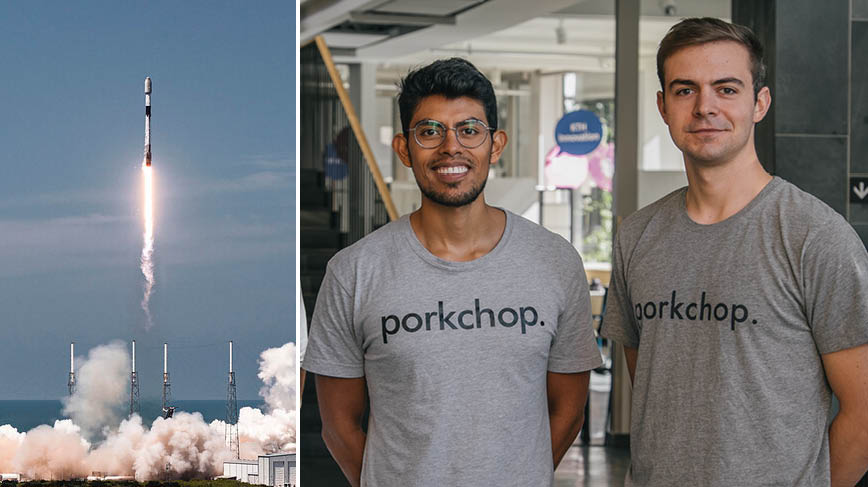
The first budget was about 25,000 Swedish kronor, then roughly $2,500. The founders bought titanium, alumina ceramic and copper and turned parts manually. A laboratory vacuum chamber was beyond reach, so they ordered a roughly $150 model from Amazon, the sort better suited to drying food. It could not mimic orbital vacuum, but it could support early tests. Impatience occasionally won: some firings happened in open air because setting up the chamber took too long.
They dried epoxy for flight hardware in an electric pizza oven. Milenovic later estimated that the domains, electronics, materials and other little purchases consumed close to $7,000 of his own money during the first two years. His verdict was dry: a smoking habit might have been cheaper.
“Always give people a chance to prove themselves.”Matija Milenovic, writing about porkchop's early grants
Sweden's early-stage grant system gave them that chance in carefully rationed amounts. The rhythm became almost mechanical: write a grant, get enough money for the next proof, build it, return with evidence, repeat. Because reimbursements arrived after purchases and the company had not yet been incorporated, the pair sometimes submitted claims when Milenovic's card declined. Glamour, like vacuum, was in short supply.
The milestones accumulated. KTH Innovation supplied workspace, coaching and access to tools. Porkchop joined its pre-incubator, then ESA BIC Sweden. In 2021, Milenovic won a 200,000-kronor ÅForsk entrepreneurship scholarship. On January 13, 2022, porkchop's propulsion system rode a SpaceX Falcon 9 into orbit on the Transporter-3 mission.
What began as consolation for a barren internship search had acquired what aerospace people call heritage: hardware with flight experience. The company also gave Milenovic two durable ideas. Credibility could be manufactured one small test at a time. And logistics, whether between orbits or between cities, was a field full of expensive dead time.
Chapter two · The operator years
Learning where ambitious hardware jams
Porkchop's intellectual property was eventually sold. Its Y Combinator biography credits Milenovic with building a sales pipeline worth more than $400 million, a reminder that even a company formed around a student workbench had to learn procurement, customers and the commercial grammar of aerospace.
He moved to Destinus as a systems engineer, leading a team of more than 20 people on supersonic unmanned aircraft. He also helped expand Ukrainian loitering-munition production from about 10 units per month to more than 100. Those are operator's problems: not merely whether one device can work, but whether a team and production system can make many of them work on schedule.
Co-founds porkchop while completing a master's degree in aerospace engineering at KTH.
Porkchop propulsion hardware launches aboard SpaceX Transporter-3.
Leads systems work on supersonic unmanned aircraft at Destinus.
Co-founds Hop Aero with Jacob Balaj.
Hop Aero joins Y Combinator and brings Rook into public view.
Balaj brought a complementary education in what delays flying machines. While serving in the U.S. Marine Corps after Typhoon Haiyan, he had watched a relief mission struggle with grounded aircraft, unavailable parts and pilot fatigue. Later came work on Falcon boosters at SpaceX, LauncherOne at Virgin Orbit, a lunar lander at Masten and satellites at SpinLaunch. His stalled relief mission and Milenovic's 23-hour hand delivery described the same problem from opposite ends.
Their answer shifted the vehicle from orbit to point-to-point travel. Hop Aero speaks of a “physical internet”: urgent goods routed with more of the speed and flexibility people expect from information. The first planned Rook stands about six meters tall. A standard shipping container serves as its home and launch infrastructure. The target trip between Okinawa and Taiwan becomes a neat demonstration of the premise: roughly 750 kilometers in 15 minutes.
The proposed Rook hop
Up to 250 kg · about 750 km · about 15 minutes in the company's example mission
The military application is explicit. Hop Aero describes contested environments where roads, airfields and ordinary supply chains may be damaged or unavailable. The commercial argument points toward factories, offshore facilities and other operations where an absent part can make downtime painfully expensive. Both cases depend on urgency high enough to justify a rocket.
Chapter three · Evidence before arrival
A contract, a hot-fire and the hard part
In September 2025, Hop Aero began a $1,249,909 Direct-to-Phase-II Small Business Innovation Research award from the U.S. Air Force. The program title, ROOK: Rapid Operations Over Kilometers, is unusually obedient to its acronym. The work funds an engineering design unit integrating propulsion, navigation, aerodynamic structures and autonomous landing logic for degraded or unprepared terrain.
The company has already hot-fired an engine and ignition system. It has flown a roughly three-meter prototype in a tethered test at Infinity One Oklahoma Spaceport and demonstrated the deployment of a drone from its cargo vehicle. Milenovic says Hop's in-house software suite, hopOS, helped take the engine from digital design to hot-fire in about two months.
These are real milestones, carefully smaller than the full promise. A tether is not a hypersonic re-entry. An engine firing is not a point-to-point service. The engineering design unit funded by the Air Force exists precisely because integration has a way of turning tidy subsystem victories into new arguments among heat, mass, guidance and reliability.
“Everything you build in aerospace is just always a series of trade-offs.”Matija Milenovic, on Rook's engineering choices
The line is almost comically restrained beside the vehicle renderings. Yet restraint suits the biography. Milenovic's public record contains bold destinations, from an interplanetary economy to the physical internet, but his working method keeps returning to the next test. Porkchop did not leap from a brochure to Falcon 9. It moved through rough parts, bad vacuum, a first firing, more grants, a flight unit and only then orbit.
Hop is following a larger and more difficult version of that staircase. In 2026, Y Combinator selected the company for its Summer batch. The announcement brought Rook's numbers, renderings and defense mission into public view. Milenovic celebrated the launch online, then offered the least cinematic update imaginable: back to building.
There is wit in his presentation. His X biography has called him Hop's “Chief Propaganda Officer.” At porkchop, he promoted “Thruster Thursdays” and entertained a colleague's suggestion that proximity operations should become “porksimity.” The jokes do useful work. Aerospace language is dense enough to require its own re-entry shield; a memorable name gives outsiders somewhere to hold on.
The underlying aspiration remains earnest. Milenovic has spent two startups trying to make important objects less stranded. The first gave very small satellites a way to maneuver without surrendering scarce internal space. The second proposes a shortcut for cargo blocked by distance, broken infrastructure or the ordinary refusal of a courier to make a promise.
Rook still has to survive the part that no headline can complete for it: integrated flight, re-entry and autonomous landing. That uncertainty gives the story its proper scale. The project is neither a finished transport network nor a mere rendering. It is a chain of increasingly expensive proofs, now backed by an Air Force contract and a founder who has already carried one improbable machine from a student workshop to orbit.
The package that started Hop Aero eventually arrived. Milenovic's question survived the trip home: why should urgent cargo spend so much of its life waiting? Rook is his proposed answer, six meters of rocket packed into a shipping container. The useful answer today is smaller. Fire the engine. Fly the tether. Build the next proof. The queue to the future advances one receipt at a time.