At first the Viceroy is simply a boat, which is almost an insult to the years of work inside it. It pushes away from a Rhode Island dock on a hull, obedient to the old laws of harbors. Then it gathers speed and rises onto three foils. The drag falls away. Beyond the marked channel, its broad wing takes over and the machine lifts a few feet above Narragansett Bay. A vessel has become an aircraft without ever agreeing to call itself one.
Billy Thalheimer has spent six years preparing for that sequence. He describes it in three clipped verbs - float, foil, fly - a phrase neat enough for a child and fiendish enough for an engineering team. Each word belongs to a different physical regime. Each transition creates another opportunity for spray, software, structure, or weather to object.
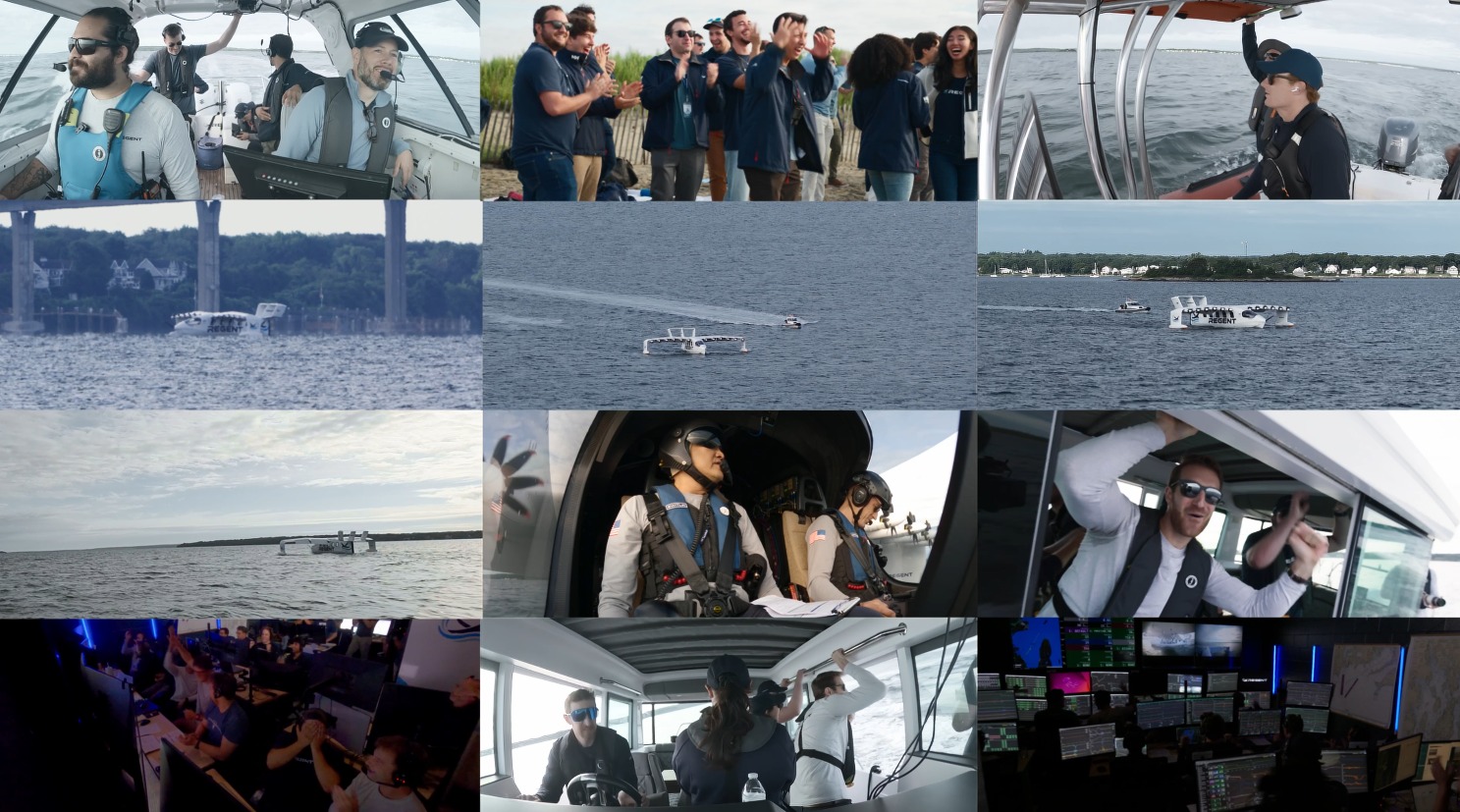
In September 2026, the full-scale, human-crewed Viceroy completed the entire sequence for the first time. On the water, chase boats followed. In the control room, engineers bent toward banks of monitors. The photographs that followed were less polished than the typical founder tableau: people shouting, hands on heads, colleagues colliding in relieved embraces. In one frame, Thalheimer celebrates aboard a support boat, one arm gripping the roof. Hardware has a useful habit of making emotion look earned.
The useful space between categories
Thalheimer is a flight-physics engineer and an FAA-licensed private pilot. He studied flight physics and aircraft design in graduate engineering at MIT, then worked at Aurora Flight Sciences, the Boeing subsidiary known for experimental aircraft. There he worked alongside Mike Klinker, an engineer focused on flight controls and autonomous systems. In December 2020, the pair founded REGENT. Thalheimer became chief executive; Klinker became chief technology officer.
Their observation was geographical before it was mechanical. Many large cities and island communities sit near water, but moving between them can be oddly slow. Aircraft offer speed but require airports, security, and travel at both ends. Ferries arrive downtown and use existing docks, but hulls spend tremendous energy arguing with water. The founders proposed a vehicle that would borrow the useful parts of each system: a boat's access, a hydrofoil's efficiency, and an aircraft's speed.
The last stage uses ground effect, the cushion of high-pressure air that develops when a wing flies close to a surface. The Viceroy is designed to cruise within roughly a wingspan of the water, where induced drag is lower. It never climbs over towns or mountains. Its runway is open water, and a safe landing surface remains close beneath it.
This explains the machine's category-straddling appearance and its regulatory path. In the United States, wing-in-ground-effect craft operate as maritime vessels under the Coast Guard. REGENT also incorporates aircraft-style safety practices into its design and test program. The result resembles an airplane, leaves from a marina, and asks ship operators to think like aviators. Bureaucracy, confronted with a hybrid, rarely becomes poetic. It asks for test data.
“We need to make sure it works in representative operational environments, like in waves and different weather.”Billy Thalheimer, describing the prototype program in 2021
A prototype is a question asked in composites
When REGENT emerged publicly in April 2021, it had raised $9 million and promised a quarter-scale prototype. Thalheimer spoke then in the cautious future tense of an engineer with an ambitious calendar. The craft would have a 15-foot wingspan, weigh about 400 pounds, and fly before the year was out. Winter and the difficulty of integrated hardware had their say. The unmanned demonstrator ultimately completed its float-foil-fly mission in September 2022.
The delay was less interesting than what the test proved. A single vehicle could move through all three regimes with one control architecture. Video of the demonstration showed a slightly improbable white craft lifting above the water, its inverted-V tail and long wing reflected in the bay. The image converted a rendering into evidence.
By then REGENT had moved from the Boston area to Rhode Island. The explanation was practical: protected coastal test water, a local tradition of marine composites, and access to engineering talent. North Kingstown also placed the company in Quonset Business Park, where a 255,000-square-foot manufacturing facility would later rise. If the seaglider was a marriage of aerospace and maritime work, Rhode Island supplied a plausible venue for the reception.
The full-size Viceroy made the abstractions harder to hide. Revealed in mock-up form in 2023, it is a 12-passenger machine designed for a 180-mile range and a cruise near 180 miles per hour. Human-crewed sea trials began in March 2025. Taxiing, foiling, control checks, and abort procedures accumulated before the first flight. A seaglider may promise to skip airport infrastructure, but it cannot skip the unglamorous repetition by which machines become trustworthy.
Demand arrives before the vehicle
Commercial interest moved faster. Brittany Ferries placed REGENT's first announced order in 2021. The company's stated order book grew from $600 million at the end of that year to $7 billion in 2022, then $9 billion in 2024. By 2026, REGENT described customers across six continents and multiple years of manufacturing capacity booked. These figures indicate appetite, not delivered vessels. They also create an unusual pressure: the prototype must mature beneath the weight of routes imagined years in advance.
Capital followed the same curve. A $60 million Series A closed in October 2023. In August 2026, REGENT announced a $240 million Series B, evenly split between equity and debt, bringing its announced funding commitments above $340 million. The money was assigned to the decidedly terrestrial work after flight: production equipment, certification, supply chains, and deliveries.
Thalheimer's job changed along the way. The engineer explaining ground effect became the chief executive arranging a factory, a regulatory campaign, international partnerships, and two lines of business. In public interviews he remains most animated by systems: why hydrofoils reduce drag, why a low-flying craft can exploit battery technology sooner than a conventional electric aircraft, why harbors matter more than vertiports. The salesman and engineer occupy the same sentences.
The second customer wears a uniform
A coastal vehicle able to move people and cargo quickly without a runway was bound to attract military attention. REGENT entered an agreement with the Marine Corps Warfighting Laboratory in 2023 and later expanded its work with the service. In July 2025, Thalheimer announced REGENT Defense, adding hybrid and autonomous models to the commercial electric program.
The dual-use logic is straightforward. Island chains and distributed maritime operations create the same map problem as civilian archipelagos, with different cargo and much less forgiving schedules. The autonomous Squire is aimed at sensing and logistics missions. The larger Viceroy offers speed and useful load. A military customer can finance capabilities, manufacturing maturity, and reliability that later benefit commercial routes. It can also pull priorities toward missions far removed from the friendly ferry terminal.
Thalheimer presents the two markets as one platform serving separate needs. It is a classic hardware strategy and a delicate managerial exercise. A machine built for passengers must earn comfort and public confidence. A machine built for contested logistics must prize autonomy, range, and survivability. Common components are easy to draw in a presentation. Common production is proved on the factory floor.
“We believe so strongly in our vision that we can connect the coastlines of the world ... that our strategy is to run through all the walls.”Billy Thalheimer at CoMotion Miami, 2025
After lift-off, the ordinary work
“Run through all the walls” is an appropriately physical line from a founder whose product keeps encountering boundaries. It is also best read with the ellipsis intact. Conviction does not dissolve hydrodynamics, certification, or factory yield. It supplies the patience to meet them repeatedly.
The first Viceroy flight closed one question and opened several more. Can REGENT expand the test envelope safely? Can it turn a hand-built prototype into vessels that leave the line alike? Can operators train crews, charge batteries, maintain foils, and fold the service into working harbors? Can a passenger look at the broad wing, low altitude, and salt spray and experience confidence rather than novelty?
Thalheimer's aspiration is to connect coastlines quickly, quietly, and at lower operating cost. The elegant part is the route map: Boston to New York, island to island, city center to city center. The harder and more revealing part is operational. Transportation changes lives only after it becomes boring enough to make a timetable.
For now, the most honest image remains that first-flight contact sheet. There is the craft above the bay, white against gray water. There are engineers in a dark control room, staring at evidence. There is Thalheimer on the boat, delighted for one unguarded second. Then comes the next run, the next data review, the next vessel. Float. Foil. Fly. Manufacture.