The useful test begins after the elegant demo ends. The satellite signal vanishes. The radio link fills with interference. The aircraft has already crossed the horizon, and the person who sent it there still needs an answer. In David Sharpin's corner of aviation, a machine that can stay aloft but cannot finish its task has merely found an expensive way to get lost.
Sharpin, the chief executive of Quantum-Systems Inc., has a sentence for this distinction. “Flying is one thing. Completing the mission while jammed - that's the standard we're holding ourselves to.” It is engineer's language, pleasantly short on incense. It also compresses more than 35 years of work across radar, manned aircraft, tactical drones, robotics and the stubborn business of turning prototypes into equipment that people can trust.
His route to the corner office did not avoid the laboratory. Born and raised in the American Midwest, Sharpin served in the U.S. Air Force and then studied electrical engineering at Wright State University, ultimately earning a master's degree. In the 1990s his name appeared on radar research, technical papers and patents. One invention used a modified form of the discrete Fourier transform to identify the periodic signatures of radar signals. Another addressed how a digital receiver could sort nearby signals without demanding absurd amounts of hardware. The subject matter is dense. The instinct is easy to recognize: make a complicated system do useful work with the resources actually available.
01 / Signal becomes judgment
An engineer learns every chair in the room
Research engineering led to systems engineering, program management and the commercial end of aerospace. Sharpin later summarized the progression as a tour through research engineer, program manager, engineering director, product-development leader, strategy executive and general manager. That breadth matters because defense technology has several ways to be correct and still fail. The physics can work while the product arrives late. The product can ship while its software ages badly. A contract can be won for a machine the operator would rather leave in its case.
At Alliant Techsystems, later folded into what became Northrop Grumman, Sharpin ran a special-mission aircraft business and helped move it from a small operation toward a provider of quick-reaction aircraft. At Orbital ATK he held senior roles in strategy, business development and aircraft protection. Then, at AeroVironment, he took charge of the Tactical UAS unit: a 250-person business supplying government customers in the United States and 45 other countries. He eventually moved into broader sales and business-development leadership across unmanned and robotic systems.
The résumé could read like a steady migration away from engineering. Sharpin's public comments suggest the opposite. The recurring attraction is still the act of making. He has called it a lifelong passion for creating “the new and different” to solve problems that exist outside a presentation deck. His patents offer the early version of that idea; his later businesses supply the heavier, noisier version, complete with factories, procurement rules and customers whose working environment includes people trying to stop the equipment from working.
“In all these positions I have drawn on my lifelong passion for creating the new and different to solve real-world problems.”David Sharpin, 2019
02 / A six-week conversion
The prototype that opened the software door
A useful career turn arrived as a demonstration. Sharpin watched a development move from zero to a functioning prototype in six weeks using Auterion's enterprise version of PX4, an open drone-software platform. The prototype then advanced to a customer demonstration. Speed alone can be a parlour trick, but this sprint showed him something structural: a common software foundation could let teams add capability quickly without rebuilding the aircraft's nervous system every time.
In June 2019 he joined Auterion as its U.S. general manager. His pitch for open standards was practical rather than ideological. Commercial and defense buyers wanted innovation, but they also needed safe, reliable and secure infrastructure. A shared architecture promised both a faster workshop and a system that would not trap its owner inside one vendor's cupboard.
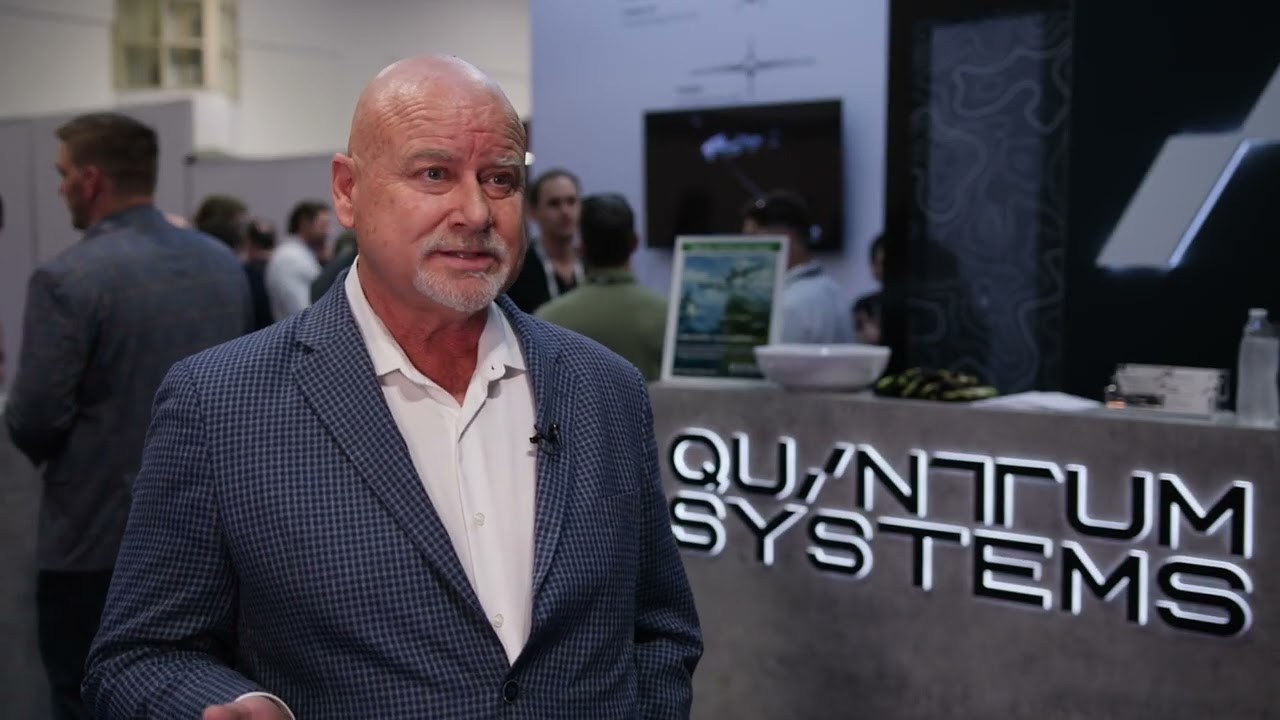
He later became chief executive and board chairman of Auterion Government Solutions. The role placed him at the meeting point between Auterion's software and Quantum Systems' Vector aircraft. For roughly 18 months, Sharpin served as the American point of contact for U.S. government programs evaluating that combination. The partnership became a handoff. In November 2021, Quantum Systems announced that he would lead its new U.S. subsidiary, with operations beginning the following January.
Sharpin described the move as the fulfilment of a plan rather than a raid on a partner. That detail reveals the shape of his opportunity. He already knew the aircraft, the software, the government buyer and the holes in the American market. Quantum Systems brought a German-designed family of electric vertical-takeoff aircraft. Sharpin brought an operator's map of the United States and a career spent translating between the people who build, buy and use aerospace systems.
03 / The unfriendly sky
Ukraine turns autonomy into a daily examination
Quantum Systems donated its first aircraft to Ukraine in March 2022. By mid-2025, Sharpin said more than 800 Vectors were in theater, supported by local production and testing. The environment changed as the fleet grew. Early flights faced less electronic interference. Then jamming intensified. Satellite navigation and communications became unreliable, forcing the aircraft and its makers to learn faster.
Sharpin describes the technical sequence with a pilot's historical shorthand. First came “Lindbergh-style” dead reckoning. Radio-based navigation followed. Vector AI then advanced toward visual navigation and targeting, using onboard computing for payload processing and mission autonomy. The ambition is not simply to fly without GPS. An intelligence aircraft must also know where it is, determine where the object of interest is and return information that another person can use.
That difference has reorganized the product. Sharpin prefers “aerial intelligence” to the narrower label of drone manufacturing. The aircraft is the visible piece, and visibility makes it a fine mascot. Yet the valuable output is an answer: what is happening, where it is happening and what decision should follow. Sensors, onboard computing, mission software and links to other battlefield systems carry as much weight as wings and propellers.
“You have to know your location and the target's location. We've built that into Vector AI.”David Sharpin on operating through jamming
The feedback loop is uncomfortable and unusually direct. Quantum Systems said Vector logged more than 20,000 operational hours in Ukraine during 2025 alone. Every hour can expose another assumption to weather, interference, hurried handling or an adversary's ingenuity. Sharpin argues that building and testing across multiple countries gives the company a more responsive system. The real advantage is measured in the time between an operator reporting a problem and an engineer putting an improvement back into the field.
04 / A factory is an argument
Moorpark, Huntsville and the geography of listening
In June 2025, Quantum Systems opened a 135,000-square-foot production and integration facility in Moorpark, California. Manufacturing lines sit alongside engineering labs, research space and flight operations. Consolidating those functions is an argument about time: fewer organizational miles between a defect, a discussion and a revised aircraft. Sharpin called the building a launchpad for scaled innovation, a phrase that sounds promotional until one considers the dull necessity underneath it. Someone must make the airframes, integrate the payloads and deliver them repeatedly.
The next American dot appeared in Huntsville, Alabama, in August 2026. The 3,200-square-foot office is modest beside Moorpark, but its location carries the point. Huntsville puts engineers near Army program offices, defense companies and customers who can explain what the machine should do next. Sharpin said the office would expand the engineering bench and speed development through closer collaboration. Proximity, in this model, is another piece of equipment.
The contracts are becoming tangible. In April 2026, the U.S. Army selected Vector AI for a company-level small-UAS requirement under a $15.3 million award. The system can be carried and deployed by one operator, takes off without a runway and connects to external battlefield-management tools. The selection followed an evaluation of aircraft performance, payload integration and interoperability. These are bureaucratic nouns with operational consequences: can it fly, can it see and can it talk to everything else?
Sharpin is also looking beyond a single aircraft and a single customer. He has discussed Reliant, a longer-range platform, as well as counter-UAS interceptors and the convergence of electronic warfare, signals intelligence and reconnaissance. At the smaller end, Twister was designed for both military units and public-safety users. He sees drone-as-first-responder programs as a way to put reliable aerial intelligence into emergencies while giving the public a useful, visible reason to trust the technology.
Commercial ambition runs into a slower machine: regulation. Sharpin has said that the long-promised ubiquity of drones failed to arrive because rules for beyond-visual-line-of-sight operation lagged behind the hardware. “We've built the tech. Now we need the regulatory runway,” he said in 2025. It is the rare aviation metaphor that also describes a docket.
05 / The capstone
What remains when the easy conditions disappear
Sharpin has called building a new UAS ecosystem at Quantum Systems a dream and a capstone to his career. Capstone is an apt word, provided it is not mistaken for retirement marble. The current work gathers the layers below it: Air Force experience, graduate engineering, radar invention, aircraft programs, international sales, open software and production. Each layer corrected the one-dimensional view offered by the last.
The young researcher learned that computation has limits. The program manager learned that schedules do too. The business leader learned to ask what customers are trying to accomplish, not which feature they requested. The drone executive learned that autonomy is judged in the least autonomous circumstances: a jammed sky, a broken link, a hurried operator and a mission that has not politely waited for better weather.
There is a dry wit hidden in this engineering worldview. Aviation loves the clean line, the polished prototype and the serene view from above. Sharpin's career keeps returning to clutter: overlapping radar pulses, incompatible systems, procurement friction, disrupted communications. He appears happiest when the mess becomes a design requirement. After all, a perfect aircraft for perfect conditions is a splendid object. It is also unemployed.
That leaves his standard intact. The aircraft must launch quickly, adapt when the map goes dark and bring back something more useful than a story about having flown. Hardware gives it shape. Software gives it options. The long career behind it supplies the less glamorous ingredient: judgment about which problem deserves solving next.