A customer taps a badge after the technician fixes the air conditioner. Three gestures later, the praise is public. The review has a star rating, perhaps a sentence about punctuality, and something most feedback systems lose: the name of the person who earned it. For Dylan Allen-Arnegård, that small act contains an entire company. It is gratitude made visible, employee performance made attributable, and evidence placed where the next customer - increasingly an AI assistant - can find it.
Allen-Arnegård is the co-founder and CEO of Cheers, a San Francisco software company from Y Combinator’s Summer 2024 batch. Cheers began as a broader bet on the overlooked mechanics of in-person work. Its wedge was an NFC-enabled badge that let a customer open a personalized page with one phone tap, then leave a review, send a tip, make a referral or verify employment. The premise was almost offensively ordinary: good service happens every day, but the useful record of it often vanishes before the customer reaches the parking lot.
Then search began to change. People who once typed “plumber near me” into Google started asking ChatGPT or Gemini whom to hire. A page of links became a short answer. For local businesses, that compressed the competition and changed the object of persuasion. Their public record now had two audiences. Humans read reviews to reduce uncertainty; machines read the same evidence to decide which names belong in an answer.
Before the algorithm, the doorstep
The founder’s path to that thesis runs through the physical world. Allen-Arnegård’s official YC biography says he spent more than five years in frontline roles across Texas, Utah, Idaho and Argentina. He has described one portion of that period with unusual candor. Just after high school, he spent two years doing missionary work in La Rioja and Córdoba, Argentina. The days involved service, conviction, talking to strangers and a great deal of rejection.
In a later reflection, he called the experience founder training: working every waking hour on something deeply believed, while hearing no with numbing regularity. It is easy to turn perseverance into a framed word on an office wall. Door knocking makes it less decorative. You approach, explain, listen, absorb the refusal and walk to the next address.
The best founder training in the world is working every waking hour on something you deeply believe in, with near-constant rejection.Dylan Allen-Arnegård
At Brigham Young University, Allen-Arnegård studied computer science, graduating in 2024. His education did not stay politely inside the engineering building. He passed through the university’s startup ecosystem and worked in companies that had already made Utah a serious software corridor. At Podium and Weave, his internships covered product management and software engineering. Both businesses lived near the territory he would later claim: communications, customer relationships and reputation for service businesses.
Microsoft offered a different scale. Allen-Arnegård worked on Azure Linux, the company’s Linux distribution for cloud infrastructure. It was the sort of line on a résumé that could become a career with excellent coffee and predictable dental coverage. In his own brisk account of the choice, he “turned down Microsoft.” The alternative was an NFC experiment in a garage while he finished his degree.
A badge as a Trojan horse
The original Cheers launch is revealing because it shows the ambition before the category language hardened. In August 2024, the company introduced itself as a “super-app for in-person employees.” NFC badges were the entrance. They could make small tasks nearly frictionless, but the larger goal was to become an operating layer for schedules, performance, tips, feedback and customer engagement.
At launch, Cheers reported 25 customers, more than 3,000 processed internal and external reviews, and monthly recurring revenue that had risen from roughly $1,400 at the beginning of July to about $4,000. Managers were using the reporting software to run competitions and provide targeted feedback. The numbers were modest enough to be believable and useful enough to expose the wedge. A badge could collect a review. Attribution could tell a manager what happened. Repetition could show a pattern.
The review’s new itinerary
There is a humane idea inside the instrumentation. Frontline labor is full of moments that are easy to feel and hard to count: the calm explanation, the careful cleanup, the employee who remembers a customer’s name. Companies can measure revenue and response time while missing the person who created trust. Cheers tries to attach the afterglow to its source. Measurement can become surveillance in an ugly hurry, but it can also become recognition. The moral difference lives in what the manager chooses to reward.
The friend at the family reunion
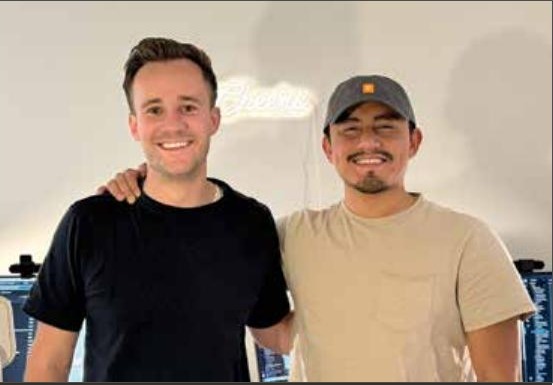
Companies like to manufacture origin myths. Allen-Arnegård and Amadeus Peterson inherited a better one. They met at a family reunion in Idaho after Peterson arrived with Allen-Arnegård’s cousin. Five years later, the friends were in San Francisco building Cheers together, Allen-Arnegård as CEO and Peterson as CTO. Allen-Arnegård called choosing to build with a friend the best decision he had made.
Their biographies form a tidy division of improbable prior work. Allen-Arnegård brought reputation software and Azure Linux. Peterson had been a Northrop Grumman software engineer working on the Sentinel missile system. One had studied how local companies talk with customers; the other had written software around machines designed for altogether less cheerful interactions. Together they moved from Utah to San Francisco for YC.
BYU Marriott captured what the accelerator meant to Allen-Arnegård. He described it as a place surrounded by people who raise your sights on what you can do, how hard you can work and what a company can become. The remark is earnest, which is unfashionable only until one remembers that startups require adults to spend years treating a fragile possibility as a calendar obligation.
Pick a small moment where value already exists but the evidence disappears. Shorten the path from experience to record. Then ask who else can use the record.
When recommendation becomes infrastructure
By 2025, Cheers had sharpened its language around generative engine optimization, or GEO. The company now describes itself as a full-stack GEO platform for local service businesses. It audits how brands appear in AI results, plans improvements to structured data and citations, generates reviews through frontline tools, and attributes outcomes to employees and locations. The badge remains. The strategic frame around it has grown.
The company’s showcase result is Vivint Smart Home. Cheers says Vivint used its system across hundreds of locations to generate more than 70,000 five-star reviews in five months and improve its position in AI and traditional search. It is a company-reported case, not a natural law. Still, the scale illustrates Allen-Arnegård’s argument: local reputation is no longer a loose pile of compliments. It is a dataset with recency, depth, consistency and geographic shape.
That argument benefits from restraint. Nobody fully controls how a language model answers, and an AI recommendation is not a vending machine slot purchased with enough stars. The more defensible promise is less theatrical: make a business easier to understand. Correct inconsistent listings. Publish useful evidence. Capture fresh, specific accounts of real work. Give algorithms fewer reasons to guess.
Still just two of us, but now with a lot more whiteboard space.Allen-Arnegård, on signing the first official Cheers office
In early 2026, Allen-Arnegård announced that Cheers had signed its first official office lease in San Francisco’s Dogpatch neighborhood. He said the company had passed $500,000 in annual recurring revenue and helped customers collect hundreds of thousands of five-star reviews. The team was still tiny. The room, at least, had expanded.
His public persona fits the work: technical curiosity delivered with the punctuation of a group chat. He posts about AI experiments, jokes about equipping video calls with a Sony mirrorless camera, and professes allegiance to StarCraft II. He can turn the memory of relentless rejection into a founder lesson without sanding off its religious origin. Colleagues describe him as sincere and eager to learn. The common thread is not polish. It is appetite.
The second audience
Cheers rests on a change much larger than Cheers: public language is becoming operational data. A detailed review once helped a stranger choose between two roofers. Now it may also supply an AI system with the nouns and verbs it needs to explain why one roofer fits the question. “Great service” is pleasant but thin. “Arrived on time, explained the repair and charged the quoted price” is evidence with handles.
Allen-Arnegård’s useful instinct is to begin with the human moment and work outward. The customer should not need an app. The employee should receive credit. The manager should see a pattern. The machine should encounter a coherent public record. Each layer makes the same event legible to a new participant.
The future of local discovery will be argued over by model builders, marketers and people who enjoy turning acronyms into conference lanyards. Meanwhile, someone will fix a furnace on a cold morning. The homeowner will be relieved. The technician will have done something worth noticing. Allen-Arnegård is building for the few seconds when relief can become a record - before the door closes, the truck pulls away, and a perfectly good signal disappears.