Ariann Langsam's team at Pilot Pen had point-of-sale data. It had social listening. It also had a decidedly less glamorous research instrument: screenshots of Amazon reviews, copied by hand into an Excel file. The ritual was slow, narrow and vulnerable to whichever comment happened to be newest. When a pen or notebook drew complaints, the team could see smoke but not always locate the fire. Was the product wrong? The retailer? The supply? The description?
This is the unromantic problem Revuze chose to solve. The company collects the noisy residue of commerce - ratings, reviews, social posts, surveys, support conversations, product catalogs and sales signals - and maps it across categories, brands, products, individual SKUs, retailers and markets. Natural-language processing identifies topics, sentiment and patterns. Its newer layer then proposes what a product manager, marketer, insights lead or e-commerce operator should do about them.
The distinction matters. Plenty of software can count complaints or draw a sentiment line. Revuze wants to be the part between the chart and Monday morning: change the listing copy, investigate a defect cluster, watch a rival launch, test an unmet need, adjust a price or ask a follow-up survey question. Its pitch is not that the internet has opinions. Everyone knows that. The pitch is that scattered opinions can become an operating system for consumer decisions.
Signals in
- Verified-buyer reviews
- Social and video
- Surveys and CSAT
- Customer care
- Commerce and pricing
Fix a PDP. Trace a return. Test a feature. Brief a campaign. Flag a launch. Compare a rival SKU.
The first idea packed a suitcase
Revuze's history contains a useful correction. In 2011, founder Ido Ramati was working on automatic analysis of travel-site reviews to improve itinerary planning. Travel did not become the enduring market. By 2013, with early backing connected to Nielsen, the company shifted toward retail and formalized the business that exists today. The travel concept was not wasted work; it revealed the underlying machine. Reviews were messy, abundant and full of decisions hiding in ordinary language.

Retail made that machine more valuable. A traveler chooses a hotel once. A consumer brand manages hundreds or thousands of products, sold by multiple retailers, in multiple languages, with fresh reactions arriving each day. The problem multiplies across a company: product wants defect signals, marketing wants the phrases buyers use, e-commerce wants conversion friction, and insights wants category movement. Traditional research can answer deep questions, but often through a project with a brief, fieldwork and a delivery date. Revuze built for the questions that refuse to wait politely.
P&G became its first major commercial client in 2014. Explorer launched in 2015, and Revuze says the product grew to serve more than 100 global brands. By 2021, its coverage exceeded 2,000 product categories. The customer roll includes L'Oréal, Coty, Dorel Juvenile, Char-Broil and Pilot Pen - businesses where one product family can generate an encyclopedia of small irritations.
A tiny color problem explains the whole product
Pilot Pen's case is revealing because the outcome was specific, not cinematic. Revuze helped the company inspect reviews by SKU and retailer. One notebook problem that first looked broad turned out to be retailer-specific. In another instance, buyers described a new ink color as insufficiently dark. The response was not necessarily a reformulation. Pilot Pen changed the product description so the promise better matched the pen.
“Before we had Revuze, we were doing screenshots of our Amazon reviews and manually putting them into an Excel spreadsheet.”Ariann Langsam, VP of Consumer Marketing, Pilot Pen
That is what SKU-level intelligence is supposed to buy: a cheaper, faster diagnosis. Broad social listening might say that a brand has a color complaint. Category and retailer context can show whether the complaint is concentrated in one listing, one seller or one product variation. A team avoids redesigning the wrong thing. It also escapes the recency trap, where the last angry review becomes the unofficial research department.

The dashboard learned to make requests
Revuze's product has moved through three recognizable eras. Explorer organized feedback into topics and benchmarks. A 2024 redesign made brand performance, over-discussed topics, competitive position and trending products easier to see. Then ActionHub, launched in April 2025, changed the product's grammar from nouns to verbs. It offers daily recommendations about what to fix, launch or optimize, tailored to a user's role and measures.
The suite now divides the work into hubs. Product Hub focuses on return drivers, purchase motivations, launch health and innovation. CI Hub gives research teams a category-to-SKU view and can launch surveys when observed behavior needs validation. eComm Hub works on product-page enrichment, review summaries, shopper friction and pricing across retailers. Social Hub reads text and video for trends, reputation, creators and campaign ideas. Reporting, customer-care analysis, surveys, a review-data API and Vee, its conversational interface, broaden the surface.
In March 2026, Revuze partnered with Charm.io to add TikTok Shop sales and creator-performance data. The combination is sensible: social excitement is not the same as post-purchase satisfaction. A clip may create demand while reviews, returns and support tickets reveal whether the object survives contact with a buyer. Revuze can compare the two stories and look for the gap between hype and use.
Where Revuze sits - and what the bill means
The market around Revuze is crowded from several directions. Qualtrics and Medallia run broad enterprise experience programs. Sprinklr and Brandwatch grew from social listening. Chattermill, Thematic, unitQ and Enterpret analyze feedback streams. Specialist tools such as Yogi and Wonderflow also court consumer brands. Gartner placed Revuze as a Niche Player in its 2026 Magic Quadrant for Voice of the Customer platforms, alongside larger and differently shaped vendors.
Revuze's lane is category-wide consumer intelligence: not only what a company's own customers reported, but how its products compare with rival SKUs across public channels. The ready-made market model and action layer are the differentiators. That also defines the conditions for success. The buyer needs enough products, feedback volume, channels and recurring decisions to make automation useful. It needs owners who can act on recommendations. A weekly alert about a weak product page is worthless if no one owns the page.
What does it cost? Revuze does not post standard plans on its own site. Software Advice and Capterra list a starting figure of about $30,000 per year, per feature in their directories. Treat that as a shopping clue, not a price tag. The relevant comparison is the combined cost of manual review collection, commissioned research, delayed launches and teams arguing from different datasets. For a small brand with a handful of products, the arithmetic will probably look silly. For a multinational managing thousands of SKUs, one retailer-specific problem caught early can change it.
It fits when
Feedback is high-volume, products span retailers and markets, teams ask the same questions repeatedly, and someone has authority to make the resulting change.
It struggles when
A company has few reviews, needs one occasional study, lacks clean product identifiers, or wants software to substitute for judgment and organizational follow-through.
The hard part happens after the demo
Consumer-intelligence software usually arrives with a seductive first screen: a market rendered legible, its complaints sorted into topics and its competitors arranged in neat quadrants. The organizational test comes later. Product, marketing and e-commerce may agree that the data is interesting while disagreeing about who must respond. Revuze's persona-specific hubs are an attempt to solve that handoff. A return driver should land with a product owner. A weak retailer description should reach the e-commerce team. A fast-growing phrase should become a creative brief rather than a screenshot in somebody's slide deck.
That requires a shared taxonomy. The same item must be recognized across a retailer listing, an internal catalog, a survey and a support system. Variants need stable identities. Markets and languages need comparable topic definitions. If the plumbing is sloppy, an elegant recommendation can rest on a false merge. Revuze emphasizes automated category capture and data cleansing because these chores decide whether the clever layer deserves trust. The software can reduce the work, but a brand still needs to know its own catalog.
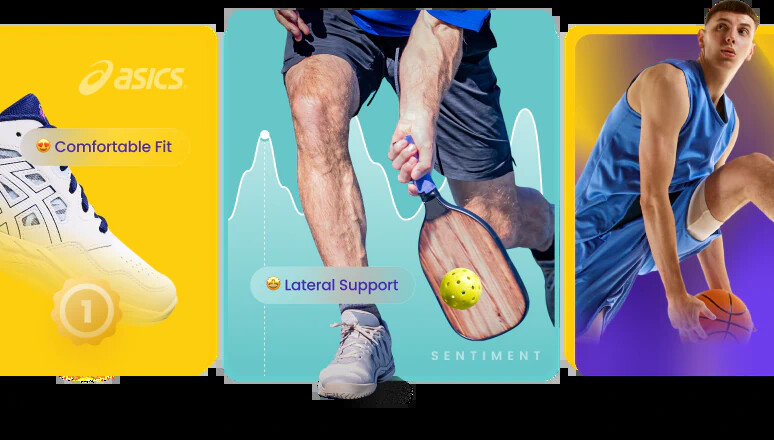
There is another quiet change. Market research traditionally concentrates access in an insights team that knows how to commission, interpret and police a study. Revuze describes a self-service model in which operators explore the evidence themselves. L'Oréal says the partnership helped more functions respond quickly to new business needs; Dorel says product, research and innovation teams gained a common view. That democratization can shorten a decision cycle. It can also create confident amateur analysis. Guardrails, provenance and an experienced researcher remain useful when a pattern is weak, a sample is skewed or a costly product change is at stake.
The sensible operating rhythm is therefore two-speed. Use continuous signals for reversible moves: change copy, flag a retailer, adjust a campaign, investigate a defect. Escalate expensive or irreversible decisions into deeper research. A dashboard can tell a team where to look; it should not make a tooling change or reformulate a product merely because a topic line twitched upward. The promise is faster judgment, not judgment removed.
The copyable move is smaller than “use AI”
Revuze offers a practical lesson even to teams that never buy it: begin with a decision, not a data lake. Name the person, the metric and the action. A product lead might ask which return reason is rising fastest for a new SKU. An e-commerce manager might ask which claim in the product description creates disappointed reviews. A marketer might ask which benefit buyers repeat without prompting. Only then decide which reviews, surveys, sales records or social posts belong in the analysis.
Second, preserve granularity. Category averages are comfortable and frequently useless. Keep retailer, market, time period, variant and SKU attached to every signal. Pilot Pen's retailer-specific notebook issue would disappear inside a brand-wide satisfaction score. Third, separate observation from validation. Reviews can expose an unexpected wish; a targeted survey can test whether the wish is widespread enough to justify a launch. Revuze's hubs deliberately connect those two stages.
Finally, make the output embarrassingly concrete. “Sentiment declined” is information. “Rewrite the color claim on this product page and measure returns for four weeks” is work. Revuze's move from Explorer to ActionHub acknowledges an old truth about business intelligence: the last mile is not another visualization. It is a person deciding that the evidence is good enough to change something.
The useful unit of consumer intelligence is not a report. It is a decision someone can make before the signal gets stale.
That is also the limit. Language models can summarize millions of comments and rank patterns, but they cannot guarantee that a complaint represents the whole market, that a creator caused a sale or that a recommendation fits a brand's constraints. Data coverage, taxonomy and human review still matter. Revuze works best as a disciplined shortcut between evidence and action, not a vending machine for certainty.
The company has come a long way from the imagined travel itinerary. Yet the original instinct survives: buried inside a heap of reviews is a better route. Revuze simply stopped planning the holiday and started telling consumer brands where to turn next.