The first AlphaSense product was born from a very expensive kind of dread. In the late 1990s, Jack Kokko was an investment-banking analyst at Morgan Stanley, shuffling through filings and research with keyword search. The tool worked exactly as designed: type a word, find that word. The problem was everything it could not understand - synonyms, context, sentiment, the relevant passage that used language Kokko had not guessed.
For a knowledge worker, that is not a cosmetic failure. A missed line can warp a valuation, weaken a board memo or leave a deal team explaining why somebody else spotted the risk first. Kokko carried the frustration to Wharton, where he met engineer Raj Neervannan. In 2011 they launched AlphaSense around a modestly radical proposition: business search should understand what the researcher means, not merely the characters they typed.
The product is a search engine wearing an analyst's suit
At its core, AlphaSense ingests a large collection of public, licensed, proprietary and customer-owned information. That includes company filings, earnings-call transcripts, trade publications, news, patent and regulatory material, broker research, expert interviews and internal documents. Its search layer recognizes business language and related concepts; its monitoring tools watch companies and themes; its generative products summarize, compare and draft while pointing back to the underlying passages.
This last detail is the point. General chatbots can produce a fluent market summary. AlphaSense sells the evidence chain: the exact filing, analyst note or interview behind a claim, constrained by the customer's permissions. In finance, pharmaceuticals and corporate strategy, a neat paragraph without provenance is often just a new problem.
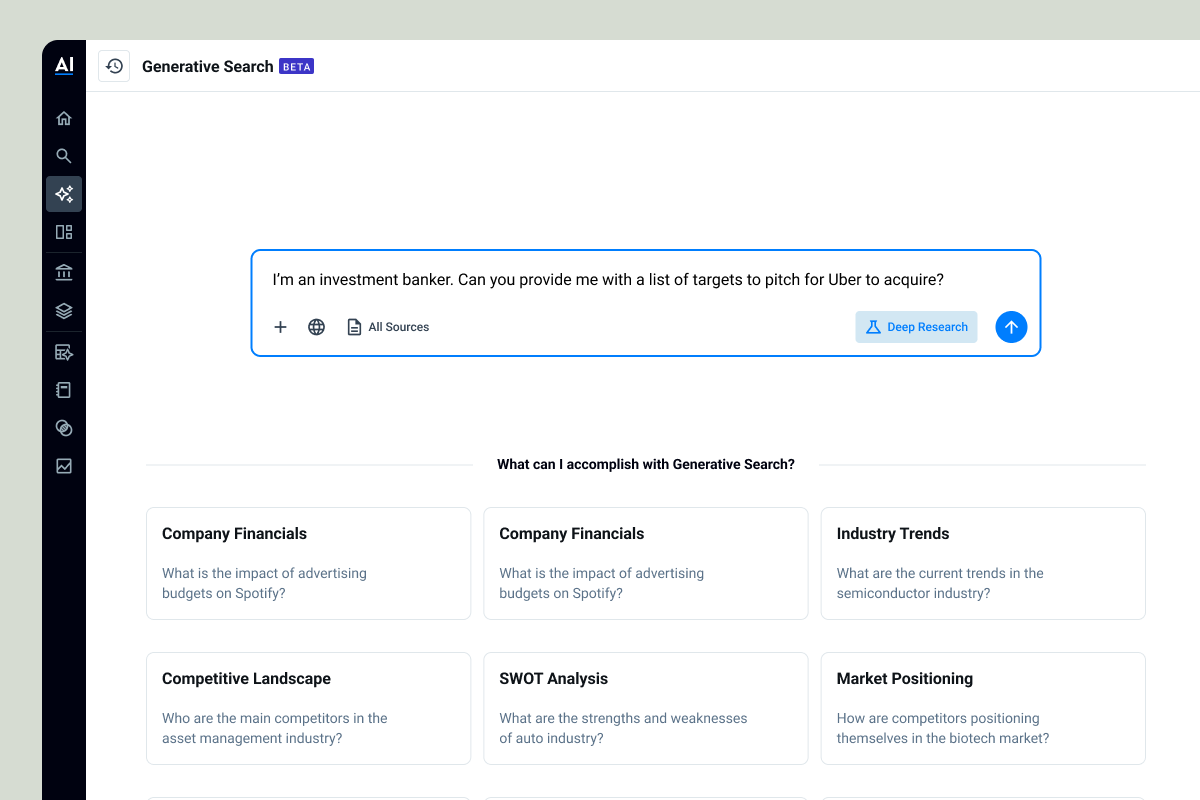
What changed: the search box ate the workflow
The first thing that failed was literal keyword search. The second limitation was AlphaSense's own definition of the job. Finding a passage saved time, but customers still had to gather private-market color, extract financials, build a model and turn the conclusions into a memo or presentation. The company gradually changed its mind about where research software should stop.
Its acquisitions map that realization better than any slogan. Stream brought expert-interview transcripts in 2021. Sentieo added a competing financial-intelligence workflow in 2022. Canalyst brought pre-built financial models the same year. The $930 million Tegus deal in 2024 gave AlphaSense a much larger proprietary expert library. Carousel, acquired in 2025, pushed into AI-assisted Excel modeling. This was not random shopping. Each purchase moved AlphaSense one station farther from “find the fact” toward “finish the work.”
Generative Search and Generative Grid now answer questions or run the same questions across many documents in a table. Deep Research performs a longer, multi-step investigation. Workflow Agents can repeat a company primer, earnings analysis or channel check on schedule. SuperAnalyst, introduced in June 2026, is the umbrella for the always-on version: software that monitors fresh signals and executes defined research jobs instead of waiting for a human to reopen the search box.
Who pays, and what does it cost?
AlphaSense sells to people whose reading list is both enormous and consequential: asset managers, hedge funds, investment banks, private-equity teams, consultants, corporate-development groups, competitive-intelligence teams and pharmaceutical researchers. The company said in June 2026 that more than 7,000 enterprises used the platform, including 90 percent of the S&P 100, all top global investment banks and 92 percent of the world's 50 largest pharmaceutical companies.
The bill is less tidy. AlphaSense offers annual, custom-quoted subscriptions by seat or enterprise deployment, with content and integrations affecting the price. There is no general public rate card. One concrete marker is its AWS Marketplace listing, which displays a $20,000 12-month basic-access dimension and routes buyers to a private offer. The important buying question is therefore not “Is search worth $20,000?” It is “How many expensive hours, duplicate subscriptions and avoidable blind spots does this replace?”
AlphaSense's own customer studies give a sense of the pitch. One asset-management team said information gathering in diligence fell by 50 to 75 percent, with a six-hour task dropping to one. Cardinal Health estimated an average saving of 45 minutes a day. Royalty Pharma reported 30 percent shorter workflows. These are selected customer accounts, not controlled experiments, but they show the product's unit of value: analyst time reclaimed and decisions reached with a wider evidence base.

The organization behind the software is unusually distributed for a company associated with Wall Street. New York is the headquarters, but Helsinki remains an important link to its Finnish founders; engineering and client teams also span India, London, Singapore, Ireland, Canada and several American offices. In 2025, AlphaSense said its engineering and product organization alone included more than 650 people. The career pitch mixes familiar software-company language - customer obsession, experimentation, psychological safety - with one more distinctive word: sisu, the Finnish idea of quiet determination when a task turns difficult. It is a fitting value for a business built around the least glamorous parts of knowledge work. Search relevance, content permissions and document ingestion do not make dramatic demos. They simply have to keep working every time another filing lands.
The moat has a library card
AlphaSense is often compared with Bloomberg, FactSet, S&P Capital IQ and LSEG Workspace. The overlap is real, but incomplete. Those terminals remain formidable in live market data, trading context, portfolio analytics and structured financial information. PitchBook is a more natural choice for fund performance, limited-partner intelligence and detailed private-capital records. Expert networks such as GLG, Third Bridge and Guidepoint compete where a bespoke human conversation matters most. Newer AI research tools compete on flexible document analysis.
AlphaSense's sweet spot is qualitative evidence at enterprise scale: locating what executives, analysts, regulators and industry operators have said, then connecting that language across time and sources. Its differentiator is the combination rather than a single algorithm - licensed Wall Street research, a large expert-transcript library, business-specific retrieval, internal-data integration, security controls and citations. Models are increasingly available to everyone. A permissioned corpus with hard-won distribution deals is not.
Where AlphaSense fits · editorial assessment
Directional comparison of product emphasis, not a benchmark score.
The playbook worth stealing
There are five useful moves here for anyone building vertical AI. Start with a painful workflow whose mistakes have a visible cost. Index the sources professionals already trust instead of asking a model to improvise authority. Tune retrieval to the language of the domain. Keep every generated claim attached to evidence. Then expand into the next task the user performs - the comparison table, recurring monitor, model, memo or deck.
AlphaSense also shows when acquisition can be product development by other means. Buying Tegus did more than add customers; it added proprietary material that improved the usefulness of search and synthesis. Buying Carousel did more than add a feature; it placed AlphaSense inside Excel, where financial analysis actually gets finished. The common thread is workflow adjacency, not a grab bag of logos.
It works when
- Research is continuous, shared and high stakes.
- Premium sources and expert evidence matter.
- Teams need citations, permissions and auditability.
- The saved analyst time exceeds the annual contract.
It breaks down when
- A team researches only occasionally.
- Public filings and free web sources are sufficient.
- The primary need is live prices or trading infrastructure.
- Users will not invest in onboarding and workflow change.
A very large bet on fewer tabs
The strategy has been expensive. AlphaSense raised $650 million in 2024 while agreeing to the $930 million Tegus acquisition. In June 2026 it raised another $350 million at a $7.5 billion valuation. The company said annual recurring revenue had climbed from $200 million in April 2024 to more than $600 million in Q1 2026. It also began working with Accenture as its first strategic channel partner, a route for placing market-intelligence agents inside larger enterprise systems.
Now comes the harder part. Bloomberg and other incumbents are adding generative interfaces. General models are improving. Enterprise buyers dislike overlapping tools, opaque prices and long deployments. AlphaSense must prove that its content, retrieval and workflow memory compound into something more reliable than a familiar terminal with a new chat window.
Still, the founding insight has aged well. The internet did not make research simple; it made the pile larger. AI does not remove the need to know where an answer came from; in high-stakes work, it makes provenance more valuable. AlphaSense built a company around the sentence an analyst might miss. Its next act depends on whether enterprises will trust it with the decisions that follow.