Company Profile · App Intelligence · Boston, MA
Apptopia.
Turning billions of mobile app signals into investor-grade data - the numbers behind the numbers.
Turning billions of mobile app signals into investor-grade data - the numbers behind the numbers.
Open your phone. Count the apps. Each download, each session, each minute of scrolling leaves a faint trace - a receipt for modern consumer behavior. Most of those traces evaporate. Apptopia's entire business is catching them, at scale, and turning them into something a hedge fund analyst will pay to read on a Tuesday morning before an earnings call.
Founded in Boston in 2011, Apptopia is an app intelligence company. It collects and analyzes billions of complex data points from the mobile app economy, then uses machine learning to estimate the metrics companies rarely disclose in real time: how many people downloaded an app, how much revenue it generated, how long users stayed, and whether that engagement is climbing or quietly falling apart. Those estimates are packaged as data products and sold, mostly, to people who invest for a living.
The pitch on Apptopia's own site is unusually plain for a data company: "Power investment decisions with mobile performance signals trusted by more than 200 leading firms." No talk of disruption. Just signal, accuracy, and trust - the three things that actually matter when your customer is a quantitative analyst deciding whether an app's momentum supports a position.
Apptopia began as a tool for the app economy itself - developers, publishers and brands who wanted to understand their competitors' downloads and rankings. That customer never left. Brands and publishers still use Apptopia to monitor a rival's complete mobile presence, spot early indicators of a competitor's performance, and benchmark their own apps against the field.
But somewhere along the way, Apptopia noticed that investors wanted the exact same intelligence - just priced and framed differently. An analyst covering a public company doesn't care about app-store rankings for their own sake. They care because a spike in a company's app usage can foreshadow a strong quarter weeks before the company reports it. That realization pulled Apptopia toward finance, and today its named clients read like a cross-section of the S&P: Google, Zoom, Visa, NBC, Target, Microsoft.
Public companies report on a delay. Earnings arrive quarterly, cleaned and lagged. Consumer behavior, meanwhile, happens continuously and in the open - on phones. The gap between what's happening now and what a company will admit next quarter is where investors either win or get surprised. Apptopia's job is to shrink that gap: to give a fundamental analyst a read on user growth, or a quant a daily feed with a median 0.8+ correlation to reported KPIs, so the surprise is smaller.
The app you downloaded is a data point. Apptopia turns billions of them into market signal.- The Apptopia thesis, in one line
Apptopia's catalog splits along the two ways professionals consume data - broad and shallow for quants, deep and segmented for fundamental analysts - with a growing layer of predictive tools on top.
Core app performance metrics - downloads, revenue, usage - across 3,500+ public companies, tuned for quantitative workflows.
Segmented behavioral insights drawn from a panel of 15M+ real-user devices, built for deep company analysis.
Models that estimate KPIs like ad revenue and user growth ahead of official earnings. Launched 2024.
A combined metric set engineered for high correlation to reported financial results.
Advertising intelligence covering creative, spend and channel activity across the app ecosystem.
App review analysis and SDK-adoption data for competitive and technology-stack insight.
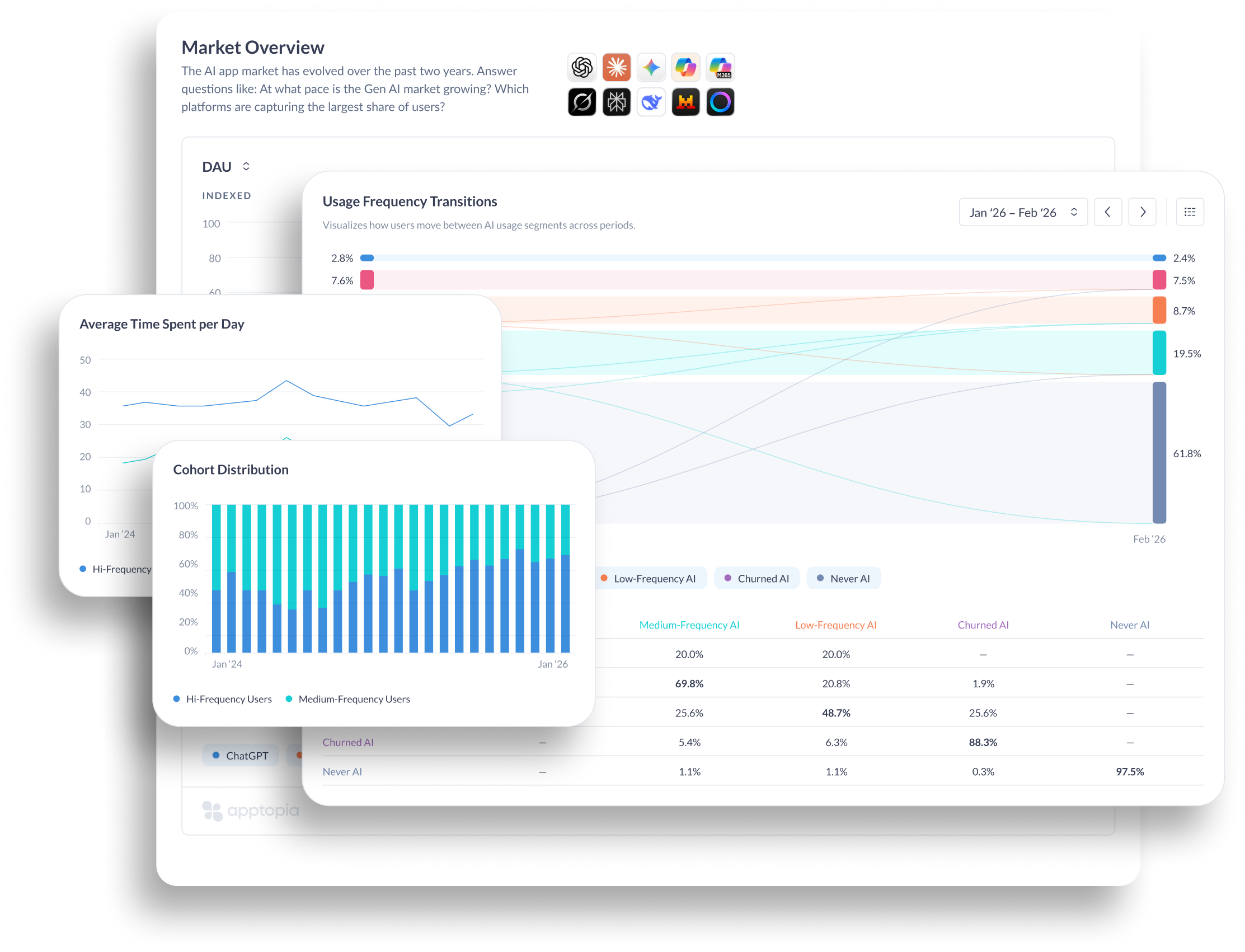
Proprietary data tracking how consumers actually adopt and use AI apps. Introduced 2025.
Apptopia competes in a crowded field. Sensor Tower and data.ai (formerly App Annie, now part of Sensor Tower) are the heavyweight names; Mobile Action and AppFollow round out the mid-market. On the surface, everyone sells app estimates. The difference is who they sell to and how much they can be trusted.
Apptopia has leaned hard into the investor use case, where a wrong number isn't an inconvenience - it's a losing trade. That focus shows up in the details it advertises: a median 0.8+ correlation to reported KPIs across hundreds of public companies, a #1 accuracy ranking from independent evaluator Maiden Century across 150+ tickers, daily and intraday feeds refreshed every few hours, and more than ten years of historical data for backtesting. In 2025 the company acquired a leading U.S. mobile consumer panel - not to get bigger, but to get more accurate, aiming to build the most extensive U.S. mobile panel by year's end.
Underneath the machine learning, Apptopia runs like a disciplined B2B subscription company. It licenses recurring access to its datasets and dashboards, priced by tier and audience - quant desks, fundamental analysts, brands, publishers, sales teams. Distribution partners such as Bloomberg extend that reach: Apptopia's mobile performance metrics now sit inside the Bloomberg Terminal, alongside the traditional feeds analysts already live in.
The discipline has paid off in a way that's rare for the category. Apptopia has been profitable for multiple consecutive years - unusual in alternative data, where many peers burn capital chasing scale. When it raised its $20M Series C in 2021, TechCrunch framed the money as fuel to expand competitive intelligence beyond mobile, not as a lifeline.
What Apptopia actually sells is judgment encoded in models: the ability to take noisy, incomplete, device-level behavior and infer clean, decision-grade metrics. That's a machine-learning problem, a panel-management problem, and a data-integrity problem all at once - and the company has spent more than a decade compounding trust one accurate estimate at a time. In data businesses, being right repeatedly is the brand. Everything else is packaging.
Apptopia is the app data insights and intelligence company, with clients including Google, Zoom, Visa and NBC.- Jonathan Kay, Co-Founder & CEO
Apptopia's cap table reads like a map of its evolution - from celebrity-backed startup to institutionally funded growth company. Total funding sits at roughly $34M across several rounds.
Apptopia launches to help the app economy understand its own performance.
A $2.7M round led by Ashton Kutcher and Guy Oseary fuels early growth, followed by a Series A.
The company sharpens its focus on investor-grade competitive intelligence.
Funding expands competitive intelligence and new connected-device data.
Investors gain early estimates of ad revenue and user growth ahead of earnings.
Apptopia buys a leading U.S. mobile consumer panel to deepen its dataset.
Zoom out and Apptopia occupies a specific seat in the alternative-data landscape. Credit-card panels tell investors what people buy; web-traffic firms tell them what people browse; Apptopia tells them what people do on their phones - which, for a growing slice of the economy, is where the buying and browsing now happen. As commerce, media and finance keep migrating into apps, the value of a trustworthy read on app behavior compounds.
That's the quiet logic of the company. It doesn't need to own the whole data-intelligence market. It needs to be the most accurate voice on one increasingly important question - what is the mobile consumer actually doing - and to keep being right about it long enough that a Bloomberg Terminal, a hedge fund, and a Fortune 500 brand all reach for the same feed.
It collects and analyzes billions of mobile app data points to estimate downloads, revenue, usage and engagement, then sells that intelligence to investors, brands and publishers.
More than 200 financial firms, plus brands and publishers. Named clients include Google, Zoom, Visa, NBC, Target and Microsoft.
It was founded in 2011 in Boston. Jonathan Kay is co-founder and CEO; Eliran Sapir was co-founder and its earlier CEO.
Roughly $34M total across several rounds, including a $20M Series C in 2021 led by ABS Capital Partners.
Chiefly Sensor Tower and data.ai (formerly App Annie), along with Mobile Action, AppFollow and other app-intelligence providers.