The first useful thing CB Insights learned about data was that it had priced the data wrong. In the wreckage of the 2008 financial crisis, co-founder Anand Sanwal surveyed credit-card executives about charge volumes, losses and delinquencies. The team packaged the answers into a report. It was useful, timely and, at $2,500, apparently much too cheap. A prime-broker contact suggested a ladder running from $12,000 to $100,000. The number sounded absurd. Customers paid.
The company did not yet look like the enterprise platform it would become. It was building private-company data under the name ChubbyBrain, a startup name so committed to sounding like a startup that it eventually collided with a purchase order. An investment bank delivered the verdict: “We love the product and the data and what you guys are doing. But we can’t buy a product called ChubbyBrain.” The founders changed the name. The CB stayed behind like a small tattoo from college.
01 / The actual jobMaking private companies less private
Today CB Insights is a subscription intelligence system for people whose next move depends on what another company may do. Corporate strategy teams use it to map markets. M&A teams hunt targets. Venture and private-equity investors screen companies. Sales teams look for accounts with momentum. Product and innovation leaders watch emerging technologies before those technologies acquire neat categories and Gartner-style maturity.
The raw problem is ugly. Public companies publish regular financial statements. Private companies mostly do not. Their condition has to be inferred from fragments: financings, job listings, patents, web traffic, executive moves, customer references, partnerships, acquisitions, news and the quality of their investors. CB Insights structures those fragments, connects them across a Business Graph, adds analyst research and makes the results searchable across more than 12 million companies and 1,600 technology markets.
Its most distinctive shorthand is Mosaic, an algorithmic score from zero to 1,000. The current model weights growth momentum at 50 percent and financial strength at 40 percent, with industry health and management strength at 5 percent each. It is less a crystal ball than a triage nurse: a fast, consistent way to decide which of thousands of companies deserves a closer examination.
What moves a Mosaic score
02 / The product stackA database learned how to talk
For years, the interaction model was familiar: search, filter, open a company profile, compare deals, save a market map, export a list. The Strategy Terminal still does all of that. It also carries proprietary measures such as Commercial Maturity, Exit Probability and customer sentiment, plus analyst rankings and research reports. VentureSource data acquired from Dow Jones in 2020 pushed the historical record back to 1983. A second 2020 acquisition, Amsterdam-based Blockdata, deepened blockchain coverage.
Then the interface began to move from queries to conversations. ChatCBI lets a user ask for an acquisition screen, competitive teardown or market memo in ordinary language. It can accept a company’s own documents, build watchlists and expose the underlying evidence. In 2025, CB Insights introduced 11 specialized agents for jobs including scouting, commercial due diligence, account planning and partnership discovery. By 2026, the data was also flowing through Microsoft 365 Copilot, Excel, Snowflake, Perplexity, APIs and MCP-compatible tools.
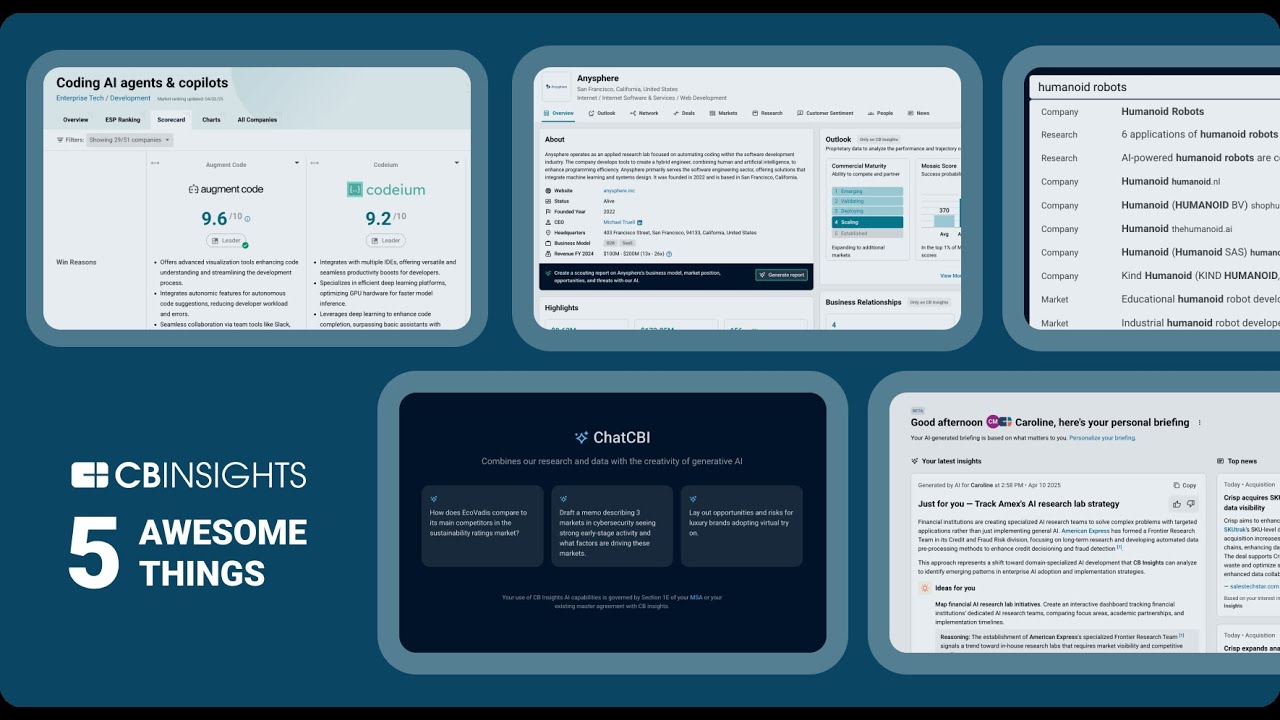
That distribution matters. A private-market database is valuable inside its own terminal; it becomes stickier when it appears in the spreadsheet, document and chat window where a decision is already being made. The generative layer is easy to notice. The harder part to reproduce is the dull accumulation underneath it: normalized entities, old deal histories, taxonomies, customer interviews and signals checked often enough to remain useful.
03 / The growth trickGive away the punch line, sell the machinery
CB Insights also built a media company inside a software company. The newsletter sent charts, research snippets and jokes with a tone that refused to behave like enterprise marketing. Sanwal signed off with “I love you.” Subject lines were tested. Instagram acted as a humor laboratory. By 2021, the email audience was approaching one million people, according to the CEO. Every useful chart was a small demonstration of what the paid database knew.
The first version of the data flywheel did not work. CB Insights asked companies to submit information, a request that helped CB Insights and gave the submitter little reason to care. Attention from the newsletter changed the bargain. A company could supply data and gain visibility with analysts and readers. Better submissions improved the database; better data produced better research; better research grew the audience; a larger audience made submitting data more attractive.
The company later moved more research behind the client wall, a reminder that free content is a lever, not a religion. The public layer had done its job: it earned habit and authority. The expensive layer saved labor and supported expensive decisions. Pricing remains quote-based. That obscurity is inconvenient for smaller buyers, but it matches a product whose value can differ wildly between a two-person fund and a multinational bank.
04 / What to stealThe playbook without the 12-million-row database
A five-step version worth copying
- Start with an urgent, expensive question and answer it manually.
- Charge for the consequence of the answer, not the file size.
- Publish small, high-signal artifacts that demonstrate your private machinery.
- Give contributors a reason to improve the dataset, even if that reason is visibility.
- Move from reports to repeatable workflows, then meet users inside the tools they already open.
The sequence is more portable than the tactics. A cybersecurity vendor could publish a useful benchmark, then sell continuous monitoring. A vertical recruiter could publish compensation patterns, then sell the live talent graph. A procurement startup could release pricing snapshots, then charge for negotiation workflows. The public artifact should prove the quality of the underlying system without giving away the entire system.
The newsletter voice is also copyable, though imitation usually produces a corpse. CB Insights worked because the personality belonged to an actual person with opinions about charts, headlines and business nonsense. The principle is not “add jokes.” It is “sound recognizable enough that a forwarded email still carries your brand after the logo disappears.”
05 / The limitsWhen the machine is the wrong answer
CB Insights is not equally sensible for everyone. If a team investigates five obvious companies per year, public filings, direct calls and cheaper databases may cover the job. If the required information is local, newly formed or deliberately undisclosed, even a large graph can be thin. A predictive score can prioritize diligence; it cannot inspect a factory, judge founder candor or guarantee that yesterday’s correlations will survive tomorrow’s market.
It fits when
- You screen hundreds or thousands of companies.
- A missed market or target is costly.
- Multiple teams need one shared intelligence layer.
- You can test signals against primary diligence.
It breaks down when
- Your universe is tiny and already known.
- Budget matters more than research speed.
- You treat a score as a verdict.
- Your niche leaves few reliable digital traces.
There is also a structural tension in every intelligence product: confidence sells, uncertainty is honest. CB Insights handles that tension best when it exposes the signals behind an answer and lets the user drill into evidence. It handles it worst when a crisp score tempts a busy executive to skip the messy work. The platform’s real value is not that it eliminates judgment. It gives judgment a better starting line.
06 / Market positionSomewhere between Bloomberg, Gartner and a research analyst who never sleeps
PitchBook is the obvious alternative for detailed deal and fund data. Crunchbase is the lighter, more accessible directory. Dealroom and Tracxn compete in startup discovery and ecosystems; AlphaSense, FactSet, Bloomberg and S&P Capital IQ overlap on company and financial research; Gartner sells technology judgment in a different form. CB Insights separates itself through the combination of private-company signals, visual market maps, predictive scores, analyst work and an unusually effective editorial voice.
Its direction is clear. The terminal is becoming less a destination and more an intelligence supply. Data can arrive in Excel, Copilot or an internal agent; specialized software can perform the first pass of a recurring analysis; a human can inspect the trail. The company that once sold a PDF now wants to sit quietly beneath every strategic question an enterprise asks.
That is the final irony. CB Insights became memorable by being loud in the inbox, but useful by being structured behind the scenes. The newsletter earned the meeting. The database earned the renewal. The agents are an attempt to earn the next action. Anyone copying the company should preserve that order. Attention is rented by the minute. A workflow that helps someone make a costly decision can stay for years.