Suppose two airlines offer the same journey. One looks cheaper. Then you add a bag, choose a seat, and discover that the bargain has developed expensive tastes. The first number was accurate. It was also an incomplete answer to the question you meant to ask.
- Aggregate Intelligence collects and structures competitive travel prices, including the context behind them.
- Its buyers are pricing teams, travel technology businesses, analysts, and builders of AI systems.
- FareTrack tackles interpretation; Shop Manager tackles collection; Vizly tackles asking questions.
- The useful lesson: compare equivalent offers, and pay attention to how often you need a fresh answer.
That small misunderstanding is the territory of Aggregate Intelligence. Its business begins where a neat price list encounters a messy booking journey. Airlines, hotels, and rental car companies want to know what their competitors are selling. More precisely, they want to know what a particular customer can buy, on a particular channel, under particular conditions. The distinction is where much of the work lives.
The trouble with a perfectly good number
Aggregate Intelligence sells competitive data and the tools to use it. Its current airline offering includes live customer-facing fares, filed fares and rules, historical prices, ancillary information, and channel discrepancy detection. For filed fare data, it names Travelport as a partner. The two views serve different purposes: one describes the published fare structure; the other checks the retail offer in front of the buyer.
A hotel comparison has its own traps. A room for one guest and a room for two are not equivalent merely because both have beds. Breakfast, refundability, room category, and length of stay can change the proposition. Aggregate Intelligence’s hospitality data maps properties, room types, and rate plans across sources. Its rental car data adds policy details such as insurance, fuel, and mileage. Normalization is the rather unromantic name for making these comparisons less foolish.
The customers are businesses making pricing, distribution, or analytical decisions: airlines, hotels, rental operators, revenue-management systems, and internal data teams. The company also targets AI agent builders. It occupies the space between a booking marketplace and an internal pricing engine, supplying an external view of the market that either can use.
- 01 / ObserveWhat can the customer buy?Live fares, room rates, rental offers
- 02 / NormalizeWhat does the price include?Taxes, policies, extras, timestamps
- 03 / InterpretWhat should the team examine?Comparisons, signals, reports
The spreadsheet was not the answer
The most revealing part of FareTrack’s origin account is an admission: supplying vast amounts of data was insufficient. Aggregate Intelligence had begun providing airline fare data in 2015. Working with revenue-management teams, company vice president Murtuza Dhinojwala saw carriers that needed timely competitive insights but lacked the people to process the information or the budget for substantial integrations.
The bottleneck appeared after collection. A business could possess the answer somewhere in its files and still struggle to act on it. FareTrack, launched in August 2021, put visualization and comparison tools in an online dashboard. Its features included fare change indicators, detailed filters, and side-by-side source comparisons. The origin account credits Dhinojwala with creating the tool.
That history explains the product better than an AI slogan does. The useful change was from delivering material to helping someone inspect it. The launch came during the pandemic’s pressure on airline staffing and resources. In that setting, an interface requiring no integration had a clear practical attraction. The company’s account describes a resource constraint and a response, rather than a miraculous forecasting breakthrough.
“Our specialty is aggregating and analyzing real-world data: information seen by customers in a booking process.”
John Tilly · FareTrack launch, 2021
Even curiosity has a meter
Competitive intelligence has a recurring expense: collecting the next observation. In its 2023 Optimize announcement, FareTrack described airlines repeatedly pulling competitor fares that had not changed for months. Those checks consumed money while adding little new information. Optimize was designed to analyze competitors’ pricing behavior and help choose a more economical extraction schedule.
The announcement presented Optimize as platform-neutral, usable alongside a customer’s preferred data supplier. That is an interesting commercial choice. The problem belongs to the collection strategy, so the proposed tool need not replace the entire data relationship. It asks when another look is likely to be useful.
The current Shop Manager makes related controls explicit: choose sources, define a collection job, set its frequency, and direct delivery. Consumption sits alongside those controls. A team can adjust scope and cadence instead of treating its original schedule as permanent. The business model is B2B data services, subscriptions, and paid analysis, with collection needs shaping the engagement.
FareTrack’s launch advertised paying for what was needed, without fixed licenses or minimums. That describes its launch proposition, not a universal price list today. For a buyer, the useful cost question is operational: which routes, properties, dates, and channels need monitoring, and how frequently? A cheap feed that misses the decision window can be poor value; a constant feed can also be wasteful.
The bag that changes the winner
In September 2025, Aggregate Intelligence launched Ancillary Intelligence: standardized airline ancillary offerings supplied as reports or underlying data. Seating, baggage, and flexibility were among the categories. Buyers could inspect a prepared analysis or bring the data into their own competitive intelligence tools.
The launch described airline reports added to a data library daily. Where a requested report was unavailable, customers could pre-purchase it for completion within 10 to 12 working days. That detail is useful because it reveals two different products under the same name: information ready to download, and analysis that still has to be produced.
The attraction is comparability. A carrier might be losing on the displayed base fare while offering a better total proposition for a traveler who needs luggage. Another might charge more for a seat while including greater flexibility. An ancillary report gives the commercial team material to examine those choices. It does not tell them which offer every traveler will prefer.
Which fare is cheaper?
Offer B includes a checked bag and seat selection. Add the same options to Offer A.
Offer A costs $30 less, with no extras selected.
A new model needs an old memory
Live prices answer what is happening. They offer less help with whether it is unusual. A hotel rate might rise because of a conference, a seasonal pattern, or something that has no obvious precedent. A newly launched forecasting system has its own history problem: it can know the business’s past while knowing little about the surrounding market.
In an August 2026 article, Aggregate Intelligence said it had more than 24 months of historical room rate data covering over 3 million hotels globally, alongside historical events data. Those are company-reported coverage figures. The proposition is straightforward: give a model market history at the start, rather than wait for it to accumulate every observation itself.
Historical hotel pricing, according to Aggregate Intelligence’s August 2026 coverage claim.
History helps only when it is comparable. Different collection times, inconsistent offer definitions, and changing market conditions complicate a model’s education. Structured historical data can reduce preparation work; it cannot make tomorrow behave like last summer. The company’s own article acknowledges that models still need current data and continued learning.
Now the database answers back
Aggregate Intelligence announced its acquisition of Vizly in October 2025. Vizly lets users ask questions about data in natural language and receive analysis and visualizations. The acquisition announcement laid out plans for a conversational layer across its data services and vertical products. The strategic logic is easy to see: another interface for the interpretation problem FareTrack had already encountered.
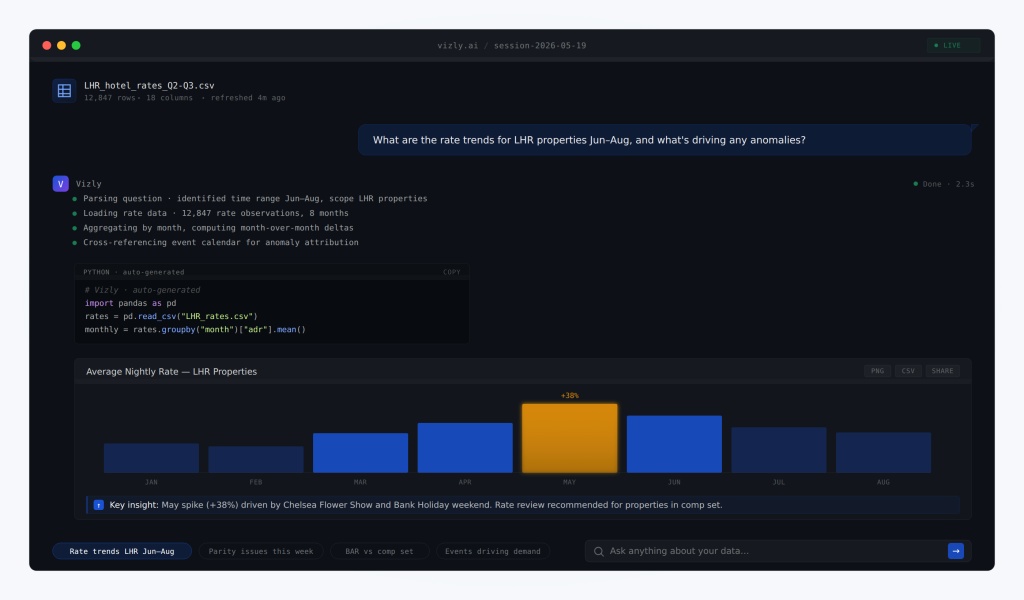
The current travel offering advertises specialist logic for taxes, fare families, channel differences, and hotel rate definitions, with Vizly access included in every data subscription. That is the differentiation it proposes against a general-purpose chat interface: commercial context built around the datasets being examined. Buyers should still test the answers against records and definitions before using them to make pricing changes.
One ownership detail matters here. Older company descriptions include StorTrack, ListSelfStorage, and RVParkIQ. Green Street acquired those platforms in July 2026. They belong in Aggregate Intelligence’s history, while its current website centers on airline, hospitality, and car rental data. A portfolio description needs a timestamp just as much as a fare does.
A useful habit to steal
Travel pricing teams can consider Aggregate Intelligence alongside alternatives such as RateGain’s AirGain; hospitality teams also have specialists such as Lighthouse. Another option is building collection and normalization internally. The sensible comparison is coverage, freshness, offer detail, integration effort, and total operating cost. A polished chart tells you little about whether the underlying observations answer your particular question.
The habit worth copying is to begin with the decision. Define the customer scenario, compare equivalent offers, and choose the update frequency that scenario requires. Then decide whether the answer belongs in a dashboard, an API, or a conversation. Aggregate Intelligence’s product history keeps returning to those choices. A price becomes useful when someone knows precisely what it means.