A bank spots a suspicious transfer. An insurer prices a storm. A hospital predicts which patient may deteriorate overnight. The interesting part is not that a model can produce a score. Plenty can. The expensive part is everything around that score: finding clean data, documenting the model, checking for bias, deploying it, watching it drift and explaining the result to a regulator or a person who was denied something important. SAS has spent half a century turning that unglamorous middle into a business.
The company began far from the current AI carnival. In the late 1960s, researchers at North Carolina State University needed a better way to analyze agricultural experiments. Anthony Barr designed the original architecture; Jim Goodnight built statistical features; John Sall added programming muscle; Jane Helwig wrote documentation ordinary users could follow. By 1976, the software had close to 100 institutional customers and its first user conference had drawn more than 300 people. The four left the university and incorporated SAS Institute with four employees.
Its first commercial asset was about 300,000 lines of code. On punch cards, that meant roughly 150 boxes - a stack more than 40 feet high. The physical absurdity is useful. SAS was never merely a friendly charting tool. It was a system for carrying heavy analytical work, first on room-sized computers and eventually across clusters, clouds and containers.
Survival required expensive acts of self-disruption. SAS moved beyond mainframes to minicomputers in the 1980s, then began rewriting the entire system in C in 1987 so it could follow customers onto new hardware. It adapted products for the web in the 1990s, bought specialist companies in the 2000s and introduced Viya in 2016. The pattern was not to abandon the installed base. SAS built a bridge wide enough for old workloads and new infrastructure to travel together. That patience helped retention, but it also created the modernization burden Viya must now carry.
The product is the decision, not the dashboard
The modern center of SAS is Viya, a cloud-native platform that connects the data-and-AI life cycle. Teams can ingest and prepare data, explore it, build statistical or machine-learning models, validate them, deploy them into live systems and monitor what happens. Business analysts get visual interfaces. Developers can work in SAS, Python or R. Administrators get lineage, permissions and audit trails. Executives get the part they actually wanted: a repeatable decision inside a process.
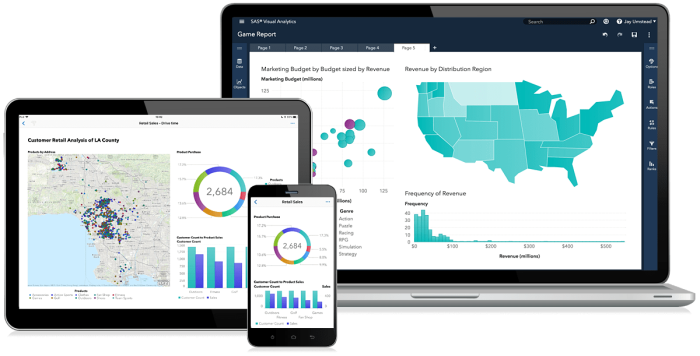
That final step explains the customer list. SAS is common where a wrong answer is costly and a mysterious answer is worse: banking, insurance, government, health care, manufacturing, telecom and life sciences. Deutsche Kreditbank says it makes real-time fraud decisions in 50 milliseconds. Georgia-Pacific says it can deploy thousands of models within minutes. Ford Motor Credit has used SAS since 1977. Newer work stretches from Liverpool FC fan marketing to manufacturing digital twins built with Epic Games technology.
SAS does not have to beat open source at being free. It has to beat it at being defensible.
Why pay when Python is free?
This is the uncomfortable question. A competent team can assemble Python, R, Jupyter, Airflow, Kubernetes, MLflow, a warehouse, a BI layer and cloud services into a formidable stack. Databricks and Snowflake cover large parts of the data and AI workflow. Microsoft, AWS and Google wrap tools in their own clouds. Power BI and Tableau have broader mindshare for everyday visualization. IBM, Oracle, SAP and Qlik remain enterprise alternatives.
SAS charges for reducing the seams. Enterprise contracts are usually quote-based; the number depends on users, workload, deployment and infrastructure. Viya also has user-based annual licensing and pay-as-you-go cloud offers. One current UK government marketplace configuration lists a hosted Viya service at £487.94 per user per month. That is not a universal price, but it makes the trade visible: customers are buying an integrated operating model, support and accountability, not cheap charts.
The model works best when several constituencies must share one governed system, old SAS code still matters, data cannot freely leave an environment, or decisions must be monitored after deployment. It works poorly for a small team doing low-stakes exploration, a startup that can tolerate stitching tools together, or an engineering organization whose open-source platform is already mature. In those conditions, SAS can be more platform than problem.
A private company learns to share the stack
For decades, SAS behaved like a self-contained software republic. Its Cary campus, large R&D budget and direct customer relationships reinforced the instinct to build and control. Cloud changed the map. Customers wanted SAS beside their existing data, not at the center of a separate universe. Viya became the bridge: cloud, hybrid or on-premises; SAS code beside Python and R; deployment through Microsoft Azure, AWS and Google Cloud.
The sales engine changed with the architecture. SAS now counts more than 1,400 partners across 96 countries. Partners influenced 65 percent of new software and hosting sales in 2025. Microsoft supplies marketplace distribution, Fabric integration and Azure OpenAI technology for Viya Copilot. AWS hosts managed services. Accenture, Deloitte, EY and KPMG help enterprises implement the software. The lesson is almost comic in its simplicity: interoperability became a go-to-market strategy.
The deal that disappeared
SAS's private ownership has been part shield, part personality. In 2021, reported talks for Broadcom to buy the company at a value between $15 billion and $20 billion ended without a deal. SAS said it was not for sale and soon announced a path toward IPO readiness. Five years later, it remains private. There is no neat public confession about what changed anyone's mind. The observable result is more useful: SAS kept control while forcing itself to adopt the financial discipline and recurring-cloud posture public investors would expect.
In 2025 the company reported more than $3 billion in annual sales, more than half from outside the United States, and another profitable year. It also expanded Workbench for developers, synthetic data through technology acquired from Hazy, industry models and early Viya Copilot capabilities. In 2026, the pitch moved toward governed agents and a Model Context Protocol server that can expose Viya capabilities to AI assistants while keeping execution inside controlled workflows.
The chicken camera that never shipped
One small story explains more about SAS than a campus tour. A team once proposed using cameras and AI to detect disease spreading among chickens. Goodnight reportedly stopped the idea with one question: how much would the cameras cost? Farmers would not pay. The technical demo may have worked. The product failed first at the customer's budget.
That instinct is copyable. Start with the whole workflow and its economics, not the model. Price the sensors, migration, human review, monitoring and retraining. Ask who owns the decision when the system is wrong. Build the smallest governed path into production. SAS itself uses this logic in its move from giant platform deployments toward lighter industry models, marketplace consumption and copilots embedded in existing tools.
- Copy the customer test: calculate the full cost of acting on an insight before celebrating model accuracy.
- Copy the migration bridge: let old code and new tools coexist long enough for customers to move safely.
- Copy the governance default: make explanation, approval and monitoring part of the workflow, not a slide for later.
- Skip the formula when stakes are low: integrated control is wasteful if a notebook and a careful analyst solve the problem.
Trust has to become a product
SAS's culture is usually described through benefits: flexible hours, on-site daycare, health programs, family leave and a green North Carolina campus. The more important mechanism is Goodnight's belief that creative employees who are not distracted or exhausted make better software and take better care of customers. A 1985 memo put users at the top of the organization chart. The perks were meant to support that operating idea, not substitute for one.
The same distinction now faces its AI strategy. “Trustworthy AI” can become soft corporate wallpaper. It becomes a product only when a bank can trace a credit decision, a government can audit a fraud flag, a model owner can see drift and a human can stop an agent before it acts. SAS has the right history and customers to make that case. It also carries half a century of software, skills and procurement habits that can make change slow.
At 50, SAS is neither a nostalgic language vendor nor a shiny AI startup. It is a profitable enterprise software company trying to turn its oldest habits - statistical rigor, customer support, regulated-industry expertise and control of the full decision path - into an advantage for a more autonomous era. If AI agents become common in high-stakes work, the boring layer around them may become the valuable layer. SAS has been waiting there for decades.