The company now called Lighthouse began with a hotel room that looked too cheap. During the London Olympics in 2012, three Belgian founders - Adriaan Coppens, Matthias Geeroms, and Gino Engels - searched for accommodation and found availability and prices below what the occasion seemed to warrant. If one of the largest demand shocks in travel was not showing up cleanly in room rates, what exactly were revenue managers looking at?
Coppens started collecting competitor pricing and pulling it into one place. That became OTA Insight, a cloud rate-shopping tool that let a hotel see how its rooms compared with the market. The first sale took roughly a year. The wedge was narrow, but the pain was broad: hotel teams had important signals scattered across booking sites, property-management systems, spreadsheets, and reports that were stale by breakfast.
“It all started at the summer Olympics in London in 2012, with my two co-founders.”Gino Engels, co-founder
The first thing that failed was the rear-view mirror
A hotel room is perishable inventory with a midnight deadline. If it goes empty tonight, nobody can sell it twice tomorrow. The old playbook leaned heavily on last year's bookings and manual checks of nearby hotels. That works until behavior changes quickly. Mobile booking, last-minute cancellations, short-term rentals, and proliferating online channels made the market twitchier. Then the pandemic made historical patterns almost comic as predictors.
That disruption changed the value of the product. A dashboard describing yesterday was useful; a forward-looking view of searches, events, live rates, availability, and a property's own booking pace was operational. Lighthouse added Market Insight and Revenue Insight around the original Rate Insight product, then Parity Insight to catch the moments when a third-party seller undercut a hotel's direct rate.
Today the platform is aimed at nearly everyone who makes money-moving decisions around a property: the revenue manager setting rates, the regional leader comparing a portfolio, the owner of a small inn who cannot hire a specialist, the marketing team trying to drive direct bookings, and the destination organization watching an entire market. Lighthouse says it profiles 16.4 million hotel and short-term-rental listings daily. The practical product is not the pile of data. It is the shorter distance between a signal and a decision.
Competitor rates
forecast
Convert direct
Performance data flows back into the next decision. Lighthouse's bet is that this loop works better when one data layer connects every step.
What $370 million buys
In November 2024, KKR led an approximately $370 million Series C, following $20 million in 2017 growth funding and an $80 million Series B led by Spectrum Equity in 2021. Lighthouse said the new money would support product development, acquisitions, and global expansion. It also reported more than 700 employees and an NPS above 70. The round was less a rescue than an acceleration of a rollup already in motion.
The purchase prices were not disclosed. The strategic bill is easier to read. Lighthouse is buying missing pieces between knowing and doing. Its subscription platform now spans pricing, performance, distribution, direct booking, data services, and commercial consulting. Customer prices are generally quote-led, with demos and selected free trials rather than a universal public rate card.
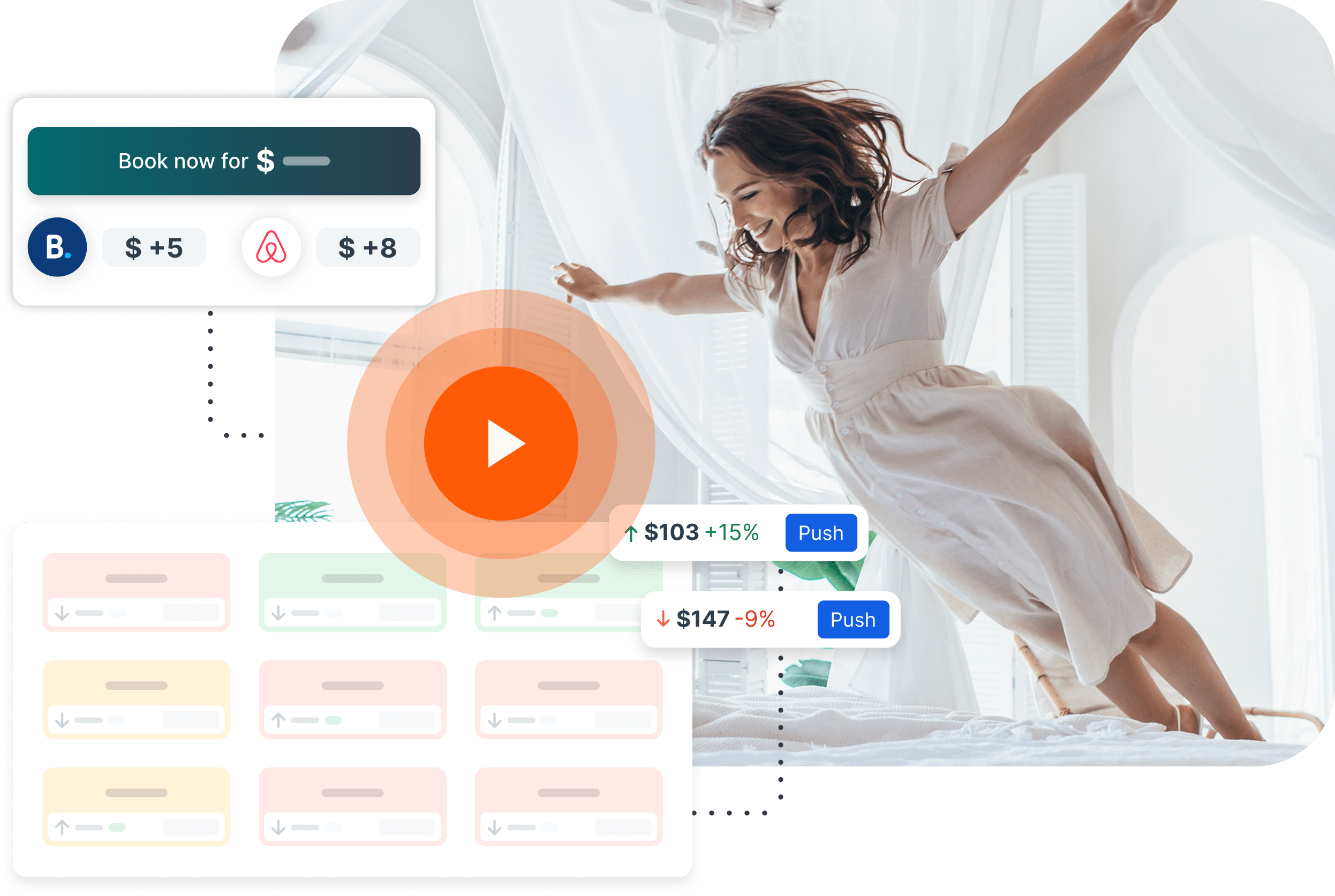
That breadth becomes concrete on a Tuesday morning. Lighthouse Pricing can flag a surge in searches and show how nearby hotels have reacted. Performance can reveal whether the property's own pickup is keeping pace. Distribution can push a new rate and restriction across selling channels. Direct can personalize the hotel website for the visitor who arrives. The pieces are sold for different teams and property types, but the intended result is one continuous commercial record instead of five versions of the truth. For independent operators, the suite also reaches into payments and reservation management. For chains, the emphasis shifts toward portfolio comparison, permissions, and reports that do not require every property to email another spreadsheet.
This is also where Lighthouse differs from a conventional revenue-management system. An RMS is usually strongest at calculating and recommending price from property and market inputs. Lighthouse surrounds that calculation with a large external data layer and adjacent workflows. A hotel can still pair it with an RMS through an integration. The ambition is not merely to win the pricing algorithm; it is to become the context in which pricing, distribution, and marketing choices are made.
One platform, two very different hotel problems
A global chain and a 24-room inn may buy from the same company for opposite reasons. The chain has specialists, but too much fragmented data. It needs consistent competitive sets, portfolio rollups, controls, parity monitoring, and integrations with existing systems. The inn has no dedicated revenue department. It needs the machine to watch demand, recommend or push rates within guardrails, synchronize inventory across channels, and prevent the owner from spending an evening updating extranets.
Lighthouse says one manual pricing decision can take 16 minutes from research through channel updates. Its Pricing Optimization uses live demand, room availability, competitor prices, events, occupancy, pickup, and booking patterns. Owners choose competitors, set minimums and maximums, and decide whether to turn on autopilot. In a company study of 84 properties across six continents, users averaged a 21 percent increase in revenue per available room. Treat that as vendor-reported evidence, not a universal promise.
The business model is recurring B2B software, supplemented by data feeds and commercial strategy services. The comparison set changes by job. RateGain and STR compete for intelligence budgets. IDeaS, Duetto, and BEONx compete in revenue management. Cendyn overlaps in commercial tooling. SiteMinder and Cloudbeds cover distribution and operations - and also integrate with Lighthouse. Hospitality software is less a tidy boxing match than a ballroom where partners keep stepping on one another's shoes.

The new shelf is an AI answer
The 2023 name change from OTA Insight to Lighthouse admitted what the product had become: online travel agencies were no longer the whole frame. By 2026, the company was pushing the frame wider again. Connect AI is designed to make a hotel discoverable, accurately described, and directly bookable inside AI travel interfaces. The Hotelrank.ai acquisition added measurement: where a property appears in answers, which attributes models associate with it, how it compares with rivals, and whether the booking link goes direct or to an intermediary.
That move is coherent with Lighthouse's oldest question. In 2012, the mystery was why hotel rates did not reflect Olympic demand. In 2026, it is why an AI recommends one hotel and ignores another. Both are distribution puzzles hiding inside data. Lighthouse also introduced Ernest, a conversational workspace meant to answer questions across connected pricing, performance, distribution, and direct-channel data. The pitch has moved from “here is the dashboard” to “here is the next action, with the evidence attached.”
The moat is not a prettier chart. It is the closed loop from market signal to price, channel, booking, and measured result.
What operators can copy tomorrow
Borrow the method, even without the software
- Choose a real competitive set by location, quality, guest type, room, and reputation - not whichever neighbor is cheapest.
- Combine three views before changing price: forward demand, competitor rates, and your own pickup or occupancy.
- Write guardrails first. Decide floors, ceilings, channel costs, and exceptions before automation starts moving rates.
- Close the loop. Measure whether the decision improved occupancy, average rate, revenue per available room, and direct share.
The useful lesson is restraint. If three comparable hotels charge $120, $134, and $155, the answer is not automatically $119. A property with stronger reviews, breakfast included, or a better location may belong above the median. Competitive intelligence should improve positioning, not erase it.
When the system will not work
Automation is brittle when property data is dirty, room types are mapped badly, the chosen competitors are irrelevant, integrations lag, or a thin market supplies too little signal. It also fails culturally when a team treats a recommendation as authority rather than a testable decision. A machine can spot a concert announcement; the hotel still knows the west wing is under renovation.
The wager behind the check
Lighthouse has moved from a clever rate-shopping wedge to a wide platform with the usual wide-platform risk. Each acquisition adds capability and another integration seam. The clean demo is one commercial brain; the messy reality of hotel systems can still be legacy property software, inconsistent data, local practices, and people who like their spreadsheet because it has never surprised them.
Yet the direction is hard to dismiss. Hotels do not need more observations. They need fewer gaps between seeing an opportunity and acting on it. Lighthouse's $370 million bet is that the company owning that decision loop will matter more than the vendor owning any single dashboard. The Olympic room rate was only the opening clue.