Snowfall is an unusual item to put in a shopping basket. At The Charleston Place, the attraction called Let It Snow was free. Yet visitors still needed to book. The hotel needed to know who was coming. And someone needed to make the whole thing run without turning the concierge desk into a small, unhappy ticket office. This is the sort of problem Way has chosen to solve.
- Way puts experience booking inside a brand’s own website and digital channels.
- Its business connects guest-facing polish with inventory, payments and reporting.
- Hotels came first; airline loyalty and luxury-brand partnerships have widened the brief.
The snowfall with a balance sheet
The Charleston Place became independent in 2022 and wanted programming that gave guests and locals a reason to visit. Way supplied tools to create, market and manage those offerings. Its case study reports more than 50,000 snowfall bookings across the 2022 and 2023 holiday seasons and a $1 million-plus year-on-year lift in total holiday revenue.
That distinction matters. Total hotel revenue includes more than experience tickets. The case study describes programming as a contributor; it does not isolate a software effect. The useful idea is broader: a free attraction can bring people into a place where other spending happens. Admission is only one possible source of value.
The Charleston Place, 2022 to 2023 · Way case study
Way occupies the space between the appealing idea and the completed reservation. A hotel may know exactly what makes its location special. Turning that knowledge into a bookable offer, then keeping the calendar and the accounts straight, is a different skill.
The voucher was the warning
At Turtle Bay on O’ahu, the problem had a wonderfully unglamorous form: handwritten vouchers. A vendor would lead an experience, submit an invoice, and leave hotel staff to reconcile the transaction and post it into the property management system. The beach could be immaculate while the paperwork quietly accumulated.
Way’s published case study describes replacing that workflow with connected bookings, guest records and vendor payouts. Guests could book before arrival and charge experiences to their rooms. The resort reported a 75%-plus increase in experiential revenue and a 180%-plus increase in transactions for experiences moved to Way. These are customer results presented by the vendor, rather than a controlled comparison.
Here, the first thing to strain was the administrative process. The lesson for an operator is to inspect what happens after someone clicks “book.” Availability, guest records and payment reconciliation are part of the experience too, even if nobody photographs them.
A cabana changed the definition
Founded in May 2020 by Michael Stocker and Jake Luster, Way initially offered Host, a tool for experiences delivered by local partners and staff. The proposition suited hotels with distinctive surroundings and people who could interpret them. A guided outing could become part of the hotel’s identity.
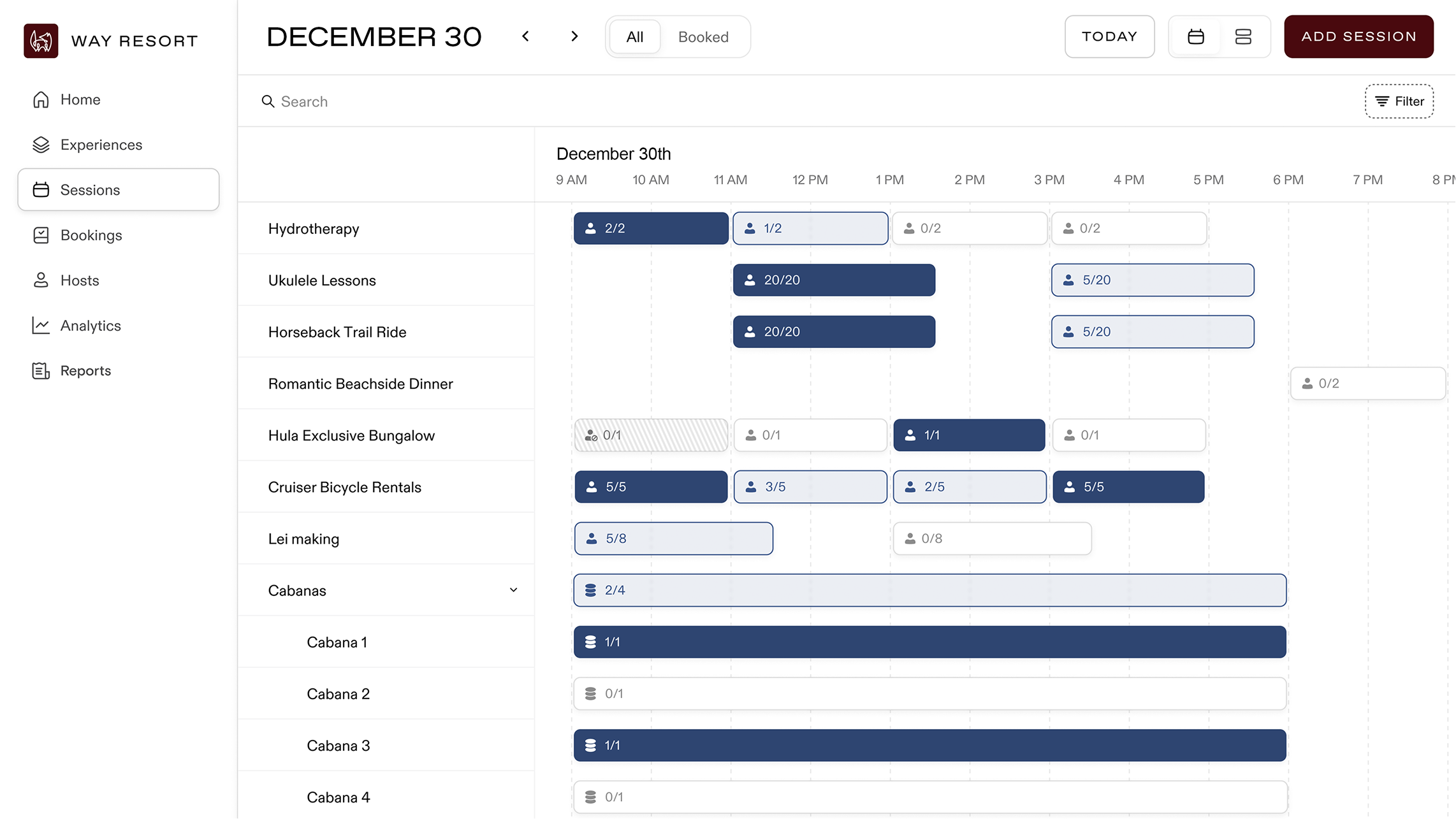
Customers stretched the definition. In a March 2024 post, Stocker explained that the company had learned how differently brands understood “experiences.” A locally led workshop, a ticketed show and a recurring cabana rental could all belong in the same strategy. They did not all need the same operational tools.
Activate and Reserve, launched in March 2024, addressed events and resource-based offerings. The current Core Platform brings creation, merchandising, inventory and reporting together. Its expertise lies in connecting these workflows while preserving a client’s visual identity. Open APIs let enterprise teams build their own interfaces and connect internal systems.
Offer + availability
Branded booking
Inventory + payments
Reporting + feedback
Who pays for the afternoon?
Way sells to businesses: hotel groups, resorts, independent properties and, increasingly, other consumer brands. It announced a $20 million Series A led by Tiger Global in November 2022, at a reported $100 million valuation. That valuation belongs to the funding announcement, rather than today’s balance sheet.
The commercial model includes software subscriptions and transaction fees. Under public brand terms updated in May 2026, embedded payments for customer-hosted experiences carry a 3.1% charge plus $0.30, with separate provisions for Mexico and foreign exchange. Subscription amounts sit in customer orders. A hotel’s calculation therefore has to include both platform costs and the expense of delivering its program.
TOURISTS, a Massachusetts motel, illustrates another way to fund that delivery. Way’s case study describes a $15 nightly art and adventure fee supporting complimentary programming. Workshops included block printmaking and Japanese mending, alongside outdoor activities. The property also reported that streamlined operations let its programming director move from a full-time to a part-time role.
“We were limping along before Way.”Tracy, quoted in Way’s TOURISTS case study
Competitively, Way’s pitch is consolidation. Separate ticketing, activity-booking and resource tools can divide the guest journey and the staff’s attention. Way puts more of that work together. Its June 2024 AZDS integration went further, combining experiences with RevRaise room booking in one transaction.
Points acquire a social life
By August 2025, the buyer could be an airline. Alaska Air Group selected Way to power Atmos Rewards Unlocked, giving Alaska and Hawaiian customers access to more than 100 experiences at launch. Members could redeem points and participate in points-based auctions, within an interface carrying the airline’s brand.
That month, Way also announced a Hyatt collaboration spanning hundreds of hotels and resorts. Its platform and APIs connect property websites, Hyatt’s app and World of Hyatt FIND. The same infrastructure can support everyday amenities and occasions worth planning a trip around. Loyalty supplies a reason to return; experiences give those points something tangible to buy.

The idea machine still needs a host
In January 2026, Way announced Curation Lab, Loyalty Sync and Partner Exchange. Curation Lab combines AI, brand identity and proprietary experience data to suggest programming. Loyalty Sync connects experiences to membership mechanics. Partner Exchange helps brands find collaborators and distribute co-created offerings. Each addresses a different question: what to offer, whom to reward, and who else can help.
The practical lesson is to start with an experience people can deliver, make it visible before arrival, and measure its wider contribution. That could mean ticket revenue, staff time or visitor spending. Surveyed enthusiasm is useful, but it is not a repeat booking.
Way’s terms leave delivery with customers and hosts. A weak activity remains weak after a beautiful checkout. The software earns its place where there is worthwhile programming, dependable availability and enough coordination to justify a common system. The guest gets the afternoon. Someone still has to organize it.