The awkward thing about a hotel room is that it cannot wait. A bookshop can sell yesterday’s unsold novel tomorrow. A hotel cannot sell yesterday’s empty bed. Once midnight passes, that particular opportunity has gone. Consider what this does to the person setting room rates: every decision comes with a clock attached, and the clock is largely indifferent to how attractive the lobby looks.
TravelClick made a business out of that predicament. Its tools help hotels understand demand, distribute rooms, attract shoppers, complete reservations, and keep in touch after checkout. Amadeus paid $1.52 billion for the company in 2018. The interesting question is what, beneath the familiar language of hotel software, was worth buying.
- See ahead: Demand360 examines reservations for future stays.
- Sell everywhere: iHotelier connects inventory with booking channels.
- Win the checkout: websites, advertising, and booking tools work together.
- Bring guests back: guest profiles and communications support repeat business.
A room with a deadline
Imagine a hotel whose September reservations look disappointing. That single observation permits several explanations. Perhaps the whole market is quiet. Perhaps competing hotels are filling up while this one falls behind. Perhaps demand is arriving through travel agents the sales team has overlooked. Each explanation calls for a different response. Cutting the rate before knowing which explanation is right is a rather expensive way to express uncertainty.
That is the attraction of forward-looking intelligence. Demand360 draws on participating properties to show booked demand for future dates, including competitive comparisons. Amadeus currently describes a twelve-month view. These are reservations already made for future stays; they are not a promise that every room will remain booked or that tomorrow’s demand is settled. The distinction matters when a hotel decides whether to pursue a group, hold its price, or advertise a quiet period. Explore Demand360’s demand view.
The company had two beginnings
A December 2000 company release traces the predecessor, Global Marketing Services, to 1996. It describes a Bain Capital investment partnership in 1999, followed by the change to TravelClick. That helps explain the different birthdays in later company profiles. The business was rooted in digital media and travel data, with products for the distribution systems used by travel agents. Its founders, Richard W. Gray and Ray Cohen, later handed the chief executive role to Robert Post in 2005. Read the contemporary account of the early business.
The company’s subsequent history is a history of adding connections. It bought channel-management provider EZYield in 2011. A 2016 executive interview described staff deliberately placed in local markets to understand a hotel’s particular concerns. The expertise included the unglamorous questions: which agencies matter, which months look weak, and which distribution channels deserve attention.
“We have people in market purposely because we want to understand what is going on.”Michele Gordon, TravelClick regional director of sales, in a 2016 PhocusWire interview
Three products, three different jobs
For an independent hotel or a mid-size chain, the reservation infrastructure is iHotelier. Its central reservations system manages rates, availability, and bookings across channels. Its booking engine handles the shopper on the hotel’s website. A useful distinction: a reservation system answers commercial questions about selling rooms; a hotel still needs the operational systems appropriate to running the property.
Demand360 supplies the market context. Agency360 addresses another audience: hotel salespeople trying to understand travel-agency business and identify prospects. Rate360 was TravelClick’s competitive rate-shopping product. These functions are related, but a competitor’s advertised price, an agency’s booking activity, and a hotel’s future occupancy are different pieces of evidence.
The rest of the portfolio makes that evidence usable. Website services and search optimization help a property get found. Digital advertising, GDS media, and metasearch reach shoppers in different settings. Guest Management Solutions organize profiles and communications, including marketing emails and loyalty activity. The current Amadeus iHotelier Suite lets hotels assemble a combination around their goals. The commercial appeal is the connection between tasks that a hotel might otherwise hand to separate suppliers.
The booking engine was already there
One King West Hotel & Residence in Toronto illustrates why a functioning tool does not finish the job. The hotel had used iHotelier for years. Its next problem was the balance of bookings across channels and its reliance on online travel agencies. It worked with Amadeus’ media team on paid search and display campaigns, using booking-window and length-of-stay information to shape packages and promotions.
Amadeus’ initial case reported 16% growth in direct bookings and 57% higher revenue per direct booking. A later, separate account reported $1.5 million in additional revenue in 2024. These are vendor-reported customer results, from different accounts and periods, rather than figures to combine into one spectacular percentage. They show what the team changed: the use of booking information to guide acquisition, rather than simply the presence of a booking engine. Read the original One King West account.
The broader idea had appeared in TravelClick’s 2017 Media Intelligence Platform. It brought iHotelier, Demand360, and Rate360 information into campaign planning. If a future month was underperforming, advertising could respond. If the pricing relationship changed, the message could change with it. A media budget becomes more useful when it knows which room nights need help.
Sometimes the trouble is at checkout
At San Francisco’s Handlery Union Square Hotel, the intervention was different. The property wanted more website visitors to book and more guests to buy enhancements. During beta testing, traffic was divided between the existing and new iHotelier booking engines. That comparison gave the hotel a way to examine the booking experience itself.
The published Handlery case reported a 25% increase in direct booking conversions and a 125% increase in ancillary revenue with the new engine. Reservations manager Kristy Doi said: “We were intrigued by Amadeus’ new integrated booking experience.” The test matters because it locates a possible bottleneck after the shopper has arrived. More advertising would send more people toward the same checkout. Improving that checkout asks a different question.
New iHotelier booking engine versus the existing engine in the published customer test. These measure different outcomes, not guaranteed returns.
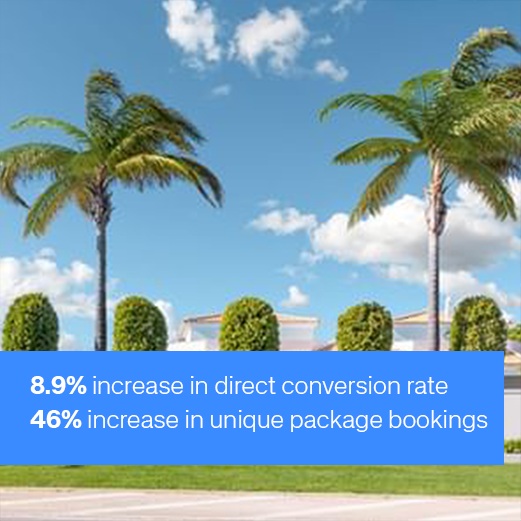
The Magnolia Hotel offers a smaller, equally concrete example: its case study reports 46% more unique package bookings and 8.9% higher direct booking conversions. Packages matter because a hotel can sell an experience as well as a room. The useful lesson is to examine the offer and the purchase flow together.
A billion-dollar purchase, and a hotel’s smaller calculation
By 2017, TravelClick had revenue of $373 million and EBITDA of $86 million, according to a Moody’s note published by Amadeus. Its appeal included independent and mid-size hotels, complementing Amadeus’ existing hospitality business. The October 2018 acquisition announcement described more than 25,000 customers in 176 countries. That is the scale at the time of the deal, not a fresh customer census.
Amadeus’ financial reporting puts the closing on October 4, 2018, and the consideration at $1.52 billion. This was a purchase of the business, not a venture round poured into a startup’s bank account. Amadeus also reported €3.7 million of integration costs before tax in the first half of 2019. Connecting businesses has a cost even when connecting their products is the point. Amadeus’ acquisition accounting.
For the hotel customer, the calculation is more intimate. TravelClick’s business combines contracted software and services with advertising and distribution arrangements. Its published terms describe product-specific charges, integration fees, and metasearch models based on clicks or acquisition. A hotel should compare the entire cost of producing a booking. Direct business still consumes software, media, and staff time; the word “direct” does not repeal arithmetic.
The thing to copy is the sequence
TravelClick competes across several markets. SiteMinder, for example, offers channel management and booking tools; SynXis is another reservations and booking-engine family. A hotel buying a single function has a different decision from one trying to coordinate intelligence, advertising, reservations, and guest communications. TravelClick’s positioning rests on combining those jobs with hospitality expertise.
The copyable practice is to diagnose before spending. Check the market against the property. Inspect the channels bringing reservations. Test the purchase flow. Then adjust campaigns and offers, and measure what remains after acquisition costs. This is an editorial deduction from the cases, not a claim that every hotel should buy the same bundle.
The sequence needs conditions. Competitive comparisons need a relevant set of hotels. Automated communications need usable guest records. Connected products need working integrations and staff who will act on the information. A property facing little demand cannot manufacture a destination’s popularity by changing a button. The system asks for coordination as well as a software contract.
The product lineage continues inside Amadeus. In June 2025, Amadeus announced Advisor chat for Demand360, using Azure OpenAI to let teams ask questions of the data; Agency360 had received Advisor in 2024. The interface is changing. The commercial question remains familiar: which future room nights need attention, and what should the hotel do about them? The guest sees a room. Behind the price sits a chain of decisions made before arrival.
Explore Amadeus Hospitality · iHotelier reservations · Demand360 · Product terms · Advisor announcement · One King West’s 2024 results
Watch: Maximizing Direct Bookings webinar · Peak Season webinar with IDeaS and HSMAI
Follow: TravelClick on LinkedIn · Amadeus Hospitality on LinkedIn · X · Facebook · News and insights