The room has not moved. The bed is the same. Yet somewhere online, the price has acquired a life of its own. A traveler sees a cheaper offer through a booking site, another sees different terms on a phone, and the hotel’s own website suddenly looks like the expensive option. For the person responsible for revenue, this is a detective assignment disguised as a pricing problem.
Fornova sells the tools for that assignment. Its software checks how rooms appear across online travel agencies, hotel websites and comparison services, then helps teams investigate discrepancies and compare their position with competitors. The commercial premise is simple: setting a rate is only the beginning. Hotels also need to understand how that rate reaches the customer.
The company’s website says it monitors 1.25 billion rates a month across more than 72 countries. Those are Fornova’s own figures, but they explain the scale of the task it is selling. Nobody is going to reproduce that exercise with a browser, a spreadsheet and a particularly strong coffee.
The price depends on where you stand
Fornova’s distinctive emphasis is the view from the guest’s side of the transaction. A revenue manager checking a property from the office may miss offers shown in another country or inside a mobile app. The company’s technology gathers those different views and makes them available for comparison. Geography and device become part of the evidence.
Its Competitive Intelligence product, FornovaCI, lets hotels select source markets, compare up to 15 competitors and examine rates as far as 365 days ahead. It also considers visibility on booking and metasearch sites. That matters because an attractive price buried down the results page has a different commercial value from an attractive price somebody actually sees.
- 01ObserveCountry + device
- 02MatchRoom + terms
- 03PrioritizeSize + frequency
- 04ResolveAct + recheck
Distribution Intelligence, FornovaDI, turns the lens back onto the hotel’s own selling network. It monitors direct and indirect channels, including sellers outside the hotel’s contracted relationships. Property teams can investigate locally while a chain can look across clusters, regions and brands. Integrations with Booking.com and Expedia extranets also help reveal participation in promotions and loyalty programs.
Fornova occupies a competitive category. Lighthouse offers parity monitoring and evidence about discrepancies; RateGain also sells rate-shopping and parity tools. Finding a cheaper listing is therefore an entry requirement. The useful buying questions concern which markets and devices are covered, whether equivalent offers are matched correctly, and how much work remains after an alert arrives.
When the bargain cannot be booked
One of Fornova’s more revealing product stories involves an investigation technique that stopped fitting the problem. Test reservations could help trace discounted inventory leaking through wholesalers. But what happens when the suspicious bargain cannot be reserved at all?
In August 2022, Fornova described customers reporting more misleading metasearch offers: unavailable rooms, links arriving at the wrong hotel, prices that gained extra charges, or packages that lost an advertised inclusion. A completed booking was an awkward tool for an offer that vanished before checkout.
The company responded by expanding its wholesaler intelligence team and the platform used by its agents. The new work involved documenting the discrepancy, classifying the issue, recording the market where it appeared and assembling screenshots for claims to metasearch services. The change was practical: follow what the traveler actually encounters, including the point where the advertised deal falls apart.
There is a useful lesson here for anyone investigating online sales. Save the journey, not just the opening price. Two screenshots can describe very different products if one includes breakfast, flexible cancellation or taxes and the other does not. An alert becomes useful evidence only when the comparison survives those details.
Less staff, fewer clicks
The same year, Fornova confronted a less glamorous problem: the people reading the data had less time. In a June product interview, Alina Povolotsky explained that pandemic layoffs and labor shortages had left smaller commercial teams. The answer was a redesigned Distribution Overview page that brought complementary metrics together.

“commercial teams were desperate to save as much time as possible”Alina Povolotsky, Fornova product interview, June 2022
The page paired a Distribution Health Score with Revenue at Risk, a dollar estimate intended to help users choose which problems deserved attention. The calculation considered how often the hotel lost a price comparison, the size of the difference and the property’s room count. This is a prioritization estimate, not cash already missing from the bank.
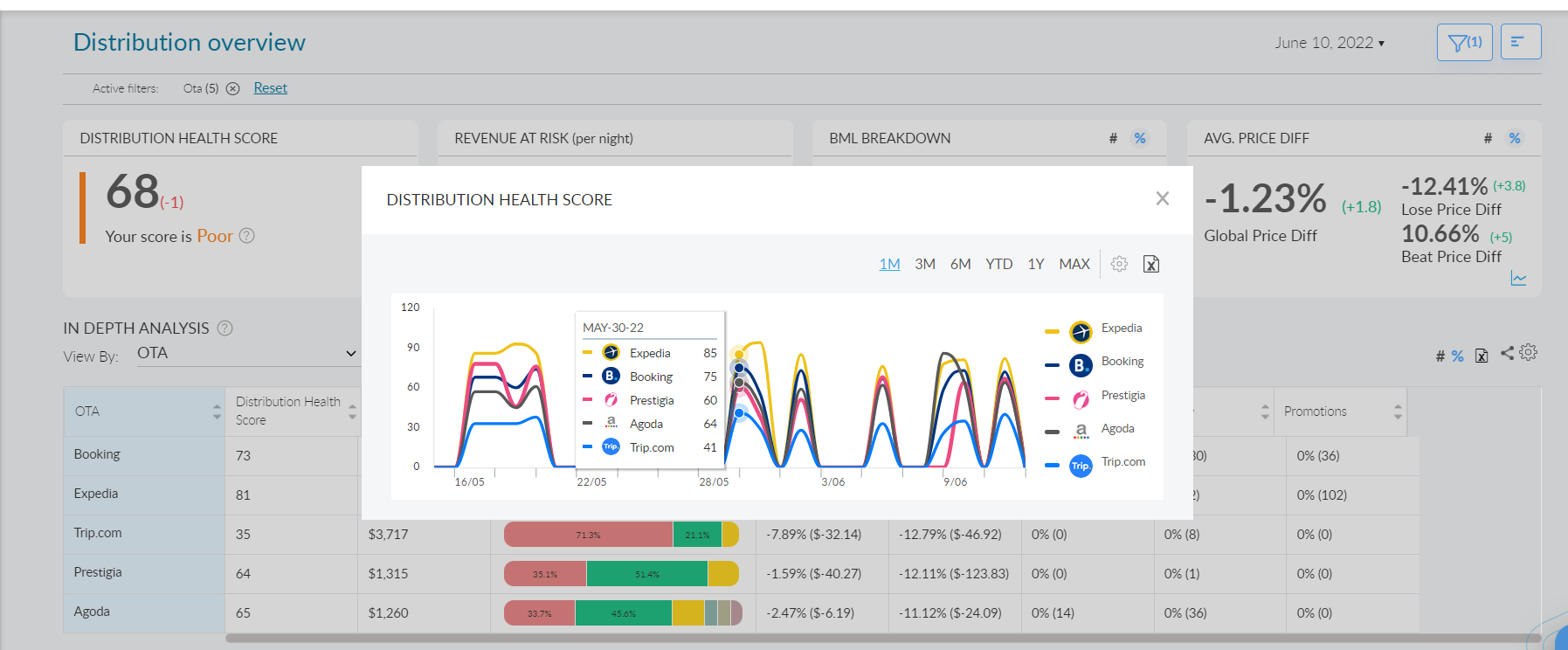
Flexible filtering addressed another irritation: users exporting raw data to manipulate it in Excel. The redesign suggests a sensible standard for business software. Measure the distance between noticing a problem and doing something about it. A richer database can still produce a slower morning.
From the shopping window to the booking ledger
Fornova dates its founding to 2010. Public histories identify Michael Rubanovich, Dmitry Babitsky and Dori Stein as co-founders, combining technical and commercial roles. Stein led the company through much of its documented expansion. Its stated ambition was to help travel businesses improve distribution, generate demand and increase revenue through better information.
The funding followed that ambition. In May 2017, Fornova announced a $17 million Series B led by Deutsche Telekom Capital Partners, alongside Waypoint Capital and JAL Ventures. The announcement said the money would support sales, marketing and product development. It also reported more than 13,000 hotel users at that time.
In March 2019, Fornova acquired HotelsBI. The strategic logic was to connect outside-market intelligence with the information accumulating inside a hotel. A revenue team might know a competitor’s price yet still need to understand its own booking pace, cancellations or guest mix. The acquisition broadened the questions Fornova could help answer.
A further $7 million round that September was led by A/O PropTech, with existing investors participating. It came with a planned design partnership involving A/O’s portfolio of 150 hotels. The proposed arrangement gave software development a practical testing ground and offered the investor fresher operating information than historical reports.
Today’s Revenue Intelligence product describes dashboards that combine hotel-system data, pickup analysis, segmentation and scheduled reports. A manager can break performance down by market, room type or booking source. Its value depends on reliable inputs and on someone turning the findings into a decision about rates, promotions or inventory.
The work behind a 20% lift
Fornova’s E-Commerce Optimizer takes those decisions into marketing. Its published capabilities include dynamic advertising content, changing inventory and budget allocation, and using live rate information in campaigns. This is where rate intelligence becomes a question about spending: which rooms deserve promotion, to whom, and at what price?
A 2021 company case study offers a concrete example. Decameron Hotels & Resorts, described as operating around 9,000 rooms across Latin America and the Caribbean, had relied on traditional distribution channels and wanted a stronger direct relationship with guests. Fornova’s work included testing messages and images, improving Google listings and building ads that updated with rates and offers.
Reported improvement in conversion over a few months.
A customer-specific result, not a forecast for another hotel.The reported conversion increase was 20% over a few months, alongside a reduction in cost per booking. Treat the result as a vendor-published customer account. The transferable part is the work: test the creative, keep the offer current and connect marketing activity to booking outcomes.
Fornova’s business runs on paid subscriptions, with services and fees defined in customer order forms. Campaign activity adds its own economics: software fees, media spending and the staff effort needed to investigate or implement changes. A hotel evaluating the purchase should compare those costs with the value of resolved problems and demonstrable incremental bookings.
Platform dependence complicates that calculation. Fornova’s published marketing still describes Google Pay Per Stay, a commission-based offer. Google deprecated commission-based Hotel Ads bidding on February 20, 2025. That older proposition belongs to its period; it should not be read as an unchanged purchasing option today.
A distributor hires the detective
Fornova also works beyond hotel commercial departments. Its OTA product analyzes competitor prices, packages and inventory, while Mobility Intelligence applies similar techniques to rental-car pricing and fleet availability. The expertise travels because each market has the same underlying difficulty: an offer changes as it moves through channels.
The November 2025 WebBeds partnership makes that breadth tangible. The travel distributor announced plans to implement Fornova Distribution Intelligence, combining rate monitoring with defined responsibilities, escalation paths and automation. The announcement identified David Samuel as Fornova’s chairman and CEO.

The interesting detail is the buyer. A distributor has its own reasons to want cleaner pricing and fewer channel disputes. Fornova’s opportunity reaches into the machinery connecting hotels with travel sellers, where a discrepancy can require several organizations to cooperate before anything changes.
For a reader considering the software, that is also the operating condition to remember. Monitoring helps when comparable data is available and a team has the authority to act. If nobody owns the partner conversation, or the booking data is unreliable, another score will do little. Start with a defined set of properties, dates and source markets; check the matches; assign the fixes; then measure what changed. The hotel room may stay exactly where it is. The revenue work happens everywhere else.
Continue the investigation
Explore Fornova · Company blog · LinkedIn · Twitter / X · Facebook
The WebBeds announcement · Dori Stein’s 2021 interview · Watch: FornovaDI demo (2021) · Watch: Decameron customer story