Consider a hotel with no room for you. You like the photographs. You can almost taste breakfast. Then you enter your dates and the booking screen runs out of answers. Somewhere nearby, a sister property might have exactly what you need. But you are already opening another tab. The hotel has paid to attract a customer whom its own software cannot help.
- TAG combines creative services with hotel booking, payments, and analytics software.
- ALBIE puts multiple properties, dates, and extras into one cart.
- Lark Hotels expanded its TAG relationship into distribution across 50-plus properties in 2024.
That hypothetical lost booking explains The Anything Group more clearly than its exuberant name. TAG sells marketing, branding, websites, public relations, and production. It also develops software. Its interesting wager is that the people making a hotel desirable should understand the machinery that turns desire into a reservation.
The camera and the checkout
Founder and CEO Rich Tuckwell-Skuda, now identified on TAG’s website as Rich Tuckwell, came through hospitality and technology. His company biography describes more than two decades in those fields and work at booking-technology business Avvio before its 2022 acquisition. The background matters: he approaches a campaign with experience of what happens after the click.

The creative work is concrete. In May 2024, the Caribbean Hotel and Tourism Association launched a rebrand and website developed by TAG. Its new mark put a spiral inside a starfish. In November that year, TAG announced renewed work producing highlight and recap videos for ESPN Events at four basketball classics, including the Champions Classic and Jimmy V Classic.
A tourism association needs an identity people recognize. A sports event needs footage while the excitement is fresh. A hotel needs a guest who actually books. TAG houses those assignments alongside software engineering, making its range unusually broad for a supplier a hotel might first encounter through advertising.
“Be a positive impact, or be no impact at all”Rich Tuckwell · published company biography
The booking that gets away
ALBIE, introduced in June 2024, is the clearest expression of that combination. The name expands to Advanced Learning Booking Intelligence Engine. It runs on hotel websites and lets travelers assemble rooms, activities, and services across properties and dates in one reservation. A stay can share a cart with a spa treatment or an airport transfer.
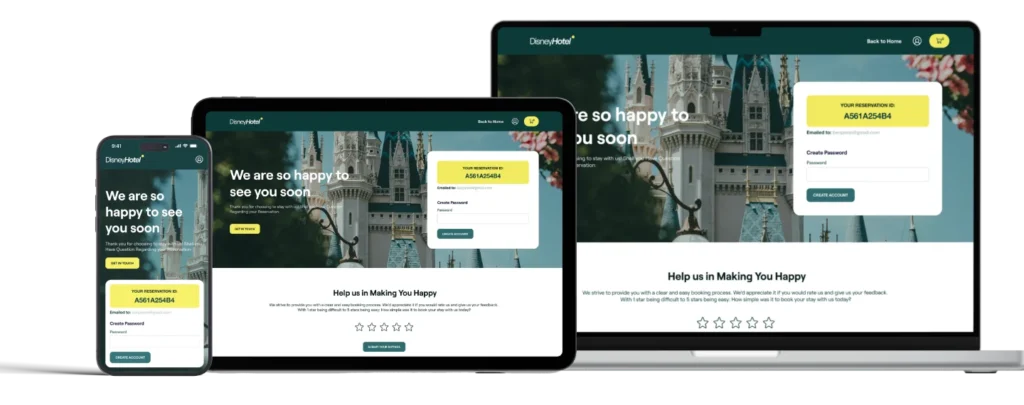
The smaller features reveal the thinking. If dates are unavailable, ALBIE can suggest nearby ones. A waitlist can notify someone when space opens. Group Recommendations offers another property in the same group. Each feature addresses a moment when a traveler might otherwise leave, while preserving an opportunity for the operator.
That approach changes the unit being sold. A traveler planning several stops has an itinerary; a conventional property search begins with one hotel and one date range. ALBIE gives the operator tools for more of that itinerary. Its appeal is strongest when a group has useful alternatives and bookable extras to offer.
- 01Dates full?
- 02Offer another stay
- 03Add experiences
- 04One checkout
Fifty hotels make the argument
Lark Hotels supplies a useful example of TAG’s broader role. In October 2024, TAG said its existing digital marketing and metasearch relationship would expand into supplying and implementing SiteMinder technology across Lark’s more than 50 properties. The announcement specified two years of integration and management.
TAG had just announced authorized reseller status with SiteMinder, whose channel manager powered its TILTAS distribution offering. Lark also chose Mews as its property management system. This was a marketing partner moving into distribution while working with established software providers. It demonstrates why TAG belongs between an agency and a hospitality technology supplier.
Its proprietary portfolio now includes RIKER, payment infrastructure built around operational requirements such as deposits and reconciliation, and Tagalitics, which brings advertising and analytics reporting into shared dashboards. For a hotel team, the attraction is having fewer separate conversations about where demand originates and what becomes of it.
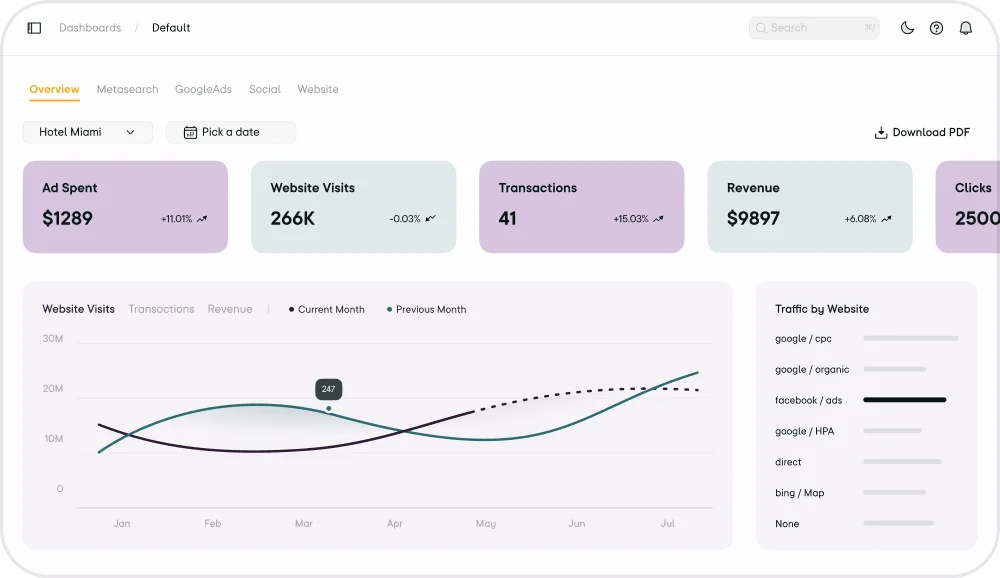
Buyers can enter through different doors. A hotel might need a redesigned website and paid-search management; a brand might commission photography or motion graphics. TAG also advertises property improvement plan management and space design. The breadth creates opportunities to expand an engagement, as the Lark announcement illustrates.
The price of keeping the guest
The business model combines service work, software, and resale. ALBIE’s original launch offer asked the first 150 clients for a $1,000 advance deposit and advertised a lifetime fee of 1.5%. Those were introductory terms. Its current pricing page directs buyers to a custom quote based on their operation.
Advertised lifetime fee in ALBIE’s limited June 2024 launch offer, plus a $1,000 advance deposit.
Tagalitics’ listed individual plan, checked October 2026. Rate-parity monitoring costs extra.
Tagalitics makes the subscription side visible: its pricing page lists $30 monthly for one client, $59 for up to five, and $99 for up to ten. Rate-parity alerts carry additional charges. Its pricing table also marks AI Insights as coming later at extra cost, a useful reminder to separate a dashboard available today from a feature on the way.
The commercial test requires arithmetic. Direct booking still has acquisition, software, payment, and staff costs. For an operator comparing TAG with a specialist agency or a separate booking vendor, the useful question is whether the combined arrangement improves retained revenue enough to justify those costs and the implementation work.
Try the impossible booking
There is a practical lesson here for anyone selling online. Try buying the thing your website cannot provide. Choose the sold-out date. Request two locations. Add an experience before choosing a room. Watch where the journey stops and who must rescue it. Those interruptions are a better starting point for a purchasing conversation than a feature checklist.
The conditions matter. Recommendations need accurate inventory and alternatives a guest would accept. Multi-property carts need coordinated availability and payment handling. Consolidated reports need dependable inputs. A standalone hotel with few extras may value different parts of TAG’s offering than a group selling several destinations.
In October 2026, TAG and Cendyn jointly published an argument for connecting hospitality systems. TAG’s own evolution gives that argument a tangible shape: creative work beside booking software, distribution implementation beside marketing. The promise is easy to understand. When a hotel earns someone’s interest, it should have a useful next answer.