Four months into a six-month advertising campaign, McDaniel College had a problem: applications had not increased. Its agency knew how to make big-name campaigns. According to Carnegie’s account, it knew less about higher education. Graduate enrollment director Kittie Pain sought a replacement. The interesting detail is what Carnegie tackled next: the website content that the college had repeatedly postponed.
- Carnegie joins college branding, recruitment, and admissions technology.
- Its tools connect student behavior with more relevant follow-up.
- The practical lesson: repair the handoffs before buying more attention.
Carnegie audited the site, updated program information, and targeted priority Maryland counties. The case reports improved engagement and more applications after launch. The lesson is familiar to anyone who has clicked an advertisement and landed somewhere confusing: the advertisement has only done the first part of the job.
A college has to answer a personal question
What is this place going to mean for me? That is the question beneath a college search. Carnegie’s business is helping institutions answer it across the many places a student encounters them. Its customers include public and private universities, community colleges, and institutions recruiting graduate, adult, and online learners.
A marketing department might hire Carnegie for a brand strategy or website. Admissions might need a recruitment campaign, financial aid modeling, or help configuring Slate, the relationship management software made by Technolutions. Institutional leaders can buy planning and student success expertise. Carnegie occupies the space where a creative agency, an enrollment consultancy, and a technology implementation team overlap.
It is a crowded neighborhood. EAB, Ruffalo Noel Levitz, EducationDynamics, and specialist agencies offer overlapping services. Carnegie’s particular proposition is coordination: research about an institution and its students can shape the creative work, the website experience, and the admissions follow-up within one engagement.
The brochure learns to listen
Consider Samford University. Carnegie used campus workshops, market perception studies, and student persona research to inform a campaign called “Realized.” A microsite let prospects explore academic offerings through their values and interests. Clarity, Carnegie’s personalization service, adapted website content using information such as location and browsing history.
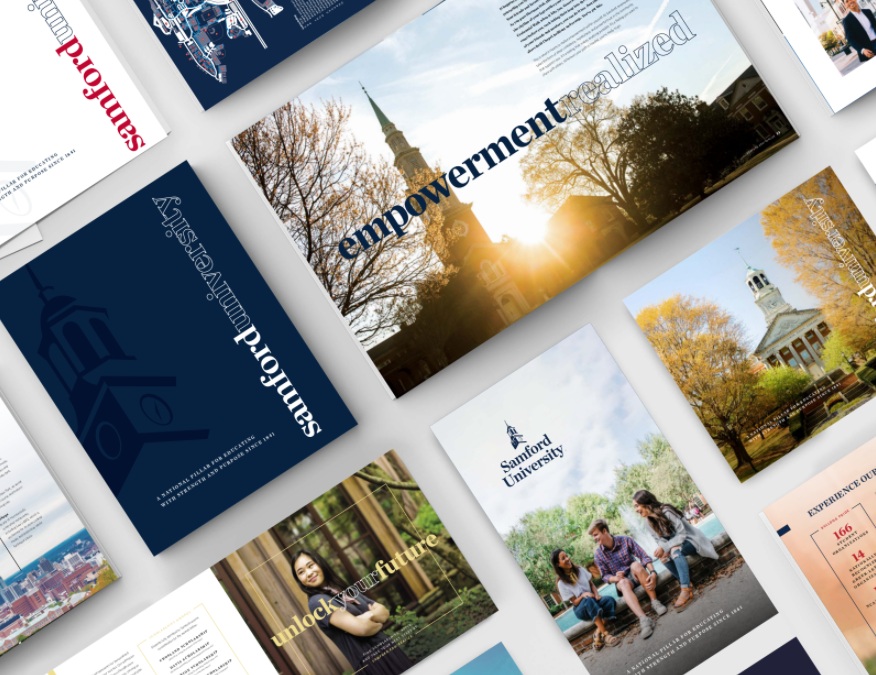
Carnegie reports 18% enrollment growth over five years and 43% lower student search spending across the partnership. Those figures describe the combined work and its context; they cannot isolate the contribution of a logo, a website prompt, or an email.
At Gettysburg College, the appeal was partly operational. Recruitment communications could be managed within the college’s own Slate environment. Dean of Admissions Gail Sweezey put it plainly:
“We love that everything is in Slate”
Gail Sweezey / Gettysburg College
The point is easy to overlook. A team can revise a message more usefully when the message and the response live within a system it can inspect.
Following the student before the form
The stranger in an enrollment database is the applicant who seems to arrive from nowhere. BlueConic’s account of its work with Carnegie describes these “stealth applicants”: people whose earlier website visits have not been connected to their eventual application. The apparent absence of a journey is a measurement problem.
Clarity combines website behavior with marketing and CRM data, using BlueConic’s customer data platform. Carnegie can then personalize content and examine which interactions preceded an inquiry or application. Its EnGauge service builds engagement scores inside Slate. These are different tools serving a related purpose: helping an admissions team decide where attention is needed.
- 01UnderstandResearch & motivation
- 02EngageCreative & website
- 03Follow throughCRM & admissions
At York College of Pennsylvania, Carnegie coordinated paid media, Slate student search, brand execution, and reporting. Its case study attributes 94% of deposited students to Carnegie campaigns. That demonstrates extensive recorded contact. It does not establish how many students would have deposited without those campaigns. A sensible buyer asks both questions.
The price is in the scope
Carnegie sells work to institutions through defined engagements. A real purchase offers more texture than a hypothetical subscription: Florida State College at Jacksonville’s September 2022 board agenda lists a $330,754 purchase order for media buying consulting services spanning awareness, leads, applications, and enrollment.
FSCJ media buying consulting services. A historical scope of work, not a current package price or an isolated agency fee.
For a buyer, the useful comparison is what the engagement includes: media, research, creative work, implementation, staff support, and measurement. A purchase order alone cannot tell you which arrangement another institution needs. It does show why enrollment marketing belongs in a discussion about institutional budgets and operating capacity.
From a magazine to the machinery
Carnegie’s history begins with Private Colleges & Universities magazine in 1985. Founder Joe Moore built a business around connecting colleges with prospective students. The 2018 merger with Dartlet brought brand research and creative strategy closer to marketing execution.
Capital accelerated the expansion. New Heritage invested in October 2020 and describes six subsequent add-on acquisitions. Shamrock Capital announced its investment in February 2024. Carnegie acquired Credo in 2025, adding institutional planning, leadership advising, and student success capabilities. Todd Zipper became CEO in September 2026, with AI innovation among the priorities in the announcement.
The expanding remit makes a practical argument: recruitment creates expectations that the campus must fulfill. Helping a student choose a college and helping that student persist are connected responsibilities. Bringing both into the business broadens what Carnegie can sell and what institutions can ask it to address.
Start with one broken handoff
The approach asks something of the institution. Personalization needs usable data and content worth personalizing. Admissions teams need the capacity to follow up. Carnegie’s scope provisions explicitly require data access for certain research services. Without it, some of that work cannot begin.
A reader can copy a smaller version: choose one audience, check the message it sees, inspect the page it reaches, and assign responsibility for the next response. Measure progress toward applications, deposits, and persistence. Carnegie’s proposition becomes most concrete there: a college promise carried through a series of ordinary, consequential interactions.