A customer-feedback app has an awkward problem: its customers have lives. They may admire the idea of helping a business improve. They may even download the app. Then dinner burns, the train arrives, or something considerably more interesting happens. A database built on spare goodwill can remain rather empty.
- HundredX pays participating causes for qualifying consumer feedback.
- Companies and investors buy intelligence about customer choices and competitors.
- The first app lacked enough data; the cause-funded model arrived in 2019.
The app that could not fill its database
HundredX founder Rob Pace encountered precisely that difficulty. His early app, Goodsnitch, published praise and sent complaints privately to businesses. A civilised arrangement, certainly. But the database never reached critical mass. In 2019, he pivoted to a model in which feedback generated funding for causes.
Investor Clark Hunt initially doubted whether people would participate meaningfully. Early campaigns for FC Dallas youth teams helped change his mind: two campaigns raised $350,000. The participants had a reason to finish that existed outside the screen.
The commercial proposition also became clearer. By 2021, reported customers included Viasat, First Republic Bank and the San Diego Padres. Annual subscriptions then ranged from about $100,000 to more than $1 million. Those historical prices place the business firmly in enterprise intelligence, far from the casual review app it once resembled.

An opinion with somewhere to go
Today, HundredX Causes recruits organizations that invite their supporters to comment on brands they use. Its site advertises payments of as much as $2 per piece of feedback. The supporter supplies time; the cause receives funding; HundredX obtains material it can turn into a paid product. Each party wants something different from the same small act.
The company reports more than $38 million provided to approximately 4,000 organizations. Its cause partners include Big Brothers Big Sisters Lone Star and Girls on the Run. This matters because the collection system is part of the product: a useful dashboard requires a continuing supply of people willing to tell it something.
Company-reported cumulative figure, October 2026
The exchange has rules. Current terms limit paid qualifying feedback to 75 submissions per person within a year, across programs. Campaign allocations can be capped, and incomplete, rushed or abnormal submissions can be excluded. Enthusiasm alone cannot make an answer useful.
HundredX aggregates and anonymizes feedback for data clients. Its privacy policy also describes personal information collected for administration and quality checks. The distinction deserves care: anonymized analytical output does not mean the collection process requires no personal information.
The customer who is about to leave
The central question is prospective: which brands will people use more or less, and why? A satisfaction score describes one aspect of a relationship. Future purchase intent asks where that relationship might go. HundredX combines these signals with customers’ explanations and comparisons across businesses.
Scout provides interactive dashboards for competitive monitoring. Users can examine purchase intent, satisfaction, brand relevance and Net Promoter Score, then filter by demographic characteristics, income or location. Searchable comments let an analyst investigate what sits underneath a number. A movement in a chart becomes a question worth asking.
Strategist addresses resource allocation, pricing power, customer migration and segmentation. Its full-wallet approach considers other brands customers use, opening questions about potential partners as well as competitors. For a strategy team, the attraction is a broader field of vision than its own customer list provides.
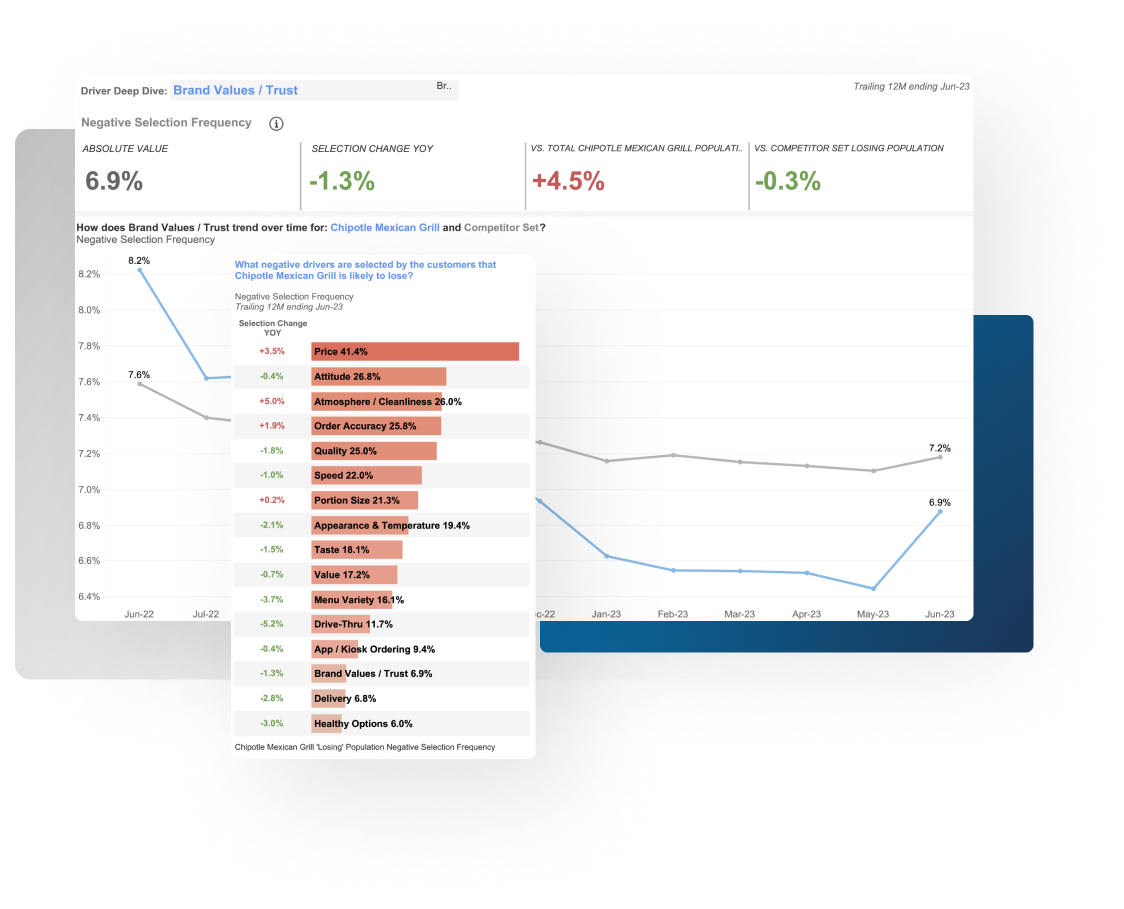
Summit adds tailored listening programs, advisory services and dedicated support, covering employees and other stakeholders alongside customers. The three offerings move from observing a market to examining strategic choices to helping an organization act. Their usefulness depends on the question a client actually needs answered. A team deciding whether to improve service, change an offering or pursue a different segment can use the tools to compare explanations. The discipline is to specify the decision first, then look for evidence that would change it. Otherwise, even a well-stocked dashboard becomes expensive wallpaper.
“HundredX has been one of the most impactful partners we’ve ever had at the Padres.”Erik Greupner, CEO, San Diego Padres
These are alternatives to commissioned research projects, internal surveys and other sources of consumer intelligence. HundredX’s distinctive combination is independently collected, cross-brand feedback with a cause-based incentive. The advantage is perspective. The limitation is familiar: stated intentions still need checking against what people eventually do.
Value has more than a price tag
Deloitte began collaborating with HundredX in 2024. An expanded multi-year agreement combines its insights with Deloitte’s Converge platforms and industry expertise. The announced applications include pricing, assortment and investment decisions. One unnamed big-box retailer was using the combined insights to investigate quality, value, selection and availability.
The companies also developed a More-Value-for-the-Price framework. Cheapness is an incomplete description of a bargain: customers weigh benefits against cost and alternatives. The Forbes 2026 Best Brands for Value list used that framework and 4.7 million pieces of feedback across more than 5,500 brands. Qualification required at least 500 responses over the preceding year.
That threshold illustrates a practical boundary. A sharply defined customer segment may look interesting while containing too little evidence for a confident decision. Leaders should examine coverage, time period and the relevant competitive set before turning an attractive chart into a budget.
The next listener may be a machine
HundredX now markets its human-verified data for AI recommendations, enterprise applications and post-training improvements. Structured signals supply comparisons; customer comments supply context. These are proposed uses of its data, rather than proof that every shopping assistant already depends on it.
The lesson readers can copy is the design of participation. Identify who needs the information, who can supply it, and what would make contributing worthwhile. Then test whether the incentive produces useful answers. HundredX’s history suggests that an elegant listening tool can struggle until somebody has a compelling reason to speak.