If your workday contains the phrase “channel check,” Tegus was built for you. The platform serves people who need to understand a company before the committee meeting, partner call or investment memo lands: hedge-fund analysts, private-equity associates, venture investors, bankers, consultants and corporate strategy teams. Its promise is practical. Search what operators have said, commission a fresh conversation, inspect the filings, pull a working model and keep moving.
That combination matters because company research is usually a desk covered in unrelated tools. The expert network lives in email. SEC filings live in another tab. The model is called final_v17_REAL.xlsx. A senior colleague remembers a useful call from last year but not who ran it. Tegus gathers those jobs into one workbench. It will not make the investment decision. It can make the scavenger hunt shorter.
Who should actually buy it?
Tegus makes the most sense when research is repeated, deadlines are expensive and a single useful answer can change a deal. A private-equity team screening several companies in a vertical can read previous customer, competitor and former-employee interviews before ordering new calls. A public-markets analyst can compare a management claim with expert commentary, then jump into the filing and adjust the model. A consultant can turn an unfamiliar category into a defensible primer without beginning from an empty search bar.
It makes less sense for casual investors, students or teams seeking live prices and execution. This is not a retail stock screener or a Bloomberg replacement in every dimension. The licensing is sold through a conversation, not a tidy checkout page. If your research needs stop at headlines, earnings multiples and a few annual reports, cheaper tools cover plenty of ground. Tegus earns its keep when the missing information lives in a person’s operating experience or in a stubborn footnote nobody wants to re-key.
The clever bit came before the chatbot
Twin brothers Michael and Thomas Elnick founded Tegus in 2017 after spending roughly a year talking with hundreds of investors about their research process. Their observation was less glamorous than artificial intelligence and more durable: investors repeatedly paid traditional expert networks for conversations that disappeared after one use. Tegus charged a membership for access to a shared library, arranged new calls at cost and, with customer and expert consent, transcribed those conversations for other subscribers.
That turned an interview from a one-night rental into institutional memory. The calls remained investor-led, so the questions tended to come from someone with a live thesis and a reason to press. Tegus screened experts before calls and reviewed transcripts afterward for confidential information and material non-public information. The resulting archive accumulated value every time customers used the service. One Reddit investor summarized the appeal neatly: they liked being able to set up calls or read earlier transcripts led by buy-side users.
How a conversation becomes research inventory
The economics were the provocation. Former Tegus president and CFO Bob Casey recalled investors paying traditional networks around $1,200 to $1,500 for calls while several funds often researched the same companies. Tegus’s current expert-call service says clients pay the expert rate, about $450 per hour on average, plus a flat $75 transcription fee, with time billed in 15-minute increments. That is separate from the platform subscription, whose list price remains private.
The archive is the product’s memory. AI is the new librarian.YesPress verdict
From transcript cabinet to research desk
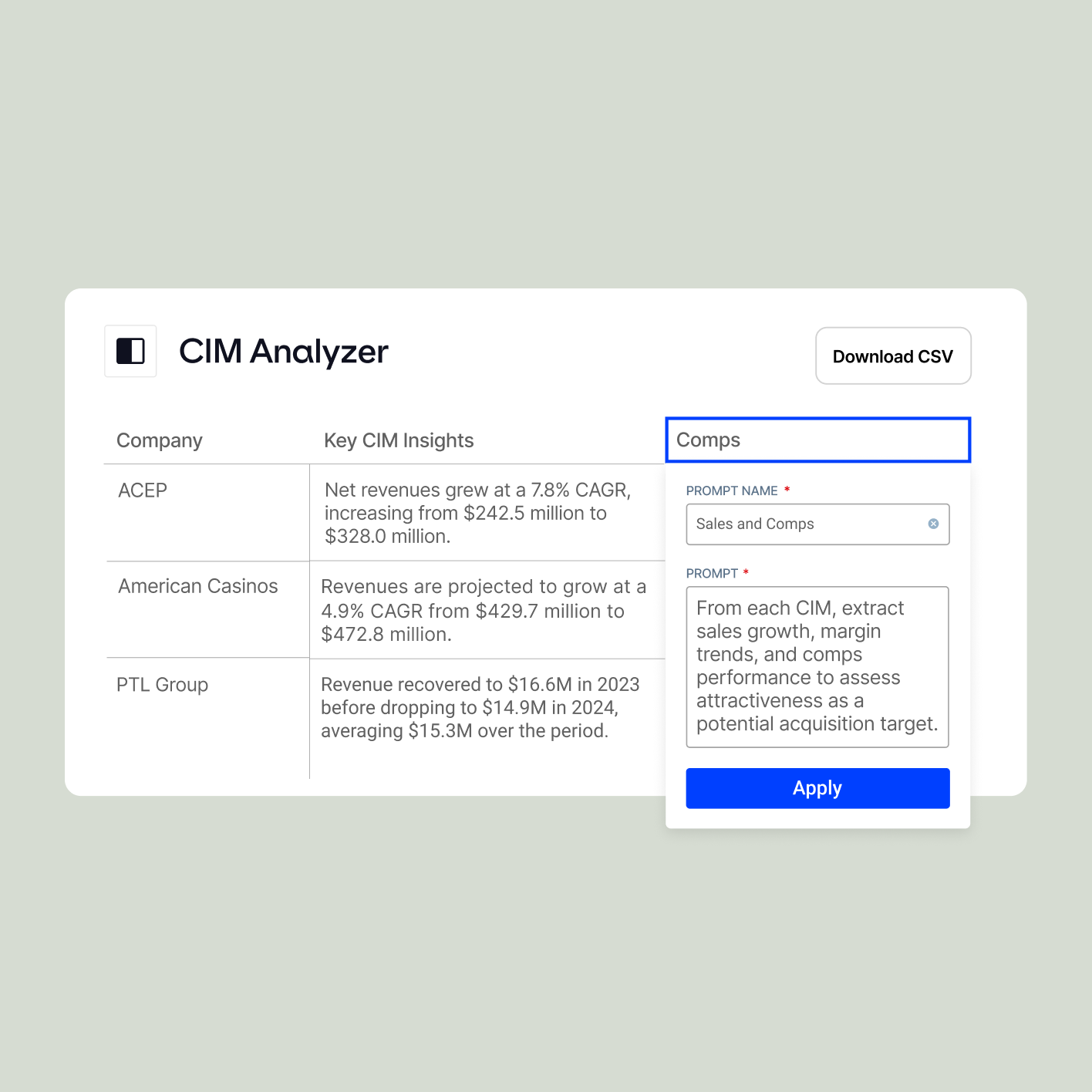
Tegus did not stay an expert-network remix. It bought BamSEC in 2021, adding the filing-search tool beloved by people who know the emotional cost of scrolling a 10-K. In 2022 it acquired Canalyst, whose analysts build editable models with historical data, company-specific drivers, forecasts and recurring KPIs. By early 2024, Tegus could pitch one place for expert interviews, SEC documents, earnings transcripts, non-GAAP figures, models, management primers and sector roundtables.
The Canalyst side is especially concrete. More than 4,000 models can be downloaded and changed, rather than admired as static datasheets. An Excel Add-In pulls Tegus data into a firm’s own workbook, refreshes it after a reporting period and lets the analyst trace a number back to its filing. That last step is not decorative. In investment work, speed is useful only while the audit trail survives.
AskTegus, with footnotes
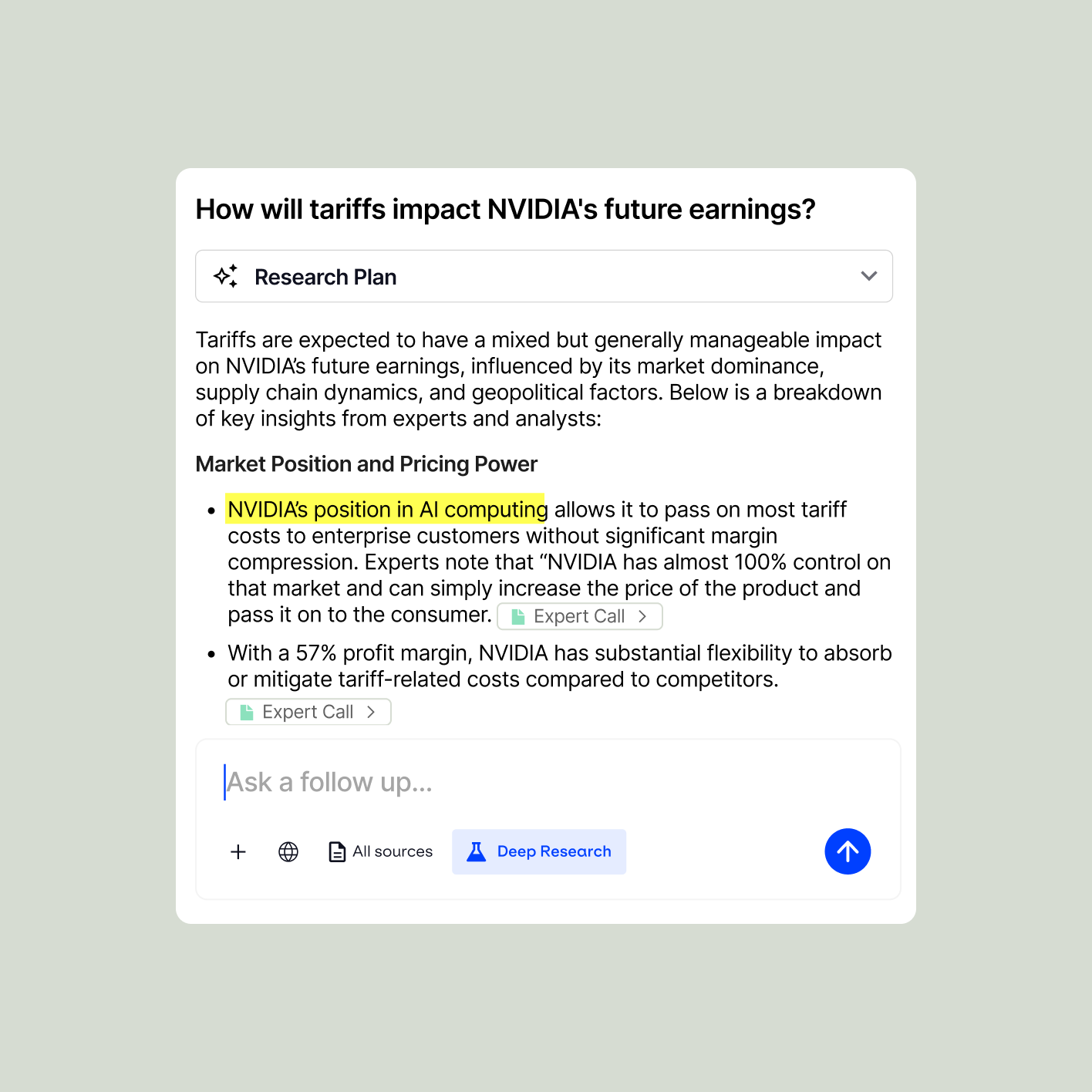
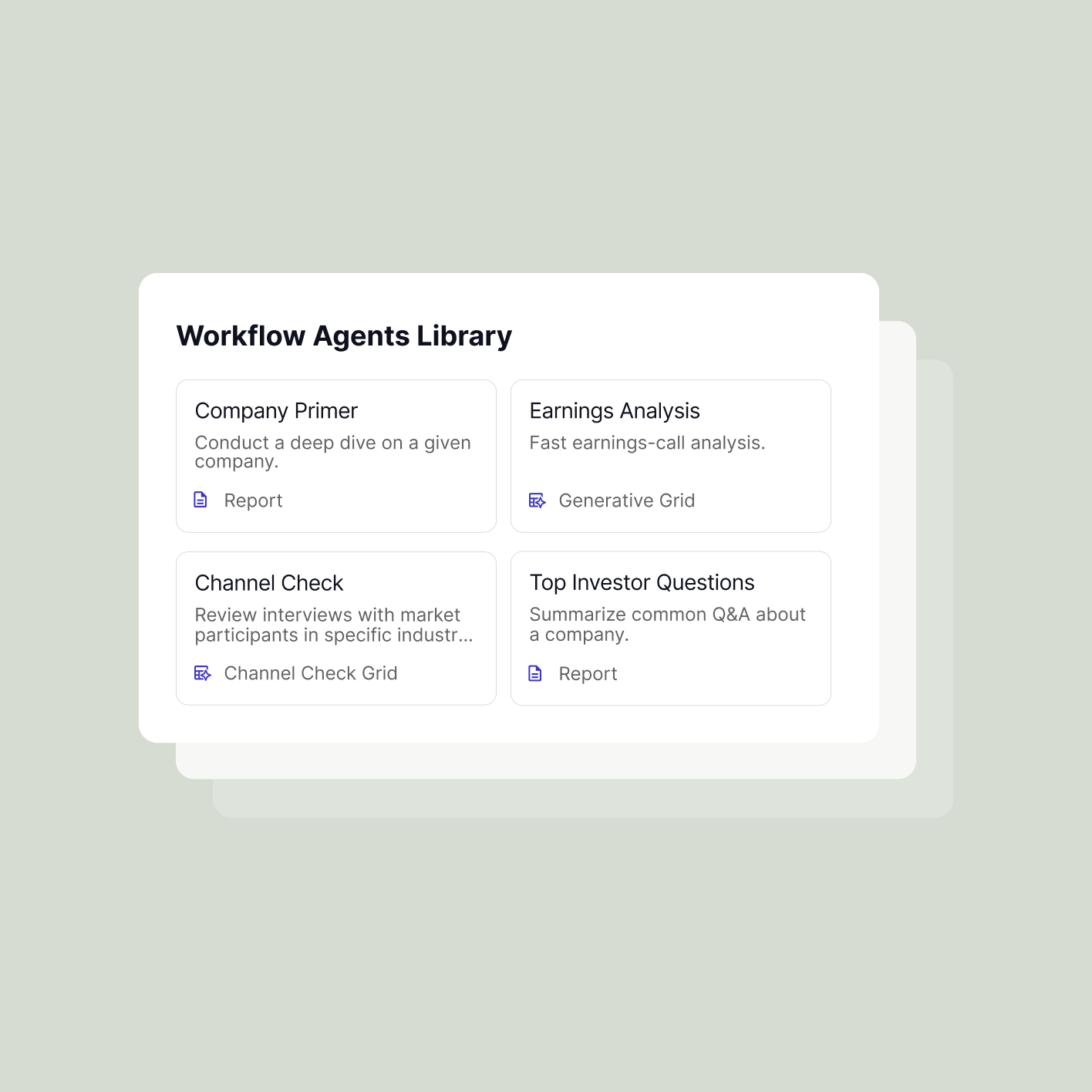
Tegus launched AskTegus in April 2024. It answers natural-language questions across the transcript library with summaries and citations, while Top Investor Questions identifies the recurring lines of inquiry around a company. The important design choice is attribution. A fluent paragraph without a source is dangerous in a diligence process; a linked passage can be checked, challenged and quoted accurately.
After AlphaSense completed its $930 million acquisition in July 2024, the library met a much larger search engine. The current Tegus site advertises more than 260,000 Tegus expert transcripts inside an AlphaSense universe of over 500 million documents and research from 1,500 broker partners. Deep Research can produce primers, competitive landscapes and pitch-deck material; generative grids compare many documents or interviews side by side; internal decks and notes can join the same search environment.
The newest twist is AI-led expert calls. AlphaSense now offers an AI interviewer as an extension of Tegus Call Services. Clients set the topics, the agent conducts and probes, and automated plus human review handles compliance afterward. AlphaSense says the service uses the same expert-rate-plus-$75-transcription pricing and that client inputs do not train the underlying model. This is still a young format. Even favorable expert feedback mentions occasional pauses and robotic gaps, which sounds about right for a colleague who never needs coffee.
What it does well, and what to interrogate
The advantage is breadth with a shared search layer. Expert perspectives explain why a metric moved. Filings show what the company disclosed. Models expose the assumptions. The platform lets a researcher travel among those forms without rebuilding context at every stop. Its transcript library is also proprietary, which gives its AI something more useful to chew on than the same public web available to everybody else.
The caveats are equally specific. Shared calls are shared. Another subscriber may read the same interview, so the library is a starting advantage rather than a private insight. Coverage will be uneven by company and geography. Expert testimony is anecdotal and can age quickly. AI summaries compress nuance. Compliance review lowers risk but does not turn a stranger’s memory into audited fact. Good users follow citations, compare several voices and order a fresh call when the thesis depends on current conditions.
| Need | Tegus fit | Also consider |
|---|---|---|
| Searchable expert interviews plus new calls | Core strength; large reusable library with call sourcing | Third Bridge, GLG, AlphaSights, Guidepoint |
| Filings and financial models | BamSEC workflows and Canalyst models live alongside transcripts | Capital IQ Pro, FactSet, Bloomberg |
| Private-company and deal research | Strong qualitative diligence and expanding AlphaSense workflows | PitchBook, CB Insights, Hebbia |
| Retail portfolio tracking or trade execution | Poor fit; designed for professional research teams | Consumer broker or portfolio app |
Pricing deserves a real procurement conversation. Tegus does not publish platform tiers, and access now sits inside the broader AlphaSense sales motion. Ask which content sets are included, how many seats the quote covers, whether old Tegus workflows remain available, what internal-content limits apply and how renewal increases work. Run a trial against an actual diligence question. Count useful sourced answers, not demo fireworks.
What users say
Public reviews split into two populations that should not be confused. Investor customers discuss the research workflow; participating experts discuss recruiting, scheduling, calls and payment. On the customer side, an IGSB managing director praised having models, filings, earnings calls and expert insight in one system. A Sands Capital partner argued that investor-led interviews produce more informed questions. On Reddit, one venture investor highlighted the choice between arranging a call and reading a previous buy-side-led transcript.
Recent expert reviews on Trustpilot repeatedly describe the staff as professional and responsive. One reviewer called the process “smooth and clear.” The criticism is useful too: experts sometimes want more context about the client or project, and some reviewers want better platform features or payment timing. G2’s review pool is tiny, so its score should not carry much weight. The better signal is consistent: Tegus works hard on the human logistics around an inherently awkward transaction between an anonymous buyer and a knowledgeable stranger.
A company built by listening, then bought for its ears
Tegus’s company history reads like a steady widening of the research loop. It raised a $90 million Series B in 2021, expanded to hundreds of employees across Chicago, Vancouver and Waterford, and ranked No. 100 on Deloitte’s 2023 Technology Fast 500 with reported growth of 1,480%. At the time of the AlphaSense deal, it had more than 100,000 transcripts and financial coverage of over 4,000 public companies. The acquisition price was far below the $3 billion valuation reported around its 2021 funding, a reminder that private-market marks are weather, not geography.
AlphaSense was once Tegus’s rival and had filed a patent suit against it before the purchase. The combination now makes strategic sense: AlphaSense brought broad market content and mature AI search; Tegus brought expert conversations, private-company texture and financial workflow tools. For buyers, the brand transition creates some naming fog, but the product logic is cleaner than the org chart.
The buying verdict
Tegus is for teams whose bottleneck is not access to more PDFs but the work of connecting what management filed, what operators experienced and what the model implies. Buy it when that loop repeats often enough to justify an enterprise contract. Skip it when you need quotes, charts and basic fundamentals. Most of all, treat the AI as a fast index with a writing habit. The citations are where the research begins.