Eighteen experts had something to say about pricing software. A small investment team had other things to do. In a case study published by Arbolus, the researchers collected video answers from all 18, then chose eight people for longer interviews. The company says the exercise avoided ten hours of calls. The result was a useful market overview and, perhaps just as valuable, a shorter calendar.
That modest scheduling victory explains a larger change at Arbolus. The London company grew by connecting people who needed specialist knowledge with people who possessed it. Now it wants investors to find useful customer evidence before anyone books a conversation. An expert network is becoming a data business, with the interview increasingly reserved for the question a database cannot settle.
The audience is specific: private equity investors assessing acquisitions, consultants researching markets, hedge funds and corporate teams. Its current emphasis is B2B technology. Think less about whether an app looks attractive and more about whether the people paying for business software intend to keep paying. A renewal decision can tell an investor rather more than a polished sales presentation.
The calendar was the bottleneck
Sam Glasswell and Will Leeming founded Arbolus in 2018 after working in the expert-network industry. Glasswell’s professional history includes six years at AlphaSights. They understood the trade: find someone with relevant experience, establish the fit, arrange access and help the client learn something useful. The difficulty was making that process serve more questions without multiplying the effort.

In the 2022 funding announcement, Glasswell called the traditional knowledge-sharing model “cost prohibitive to scale.” Arbolus raised a $15 million Series A led by Element Ventures alongside Fuel Ventures. It also launched Canopy that year. The product changed the format: researchers could send a question set and receive recorded answers without getting everyone onto a succession of live calls.
The pricing-software project, published in August 2024, shows the mechanism. The investor needed both a market overview and perspectives from senior finance people at selected companies. Arbolus says it gathered the 18 responses in eight days, with participants ranging from directors to CEOs. Video became a way to select the deeper conversations. The ten-hour saving was the company’s calculation for that engagement, rather than a universal productivity promise.
There is a practical lesson here for any research team. Ask a comparable set of questions across a group, inspect the differences and spend interview time on what remains unresolved. The method depends on a brief that people can answer without constant clarification. If every answer needs an immediate follow-up, a conversation may be the efficient choice from the start.
A library built for the buyer’s buyer
Canopy still begins with a fresh question. Customer Library moves the starting line earlier. Launched in 2025, it gives clients existing feedback about B2B technology companies, organized around matters such as annual spend, renewal intent, customer sentiment and competitive alternatives. A researcher can search a company, inspect comments behind a metric and decide which uncertainty deserves new fieldwork.
Consider an illustrative acquisition question: customers praise a software vendor, but will they renew after a price increase? A satisfaction score alone does not answer it. Spend, purchasing responsibility and switching considerations provide context. Arbolus’s proposition is to bring those details together so the investor can distinguish a happy user from someone who controls the budget.
The company currently advertises more than one million customer data points, more than 50,000 tracked technology companies and a community exceeding 200,000 experts. Those are different measures. A tracked company is not a promise of equally deep coverage, and a data point is not necessarily a complete review. The sensible first check is how much relevant evidence exists for the particular target.
In January 2026, the founders said most reviews were now being captured automatically through everyday operations. Their stated ambition was to put data at the center of the company, supported by products and services. The economic attraction is straightforward: collecting useful information once creates something that multiple authorized customers can consult. Arbolus gets more value from the research it already organizes.
“The traditional model for knowledge sharing lacks innovation and is cost prohibitive to scale.”
Sam Glasswell / April 2022 funding announcement
The call survives. Its job changes.
Arbolus sells several ways to pursue the next question. Canopy collects video and text responses, generates summaries and lets researchers compare answers by person or topic. Expert Calls provide the longer conversation, with custom sourcing when the existing community does not supply the right fit. Arbolus advertises searchable AI transcripts delivered within an hour of a call.
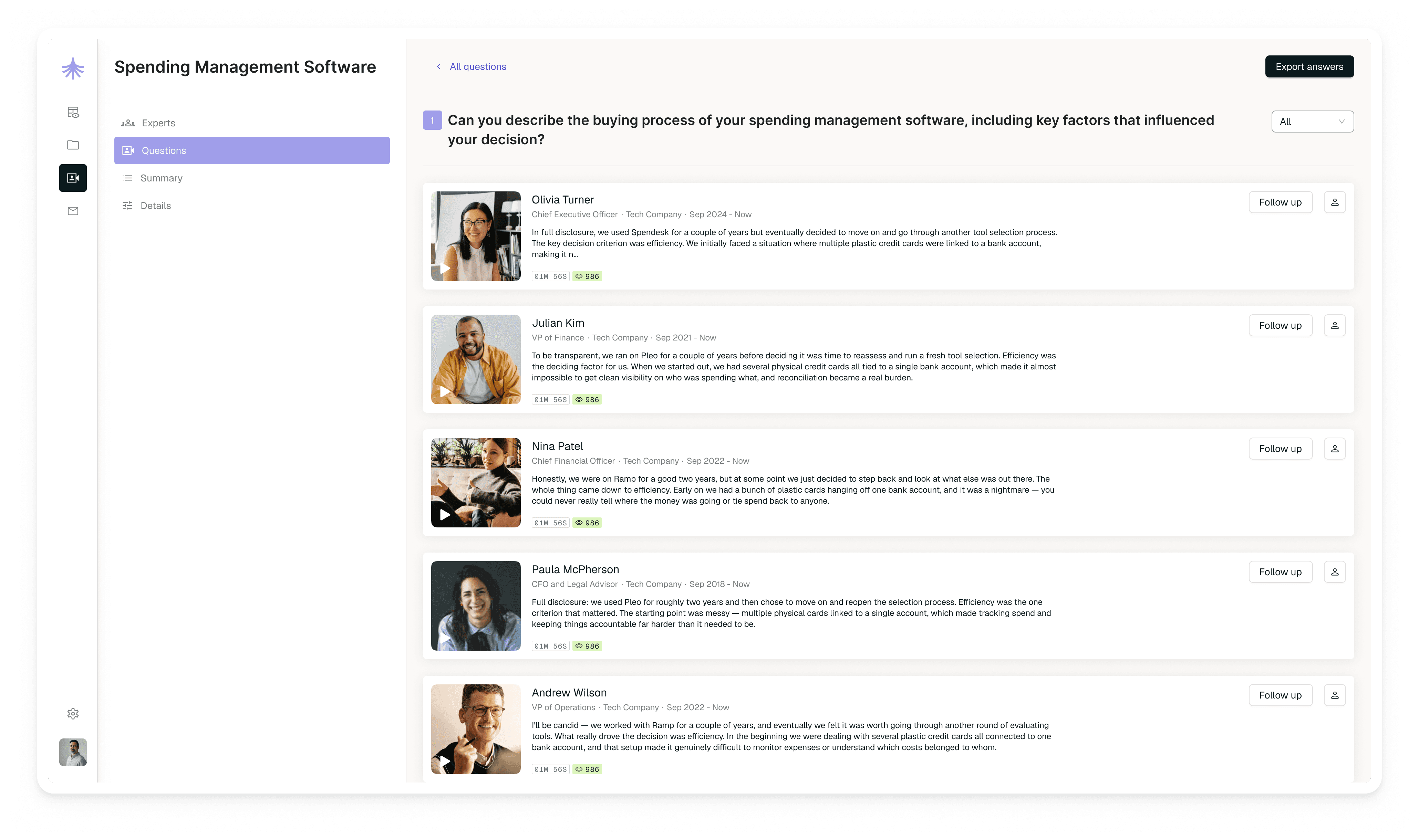
Surveys add a way to quantify a signal; recurring panels track how a chosen group’s views change. In a June 2024 application-security study, Arbolus says it supplied 124 respondents in ten days toward a consulting client’s 250-person requirement, alongside three other vendors. Its account describes recruiting through its network and then sourcing externally. The software still had a substantial people-finding operation behind it.
The integration products extend that approach beyond Arbolus’s own interface. Its API page offers access options for bringing customer intelligence and commissioned transcripts into internal research systems. Its MCP offering is marketed for querying licensed data through AI tools, subject to an active account and subscription allowance. The idea is to make the evidence available where analysts already work.
- ReadSearch existing customer evidence.
- CompareTest an open question across relevant experts.
- ProbeUse a live call to investigate the difference.
A route through the products, not a required sequence.
This puts Arbolus between established expert networks and customer-intelligence platforms. GLG, AlphaSights, Third Bridge and Guidepoint are alternatives for expert access. Arbolus also now publishes comparisons with G2, Gartner, TrustRadius and Capterra. Its chosen distinction is a diligence workflow built around customer evidence and follow-up access. Those comparisons express its positioning; they do not establish that competitors lack useful data or technology.
A funding headline with two kinds of money
Clients pay under agreed commercial terms for research services and data access. Arbolus’s terms distinguish commissioned work from the Customer Library, which clients license. MCP allowances depend on subscriptions. For buyers comparing proposals, the useful calculation is the cost of answering a defined research question, including any additional sourcing and conversations, rather than simply counting platform seats.
Experts enter through a different door. Joining is free. The website advertises potential consultation compensation of $200-$500 an hour, while the Rewards Programme offers earnings from eligible software contributions and client views. That advertised hourly range describes expert compensation, not the client’s bill. It also does not promise that any individual will receive a steady stream of engagements.
Building this system has required outside capital. Fuel Ventures and Plug and Play backed a $6 million round in 2021. The $15 million Series A followed in 2022. In November 2024, Arbolus announced a $20 million growth investment led by Kayne Anderson Partners Fund V, sub-advised by Composition Capital, to support American expansion and product development.
There is a revealing distinction in the paperwork. A 2025 Fuel Ventures prospectus describes a September 2024 transaction involving $5.5 million of primary investment and $15 million of secondary investment. Secondary purchases pay selling shareholders. The figures and timing differ from the company announcement, so the $20 million headline should not be read as a precise account of fresh cash available to spend. Nor should the two descriptions be added together.
The people behind the data
Arbolus’s culture has a more concrete illustration than its stated values of curiosity, sharing and autonomy. In a February 2025 employee interview, finance executive Harriet Hope described joining as financial controller in 2022, moving to Barcelona with her partner and cat, and becoming VP of Finance in 2024. She credited mentoring and room to build the function.
Her account also supplies the unglamorous details of a growing company: new reporting systems, an external group audit, debt refinancing and fundraising. These are the chores behind the product announcements. The founders’ January 2026 review acknowledged uneven progress, with growth in five of six operating zones, and emphasized tighter processes. The transition demanded operational work as well as software.

Useful evidence still needs a difficult question
The attraction of attributable research is that an analyst can examine the context behind an answer. It does not make a sample representative. A buyer at a large multinational may face different switching costs from a smaller customer. A panel rich in enthusiasts can miss dissatisfied former users. AI summaries make evidence easier to read, but the researcher still needs to inspect disagreement and omissions.
Arbolus’s compliance process includes question approval and reviewing Canopy responses for confidential information before delivery. Its platform terms separate licensed library insights from private client work. Those boundaries matter to a business promising reusable knowledge: permission to learn from professional experience is not permission to circulate every detail of a confidential engagement.
By July 2026, Arbolus had introduced a new identity to reflect its data-business direction. The harder test is practical. Can an investor find enough relevant customer evidence to ask a better next question? In the pricing-software case, eight conversations survived the first pass. That is a persuasive place to judge the product: the quality of the interviews that remain.