The company teaching machines to read the room
A new kind of customer intelligence platform, purpose-built for the agentic era. Trusted by CX, product and insights teams from the world's leading enterprises.
Every business swears it listens to customers. Then the reviews pile up in one place, the support tickets in another, the survey scores in a third, and the tweets nowhere anyone reads. Somewhere in that mess is the answer to the only question that matters - what should we fix next - and for most companies it takes weeks to dig out. Chattermill was built by two engineers who found that wait unbearable.
Founded in London in 2015 by Mikhail Dubov and Dmitry Isupov, Chattermill is a customer experience intelligence company. In plain terms: it reads everything your customers say about you, everywhere they say it, and turns the pile into something you can act on before the quarter ends. The two met through Entrepreneur First, the deep-tech programme that pairs technical founders who don't already know each other, and started with a hunch that deep learning had finally gotten good enough to find signal in messy human feedback.
Dubov, a Cambridge graduate who had worked as a software engineer at AlphaSights, took the CEO seat. Isupov became Chief Strategy and Insights Officer, the role that keeps the product honest about what real research teams actually need. Their opening move was not a survey tool - there were already plenty of those - but the layer that reads the surveys, and the reviews, and the tickets, all at once. That distinction, analysis rather than collection, still defines the company a decade on.
01 / The problemA billion things customers said
Consider the scale a company like Uber or HelloFresh generates. App store reviews in dozens of countries. Support conversations in dozens of languages. Post-delivery surveys, NPS prompts, social posts, refund requests. Individually, each is a shrug. In aggregate, they are a roadmap - if you can read them all and, crucially, compare them.
The hard part isn't storage. It's comparability. A one-star review in Tokyo about a confusing filter and a support ticket in Berlin about the same confusing filter need to land in the same bucket, or the pattern stays invisible. This is the unglamorous problem Chattermill set out to solve: not counting feedback, but understanding it consistently at scale.
02 / The engineMeet Lyra, the model that only does one thing
At the centre of the platform is Lyra, Chattermill's proprietary AI engine. In an era where every startup claims a proprietary model, Lyra's pitch is specialisation: it is trained for one job, customer experience, and it combines three techniques rather than betting on any single one. Aspect-based sentiment analysis pulls apart a sentence so "the app is fast but the checkout is broken" registers as praise and a complaint, not a muddled neutral. Supervised learning keeps it accurate on a company's own taxonomy. Large language models handle the nuance and the long tail.
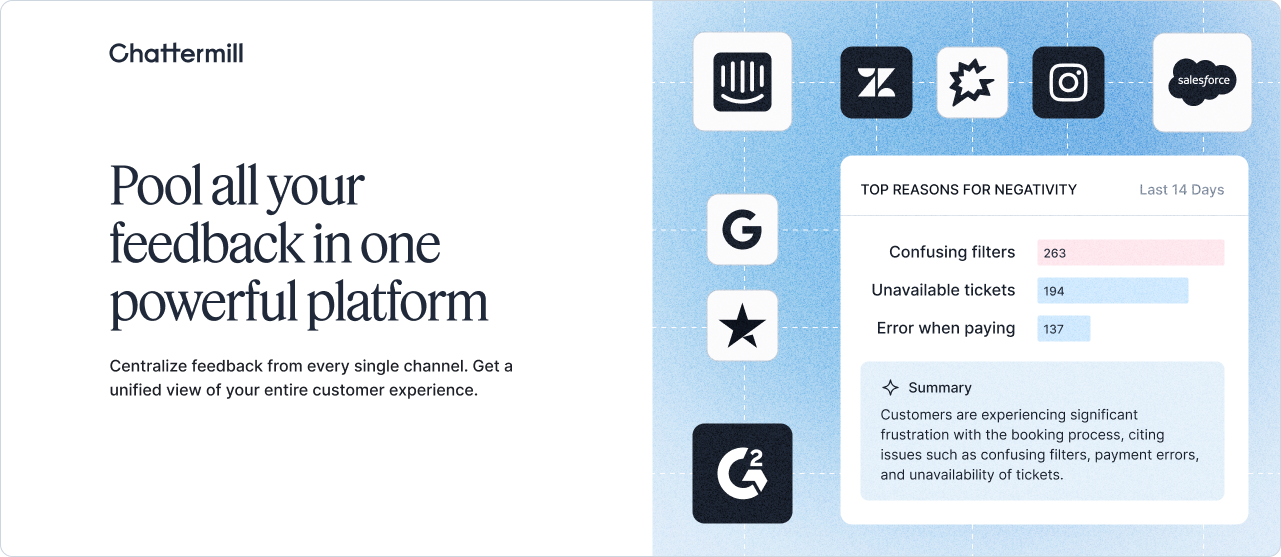
How feedback moves through the platform - many messy inputs, one comparable output.
The output is the part executives care about. Chattermill links themes and sentiment to the metrics on the dashboard - NPS, CSAT, retention, revenue. That connection is the whole game. It turns "customers seem annoyed" into "this specific issue correlates with churn worth this much," which is a sentence a finance team can act on.
03 / Who uses itThe customer-obsessed, and their receipts
Chattermill's client list reads like a directory of companies that live or die on experience: Uber, HelloFresh, Wise, Booking.com, Just Eat, Tesco, E.ON, Santander, Zappos and Qonto among them. These are not firms short of data. They are firms drowning in it, staffed by CX, product and insights teams whose job is to turn that flood into decisions faster than a competitor can.
That framing - the roadmap already exists, you just can't read it yet - is the reason a Chattermill contract makes sense to a large enterprise. The alternative is a room of analysts hand-tagging spreadsheets, which is slow, expensive, and inconsistent the moment you cross a language border. Two different humans tag the same complaint two different ways; a model, whatever its faults, at least tags it wrong the same way every time, which makes trends real.
The practical payoff is speed. A theme that used to surface in a quarterly research readout can surface the week it starts trending. When a checkout change quietly annoys a slice of users in one country, the goal is to catch it as a rising line on a chart rather than as a dip in next quarter's retention. Chattermill's pitch is that the distance between a customer's complaint and the company's response - measured in weeks for most businesses - is a number worth shrinking, and that most of what it builds exists to shrink it.
03.5 / The productsWhat you actually log into
The platform is sold as Unified Customer Intelligence, and the name is doing real work: the promise is one place, one taxonomy, every channel. Underneath sit the pieces. Lyra is the engine. On top of it, a 2025 wave added Observations, which pull quantified, specific issues out of the noise automatically; Highlights, which surface the moments worth a human's attention; and Ask Lyra, a natural-language interface that lets a product manager type a question about customers and get an answer drawn from the whole corpus rather than a filtered spreadsheet.
The newest layer, MCP and Skills, is less a feature than a direction. It exposes Chattermill's verified customer intelligence to AI agents through an open protocol, so the same facts that power a dashboard can power an autonomous agent. The business model that carries all this is straightforward B2B SaaS: annual enterprise subscriptions, priced on data volume, seats and integrations, sold to teams for whom a percentage point of retention is worth far more than the licence.
04 / The marketA crowded room, and a specific seat
Chattermill plays in the voice-of-the-customer and experience-analytics market, where the incumbents are large: Medallia, Qualtrics, InMoment. Those platforms are broad and survey-heavy. A newer wave - Enterpret, Unwrap, Lumoa - is AI-native and lighter. Chattermill's position sits between them: enterprise-grade and multi-channel, but built around a single specialised model rather than a survey tool with analytics bolted on.
The expertise underneath is the part that doesn't fit on a pitch deck. Chattermill has spent roughly a decade in natural language processing - long enough to predate the current LLM boom and to have built opinions about where general-purpose models help and where they quietly mislead. That is why Lyra is a blend rather than a single large model: aspect-based sentiment and supervised learning handle the parts where precision and a customer's own taxonomy matter, and LLMs handle the nuance. The team, led on the science side by a chief scientist and built out across engineering and product from its Hanbury Street base in London's East End, treats customer feedback as a genuine data problem rather than a dashboard to decorate.
Funding history · total ~$40M
The $26M Series B in December 2022 was explicitly framed around scale: money to analyse over a billion pieces of feedback for enterprise brands. In a category where the moat is how much data you've learned to read consistently, more volume is more moat.
05 / What's nextFeeding the agents
Chattermill's 2025 direction is a tell about where customer experience is heading. It shipped Observations, Highlights and Ask Lyra - features that extract quantified insights automatically and let a team query their customers in plain English. More telling, it connected the platform to AI agents through the Model Context Protocol, so an agent answering a customer or a colleague does so grounded in verified, quantified feedback rather than guesswork.
That is the bet in one line. As companies wire AI agents into support and product, the scarce ingredient becomes trustworthy customer context. Chattermill spent a decade building exactly that context. The name fits the thesis, too: chatter, the raw noise customers make, run through a mill that turns it into something usable.
06 / The takeawayCustomer-obsession, with a number attached
Plenty of companies say they are customer-obsessed. Very few can point to the number. Chattermill's quiet contribution is to make that claim measurable - to take a value everyone professes and attach it to a retention curve. Whether it wins a crowded market is an open question. But the problem it picked, reading the room at a scale no human team can, is not going away.