The Feedback Economy
The Race to Turn Customer Complaints Into a Product Roadmap
Eight companies, from scrappy startups to a $6.4 billion giant, are betting they can read every angry review, support ticket and feature request faster than your product team ever could. Here is how the feedback-intelligence market actually shakes out.
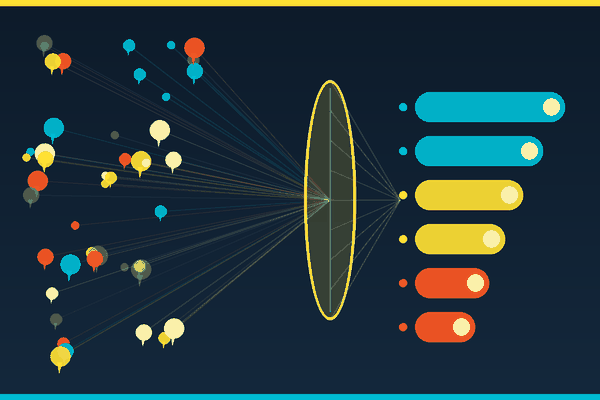
Every company says it listens to customers. Almost none of them read all the feedback. That gap - the distance between the reviews, tickets and requests you receive and the ones you actually process - has quietly become a software category worth billions of dollars. Eight companies are fighting over it, and they do not agree on what the job even is.
Look at the names on the whiteboard: Thematic, Idiomatic, Enterpret, Keatext, Productboard, Marker.io, Medallia, Featurebase. Put them in a single sentence and they sound interchangeable - "software that helps you understand customers." Spend an afternoon with each and they stop looking like competitors at all. One of them wants to help your engineer reproduce a bug. Another wants to help your chief executive understand the entire customer base. The distance between those two ambitions is the whole story.
So before you shop, it helps to see the market for what it is: not one product with eight logos, but a relay race. A customer's throwaway sentence has to travel from the moment it is captured to the moment it changes a decision. Different companies own different legs of that trip.
The four rooms of feedback
Capture · Analyze · Prioritize · Decide
Think of feedback as passing through four rooms. In the first, capture, raw input arrives - a bug report, a one-star review, a survey line, a feature vote. In the second, analyze, that pile gets read and clustered into themes. In the third, prioritize, the themes get ranked against effort and impact. In the fourth, decide, a human actually reprioritizes the sprint.
Almost every vendor claims to live in all four rooms. Almost none of them do. Knowing which room you are really shopping for is the difference between a tool that fits and a year spent forcing one that does not.
The market on one spectrum
The capture end: cheap, honest, unglamorous
Start at the scrappy end, because it is the most misunderstood. Marker.io does one thing with unusual discipline: it lets someone report a problem straight from a live website. Click the widget, circle the broken button, and the tool grabs a screenshot, the annotation, and the technical metadata a developer actually needs - console logs, network requests, browser, screen size - then syncs the whole package into Jira, Trello, GitHub or ClickUp. The bug arrives pre-diagnosed. That is not analysis. It is plumbing, and good plumbing is worth paying for.
Featurebase sits a step further in. It collects feature requests, lets customers upvote them on a public board, and converts that into a changelog and a lightweight roadmap - the full feedback-to-roadmap loop, priced so a five-person startup can run it without a second thought. Plans start in single-digit dollars per month. For a lot of teams, this is genuinely all they need, and admitting that saves them from buying something twenty times more expensive.
Hold those three numbers next to each other. They are all in the same market. That is the first thing worth internalizing about feedback software: the price range spans nearly three orders of magnitude, and the vendors would very much like you to believe the gap in value is just as wide. It usually is not.
The analyze end: where AI earns its keep
Now the middle of the picture, the lens. Once feedback runs into the tens of thousands of items across support tickets, app-store reviews, sales calls and surveys, no human team can tag it in time to matter. This is where Thematic, Keatext, Idiomatic and Enterpret live, and where the last two years of AI progress actually changed the product rather than the marketing.
Thematic tracks themes and sentiment in near real time. Keatext built its whole reputation on explainable analytics - not just "here is the theme," but "here is why the model surfaced it," which turns out to matter enormously the first time an executive asks whether they can trust the chart. Idiomatic clusters feedback into the categories a specific business cares about. Enterpret, the best-funded of the young cohort, unifies feedback from every channel into a single taxonomy and, as of late 2025, layers no-code AI agents on top to push findings toward the product, marketing and sales teams who need them.
The hard part was never collecting feedback. It was trusting it enough to change a roadmap.The unspoken thesis of every analyze-layer vendor
Enterpret's customer list is its argument: Notion, Canva, Monday.com, Linear, Strava, Hootsuite, Nextdoor, The Browser Company. That is the modern software crowd - companies that generate more feedback than any team can read and treat the reading of it as a competitive edge. The company says it doubled its annual recurring revenue in roughly six months, which tells you the demand at this layer is real, not speculative.
The heavy end: Productboard and Medallia
Two names anchor the far side. Productboard is not really an analysis tool - it is a prioritization system. It gives a product team one place to hold customer insights, weigh them against effort, and publish a roadmap everyone builds from. It answers the third-room question: given everything we now know, what do we do next, and in what order?
Medallia is the giant, and it plays a different game entirely. It grew up as enterprise experience management - surveys, signals and analytics stitched across the entire customer and employee journey, at the scale of the world's largest companies. In 2021, Thoma Bravo took it private in an all-cash deal worth $6.4 billion, one of the largest in the history of the category. Where a startup buys Featurebase to hear its first thousand users, a bank buys Medallia to hear its ten millionth.
Same market, different weight class — relative price / scale
Illustrative positioning, not a price sheet. The point is the spread, not the pixels.
What actually separates the winners
Here is the part the category pages never say out loud. Every one of these tools can now produce more signal than any team can act on. Sentiment scores, theme clouds, ranked lists - the supply of insight is no longer the bottleneck. The bottleneck is the decision. The tools that win are the ones that close the loop: they do not just tell you customers are frustrated with onboarding, they make it cheap and obvious to do something about it and to show the customer you did.
- Coverage - does it read every channel, or just the one it was built for? A blind spot is a decision you will make wrong.
- Explainability - can it show why it surfaced a theme? Insight nobody trusts changes nothing.
- The loop - does the finding travel to the person who can act, and back to the customer who raised it?
- Fit to volume - a $9 board and a $6.4B platform are both correct answers, for very different companies.
The mistake buyers make is shopping by feature list, where everything looks the same, instead of by job. Figure out which of the four rooms is actually costing you - the bug you cannot reproduce, the requests you cannot rank, the themes you cannot see, the decision you keep deferring - and the eight-way tie resolves itself almost immediately.
Where this goes next
AI did not kill the product manager. It killed the excuse. When a model can read a hundred thousand tickets before lunch, "we did not have the data" stops being a defense. The frontier now is not hearing more - every tool here already drowns you in signal - it is deciding faster and proving you listened. Enterpret's move into agents is a bet on exactly that: software that does not just surface the finding but carries it to the team and nudges the next step.
The eight companies on the whiteboard will keep drifting toward each other's turf - the capture tools reaching for analysis, the analysis tools reaching for the roadmap, the giant reaching downmarket. But the underlying map will hold. Somewhere between the bug tracker and the boardroom, a customer's offhand sentence becomes a line on a roadmap. These are the machines built for that trip, and the good ones are worth every dollar of the spread.
The eight, in their own words
Questions people actually ask
What is customer feedback intelligence software?
Tools that collect unstructured customer input - reviews, support tickets, survey responses, bug reports and feature requests - and use analytics or AI to turn it into themes, priorities and decisions that product and experience teams can act on.
How are these eight companies different from each other?
They sit on a spectrum. Marker.io and Featurebase focus on capturing bugs and requests. Thematic, Idiomatic, Keatext and Enterpret specialize in analyzing feedback at scale. Productboard centers on prioritization and roadmaps. Medallia is the enterprise experience-management heavyweight spanning the whole loop.
Do you actually need AI to analyze customer feedback?
Not for small volumes. But once feedback runs into the tens of thousands of items across channels, manual tagging breaks down, and AI clustering and theme detection become the only practical way to see patterns in time to act on them.
Why did Medallia sell for $6.4 billion?
Thoma Bravo took Medallia private in 2021 for $6.4 billion, betting on its position in enterprise experience management, its large installed base, and recurring revenue that had grown roughly 19% the prior fiscal year.
Which feedback tool should my team choose?
Match the tool to the job. To capture and reproduce bugs, look at Marker.io. To run a feedback-to-roadmap loop affordably, Featurebase. To analyze large volumes of qualitative feedback, Thematic, Keatext, Idiomatic or Enterpret. For roadmapping, Productboard. For enterprise-wide experience programs, Medallia.