Chattermill Turns a Billion Customer Gripes Into a Roadmap
The London startup founded by Mikhail Dubov and Dmitry Isupov reads Uber, H&M and HelloFresh's messy feedback for a living - and it is now racing Seattle's Unwrap for the voice-of-customer crown.
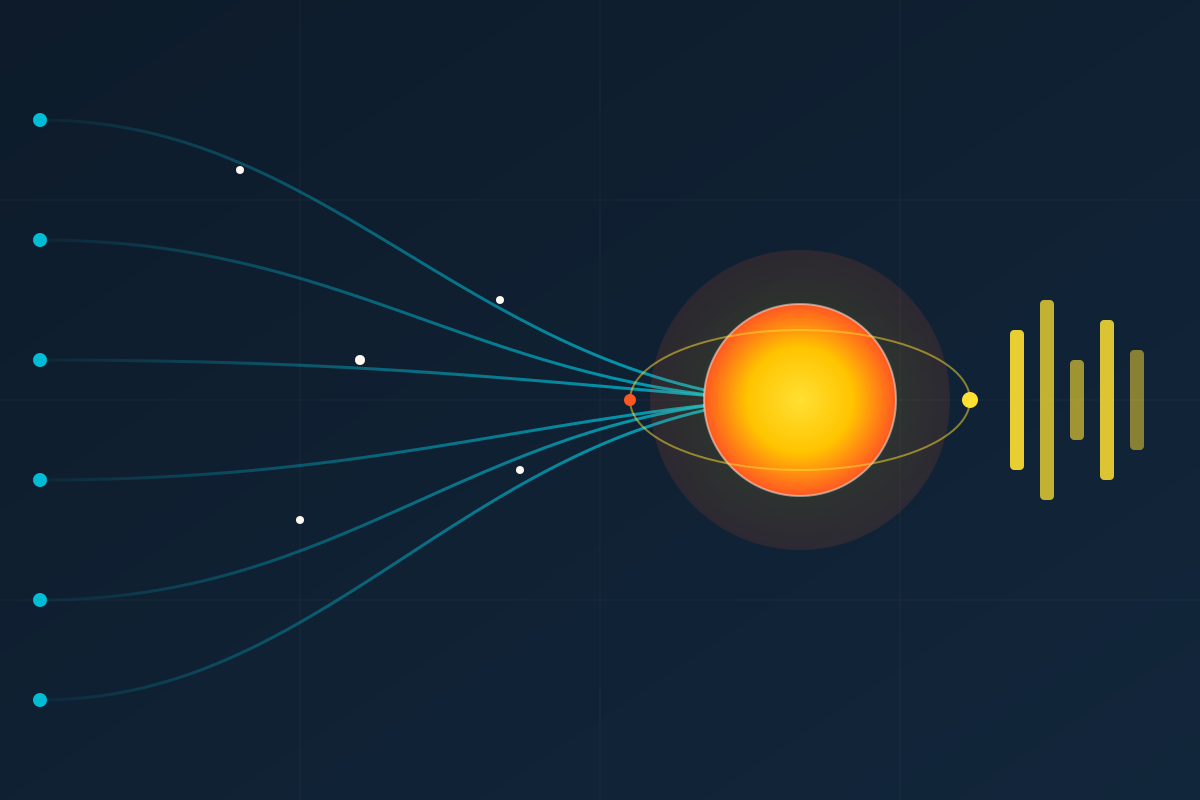
Every company you use has a folder somewhere full of things you have said about it. The one-star review you left at 11pm. The support ticket that started polite and got sharp. The survey box you actually typed a paragraph into. For most businesses that folder is a graveyard - too big to read, too messy to sort, too honest to ignore. Chattermill's entire reason for existing is to walk into that graveyard and come back with a plan.
The London company was started in 2015 by Mikhail Dubov and Dmitry Isupov, two founders who met through Entrepreneur First and shared one specific irritation: customer research took forever. Weeks, sometimes months, to turn a pile of feedback into anything a team could act on. By the time the insight arrived, the moment had usually passed. Their bet was that machines could read faster than a research team ever could, and that the reading itself - not the dashboard around it - was the hard, valuable part.
Eleven years later that bet looks sound. Chattermill's customer list reads like your week: Uber, H&M, HelloFresh, Tesco, Qonto, E.ON Next. These are companies that generate feedback by the truckload and cannot afford to guess what it means. The pitch to each of them is the same - stop sampling, start reading everything.
01 / THE PROBLEMFeedback is a firehose. Insight is a teaspoon.
Here is the trap most product teams fall into. Feedback arrives from everywhere at once - app-store reviews, Zendesk tickets, NPS surveys, Trustpilot, Twitter replies, in-app prompts - and each source lives in its own tool with its own format. A human can read a few hundred comments and form a hunch. They cannot read a million and stay objective. So teams do the thing that feels responsible and is actually dangerous: they sample. They read the loudest fifty and call it the voice of the customer.
The loudest fifty are rarely representative. They are the extremes - furious or delighted - and the quiet middle, where most of your revenue lives, goes unread. Chattermill's answer is to read the whole thing and let the pattern, not the volume, decide what matters. Its models tag every comment by theme and sentiment, cluster them, and connect the clusters to outcomes a business already tracks: churn, retention, spend. The output is not "customers are unhappy." It is "customers on the annual plan mention checkout friction three times more than monthly customers, and those who mention it churn at a higher rate."
Our goal is that our AI is able to analyse over a billion pieces of customer feedback for our clients. Mikhail Dubov, CEO & Co-Founder, Chattermill
The reason this is hard - and the reason it took a decade and real money rather than a weekend project - is language. People do not file complaints in clean categories. They write "love the app but the new update logs me out constantly," which is praise and a churn risk in the same breath. They write it in French, Portuguese and Japanese. They use sarcasm, shorthand and the name of a feature your product team calls something else internally. Reading fifty comments, a human handles all of that instinctively. Reading a million, at speed, without drifting or getting bored, is a genuine engineering problem. Chattermill's claim is that it handles both halves of every sentence, in fifty-odd languages, and does it the same way on comment number nine hundred million as on comment number one.
A billion is a deliberately concrete number. Founders usually raise money on vision - "we're building the future of X." Dubov raised on a metric you can check. That tells you something about how the company thinks: the value is in throughput and accuracy, not in a prettier chart. When the $26M Series B closed in December 2022, led by Beringea with DN Capital, Ventech, Runa Capital and others returning, the money went where the thesis pointed - engineering, data science, and the unglamorous work of reading more languages more reliably.
02 / THE RIVALTwo coasts, one prize
Chattermill does not have this space to itself, and the most interesting challenger is Unwrap.ai. Unwrap was founded in 2021 by Ryan Millner and Ashwin Singhania, two former Amazon Alexa product managers, and spun out of Seattle's Allen Institute for AI. It raised a $12M Series A led by Scale Venture Partners, with Atlassian Ventures along for the ride.
The two companies attack the same problem from opposite instincts. Unwrap leans on "zero-shot" analysis - it surfaces themes without anyone predefining the tags, which means a team can point it at a mess of feedback and get trends back fast, with almost no setup. That speed is the whole selling point. Chattermill leans the other way: deeper, multi-language, multi-source analysis built for enterprise insights teams who need the model tuned to their specific business and are willing to invest to get there. One optimises for time-to-first-insight. The other optimises for how much you can trust the insight once your board is looking at it.
Neither approach is obviously right, which is exactly why the category is worth watching. AI made "read all of it" cheap enough that the old assumption - that you had to choose between speed and depth - is being renegotiated in real time. The legacy names in the room, Qualtrics and Medallia, built their businesses on structured surveys. Both Chattermill and Unwrap are betting that the future is unstructured: the paragraph someone actually typed, not the number they clicked.
03 / THE STEALWhat a product team can copy tomorrow
You do not need a Chattermill contract to use Chattermill's idea. The transferable lesson is a reframe: your feedback is not a support cost to be closed as fast as possible. It is a ranked, unfiltered vote on your roadmap that your customers are already casting for free. Most companies delete that vote by treating tickets as fires to put out and reviews as reputation to manage.
Try the small version. Pull a quarter's worth of support tickets and reviews into one place. Tag each by the theme it's really about and whether the sentiment is positive or negative - a spreadsheet and an afternoon will do for a first pass. Then rank the themes by how often the negative ones show up next to customers who leave. You will almost always find one or two issues that are quietly expensive and were never on the roadmap because no single complaint was loud enough to notice. That is the Chattermill move at hobby scale. The company just does it across a billion comments, in fifty languages, without getting tired.
The point most teams miss is that the ranking matters more than any single item on it. A loud complaint feels urgent and gets fixed; a quiet, recurring one feels minor and gets ignored, even when it costs more in aggregate. Reading everything is the only way to see the second kind. Once you have the ranked list, the roadmap conversation changes tone - you stop arguing from anecdotes and the last thing an executive happened to read, and start arguing from what the whole base actually said. That shift, from opinion to evidence, is the real product Chattermill sells. The dashboard is just where it shows up.
There is also a business lesson buried in here for anyone building. Chattermill picked the boring middle of the stack - reading - and stayed there for a decade while flashier categories came and went. The reward for owning an unglamorous, genuinely hard job is durability. A ranking of "best AI text analytics" put it at the top of G2's Momentum Grid; the team doubled between funding rounds; and it hit 200% of its new-business targets in a single quarter. None of that is loud. All of it compounds.
04 / WHAT'S NEXTThe listening decade
The obvious story about AI in 2026 is writing - models that generate. The quieter, arguably bigger story is listening. A model that can read a million honest comments and tell you, accurately, what your customers mean is worth more to most companies than one that can draft another marketing email. Chattermill has been building toward that since before it was fashionable, and Unwrap is sprinting at it from the other coast. The prize both are chasing is the same: to become the single layer where every piece of customer feedback lands, gets understood, and turns into a decision.
Whether that layer ends up wearing a London accent or a Seattle one is still open. What's already settled is the shape of the bet - that the companies who win the next decade will be the ones who actually read what their customers wrote, instead of guessing from the loudest fifty.
Explore & verify
- SITEchattermill.com
- SERIES BChattermill secures $26M Series B
- CEOMikhail Dubov on LinkedIn
- COMPANYChattermill on LinkedIn
- RIVALUnwrap.ai
- CONTEXTGeekWire on Unwrap's launch
FAQQuick answers
What does Chattermill do?
It uses AI to unify and analyse unstructured customer feedback - reviews, surveys, support tickets, product feedback and social posts - so product and CX teams can see what customers mean and act on it.
Who founded Chattermill and when?
Mikhail Dubov (CEO) and Dmitry Isupov (Chief Strategy & Insights Officer) co-founded it in 2015 out of the Entrepreneur First programme in London.
Who are Chattermill's customers?
Consumer brands including Uber, H&M, HelloFresh, Tesco, Qonto and E.ON Next.
How much funding has Chattermill raised?
An $8M Series A in 2020 and a $26M Series B in December 2022, led by Beringea with participation from DN Capital, Ventech, Runa Capital and others.
How is Chattermill different from Unwrap.ai?
Chattermill targets enterprise CX and insights teams needing deep, multi-language, multi-source analysis at scale. Unwrap, a Seattle AI2 spinout, emphasises fast, low-setup "zero-shot" trend surfacing for product and CX teams.