The problem with the internet is that it keeps having opinions. A new shampoo lands, a flight is canceled, a chief executive misspeaks, and somewhere a comment section begins breeding. Brandwatch built its business by catching those scattered remarks and arranging them into something a company can use before the meeting ends. Today its software processes roughly half a billion posts every day from more than 100 million online sources. The number is enormous. The actual product is restraint.
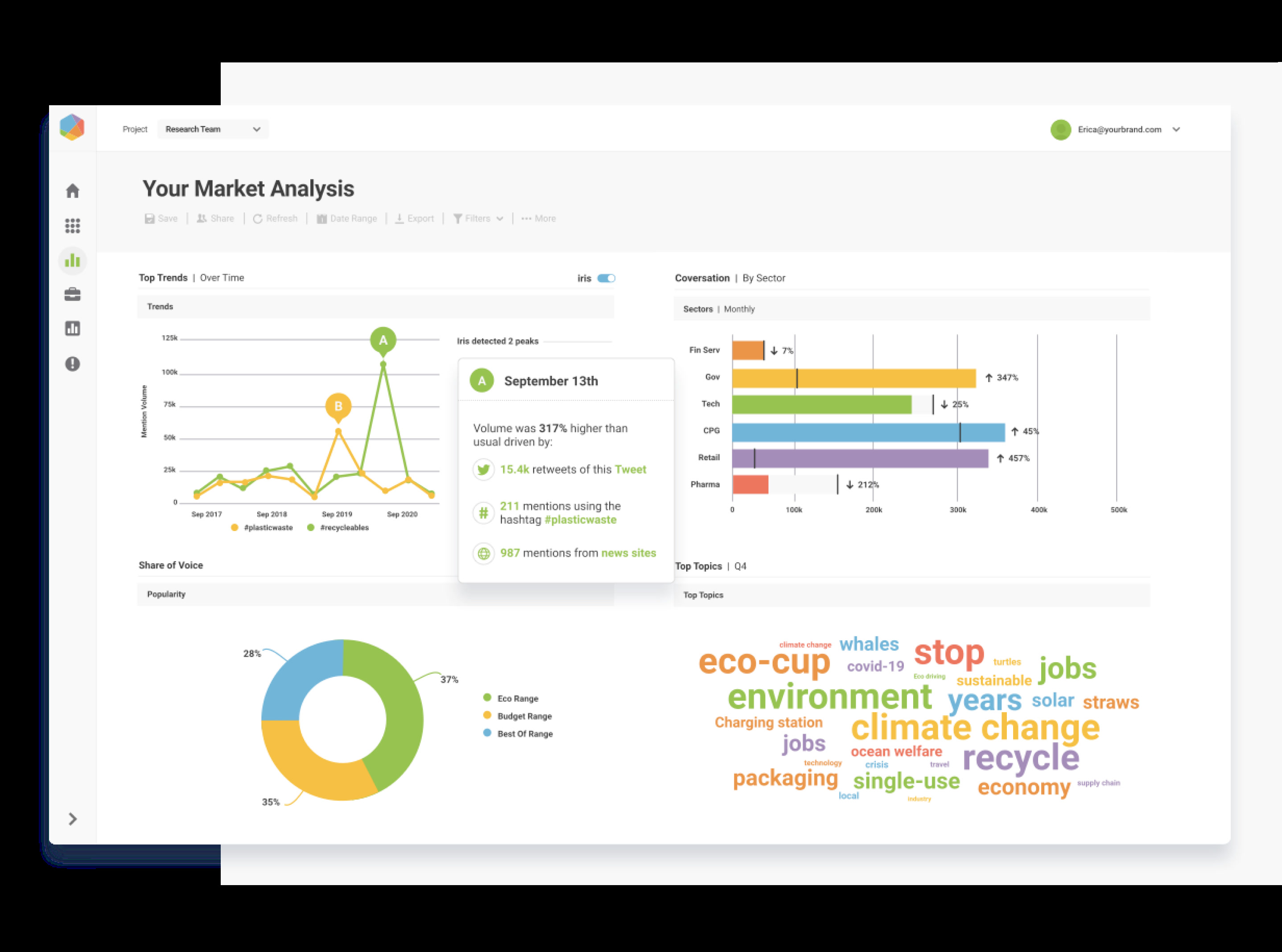
Brandwatch lets an analyst define a subject, search public conversations, separate signal from spam, inspect sentiment and themes, compare competitors, spot an unusual spike, and turn the finding into an alert or a report. Its second half runs the social desk: plan and publish posts, approve campaigns, answer messages, measure performance, manage creators, and convert a furious comment into a customer-care case. Search intelligence and monitoring of generative-AI answers now stretch the map beyond conventional social feeds.
It started with the embarrassing search result
The origin is pleasingly unfashionable. Giles Palmer had already watched a perfume-and-cosmetics television-commerce startup called 5Senses expire. He then helped run Runtime Collective, a software shop with open-source ideals and no crisp destination. Client work paid; freely reusable software did not. The company could build, but it could not say exactly why it existed. Palmer later described the result as wasted time, frustration, and a team pulled in too many directions.
A vertical-search product followed and spent a year going nowhere. Then, in 2006, Palmer spoke with friends from the SEO agency Spannerworks. Their clients wanted to know not only where they appeared in search but what the result actually said. Ranking first is a hollow victory when the top link calls your product terrible. Palmer inverted a line from The Cluetrain Manifesto: if markets are conversations, conversations could be markets. Brandwatch had its job.
“Conversations are markets.”Giles Palmer's inversion that became the product thesis
A £500,000 seed round led by Jason Ball helped launch Brandwatch v1 as SaaS in August 2007. Alliance & Leicester became its first customer. What followed was not a montage. Developers waited beside demos in case something broke. The team chased invoices, prayed for research-and-development tax credits, and tried to persuade procurement departments that 90-day payment terms were not charming.
The first hard problem was too large
Palmer asked an early developer whether software could automatically read sentiment across web pages. The answer was cautious: perhaps in one narrow domain with similar posts, but not reliably across general conversation. Palmer's response was concise: “Damn, let's do it anyway.” Thirteen years later, he conceded that the developer was still right. General sentiment is a slippery target. Sarcasm, slang, mixed feelings, language, and context do not politely become green and red bars.
That admission explains both the appeal and the risk of Brandwatch. The machine can collect and classify at a scale no focus group can touch, but the analyst still has to frame the question, inspect the sample, and know when a metric is lying by omission. Brandwatch's Iris AI can detect peaks, summarize chatter, help write queries, classify images and text, and suggest customer replies. It accelerates the work. It does not repeal research design.
Radian6 changed the appetite
By late 2011, Brandwatch was growing around 80 percent a year and running at roughly £250,000 in monthly recurring revenue. It was also, in Palmer's earthy account, getting its “asses kicked” by Canadian competitor Radian6. Brandwatch had a good product. Radian6 had a good product and much better marketing. Staying comfortable in Britain risked letting the category form around somebody else.
Palmer wanted venture capital and a North American push. CTO Fabrice Retkowsky and COO Bryan Tookey preferred the business they already had. Palmer made the case at least four times over five months. They eventually agreed, raised €4 million from Nauta Capital, and sent sales director Seb Hempstead to start in New York with no meaningful local recognition. The office booked $1 million in revenue in its first year.
There is a copyable lesson here, though it is not “raise money.” Brandwatch named the competitive threat, named the geographic response, and attached the financing to that response. Capital had a job. For a company without a repeatable product, a reachable overseas market, or leaders willing to endure enterprise sales, the same move would merely purchase a more expensive variety of confusion.
A suite assembled from strong opinions
The Brandwatch on sale today contains other companies' histories. PeerIndex added influencer mapping. BuzzSumo brought content research. Qriously added surveys. A 2018 merger with Crimson Hexagon joined two large listening archives and two cultures. Cision's Falcon.io became Brandwatch Social Media Management in 2022. Paladin became Influence, a creator-discovery and campaign system with more than 30 million creator profiles.
The result spans two once-separate jobs. Consumer Intelligence is for the researcher who wants to understand a category, brand, audience, or cultural shift. Social Media Management is for the operator who must publish, approve, answer, benchmark, and report across Facebook, Instagram, X, LinkedIn, TikTok, YouTube, WhatsApp, Pinterest, and other channels. Case Management pulls care teams into the same room. Cision adds PR distribution and wider media intelligence next door.
That breadth distinguishes Brandwatch from a scheduler with listening bolted on. Against enterprise peers, the center of gravity is its historic conversation archive and research depth. Sprinklr leans toward a broad customer-experience operating system. Meltwater and Cision are natural comparisons when earned media and PR matter. Talkwalker and Synthesio meet it in large-scale listening. Sprout Social and Hootsuite are easier comparisons when publishing is the main job; Brand24 and Mention make more sense when a small team simply wants alerts.
What does it cost?
Brandwatch currently sells through demos and custom quotes. A 2024 UK public-sector pricing document listed five queries at £21,000 per year and higher-volume packages above £45,000. Those are procurement examples, not a universal rate card. The honest budget includes the contract, data add-ons, onboarding, and the analysts required to keep the queries useful.
The customer is a team, not a login
Brandwatch says it works with more than 2,000 brands and agencies and has served names including Unilever, Walmart, Dell, Cisco, British Airways, Sony Music, Monzo, Omni Hotels, and OnePlus. The users are market researchers, social managers, communications leads, brand strategists, care agents, and agencies proving their taste with something sturdier than instinct.
The most persuasive outcomes describe changed work. Creative agency Art of the Possible says Brandwatch cut the time spent searching for actionable data in half, saved 200 hours a year, helped win 14 pitches at a 95 percent success rate, and accompanied 158 percent growth in key client accounts. Influencer agency The Sociable Society reported saving 30 percent of working hours and taking on 50 percent more clients. These are vendor-published case studies, so they are evidence of possibility, not a coupon guaranteeing identical arithmetic.
The conditions hidden under the graph
Brandwatch is strongest when online conversation is genuinely relevant, there is enough volume to analyze, and somebody skilled owns the research. It can shorten the path from “people seem annoyed” to a defensible finding. It can help a global team govern dozens of accounts, compare markets, find an emerging complaint, or see which creator actually drove consumed hotel nights.
It is weaker when buyers confuse public conversation with a representative population. Quiet customers do not appear merely because the archive is large. Network rules constrain what any third party can collect. Historical access varies by source. Automated sentiment can flatten the joke, and a beautiful spike may be one viral repost rather than a social movement. Small teams can also end up paying for an aircraft carrier to cross a pond.
Brandwatch's own history offers the cleanest standard. Its first software company could build almost anything and therefore wandered. Brandwatch found traction only after giving the technology a clear purpose. The same applies to its customers: the platform becomes valuable when a team knows which decision the noise must improve. Otherwise, half a billion daily posts are just a very large reminder that everyone is talking.
Keep watching