Sprout Social began with an observation so plain it now sounds inevitable: businesses were entering social networks through tools built for ordinary people. In 2009, a salesperson, a designer and two engineers saw brands juggling logins, customer complaints and crude spreadsheets while Facebook and Twitter became real customer channels. The four founders connected in part through a double date at Chicago’s Violet Hour. They talked whiskey and software, built after hours, and opened Sprout in 2010.
The first product did the obvious jobs well. It pulled feeds into one dashboard, let teams publish across networks and translated activity into reports. The useful invention was not the scheduled post. It was a layer of coordination above networks that did not coordinate with one another. A social manager could stop acting like an air-traffic controller with twelve tabs open.
That simple wedge became a public software company. Sprout reported $457.5 million of revenue in 2025, up 13 percent. It serves tens of thousands of organizations in more than 100 countries. Customers range from agencies and nonprofits to the Chicago Bulls, Kraft Heinz, Canva and Salesforce. Its software now covers publishing, engagement, social customer care, listening, analytics, employee advocacy, influencer campaigns and predictive media monitoring.
13% annual growth
The product is a very expensive reduction in friction
Sprout’s Smart Inbox gathers comments, direct messages, mentions and reviews. Publishing adds calendars, approval routes and recommended send times. Listening searches wider conversations for themes and sentiment. Analytics turns performance into shareable reports. The influencer product finds creators, handles campaigns and measures results. Employee Advocacy gives staff a shelf of approved posts. Connections to Salesforce and Zendesk can push social conversations into customer-care systems.
The price makes sense only when that coordination is expensive. In 2026, Sprout listed Essentials at $79 per seat per month when billed annually. Standard was $199, Professional $299 and Advanced $399. Enterprise pricing was private. Listening and other premium capabilities can add more. A five-person team on Advanced is nearly $24,000 a year before extras. A solo shop that needs a calendar should flinch. A global team routing thousands of customer messages might see a bargain.
“The scheduled post is not the valuable trick. The trick is keeping marketing, care, legal and leadership in the same room without scheduling the meeting.”YesPress analysis
Salesforce supplies Sprout’s favorite proof. After moving more than 150 social channels into the platform, its social team reported saving 12,000 hours in the first year and increasing community-management efficiency tenfold. Those are customer-reported figures, but they explain the enterprise pitch better than a feature list. Software earns its seat when it removes labor, risk and repeated translation.
A scheduler grows teeth
Sprout widened the product by building and buying. It launched employee advocacy in 2015 and a paid Listening module in 2018. It acquired Simply Measured for analytics, then Repustate in 2023 for natural-language processing and sentiment analysis. That same year it paid $140 million in cash for Tagger Media, moving into influencer marketing. In 2025 it paid $55 million in cash, with up to $10 million more in earnouts, for NewsWhip’s predictive media intelligence.
The logic is coherent. A brand should be able to spot an emerging story, understand the audience, recruit a creator, publish a response, manage replies and report the result without rebuilding context in six tools. It is also demanding. Every acquisition creates another interface, sales motion and data model that must feel like one product. If the pieces remain adjacent rather than integrated, the customer has merely purchased a more handsome collection of tabs.
The customer mix shows which side is winning. By June 2026, Sprout had 3,926 customers spending at least $30,000 annually, up 11 percent from a year earlier. They supplied 61.4 percent of subscription revenue, compared with 56.9 percent one year before. The $50,000-plus group grew 16 percent to 2,127 customers. Sprout is becoming more dependent on buyers with complicated operations, deeper budgets and longer procurement cycles.
What failed first was the old growth bargain
Nothing dramatic broke in the core product. The earlier bargain did. A broad customer base, regular price increases and more seats once produced faster growth. By 2026, management acknowledged pressure in the sub-$30,000 segment. Price increases had hurt demand and retention. Revenue still grew 11 percent in the second quarter, but the company was balancing that slower pace against the expectations placed on a mature public SaaS business.
The response was a sharper enterprise strategy and a painful cost reset. In July, Sprout approved a plan to eliminate about 260 roles, roughly 20 percent of its workforce. It expected $18 million to $20 million in pre-tax restructuring charges. CEO Ryan Barretto later said departing U.S. workers would receive 12 weeks of salary plus a week for every year of tenure, six months of healthcare, cash for equity due to vest within 90 days and outplacement support.
This matters because Sprout has spent years advertising its culture. Its values include “Be a Joy to Work With” and “All In, All Together,” and it has collected workplace awards. A considerate severance plan does not make a 20 percent cut painless. It does make the company’s decision legible: management changed its mind about how much organization the next stage required. It chose fewer layers, larger customers, higher margins and concentrated investment in AI-powered intelligence.
Trellis is the new argument
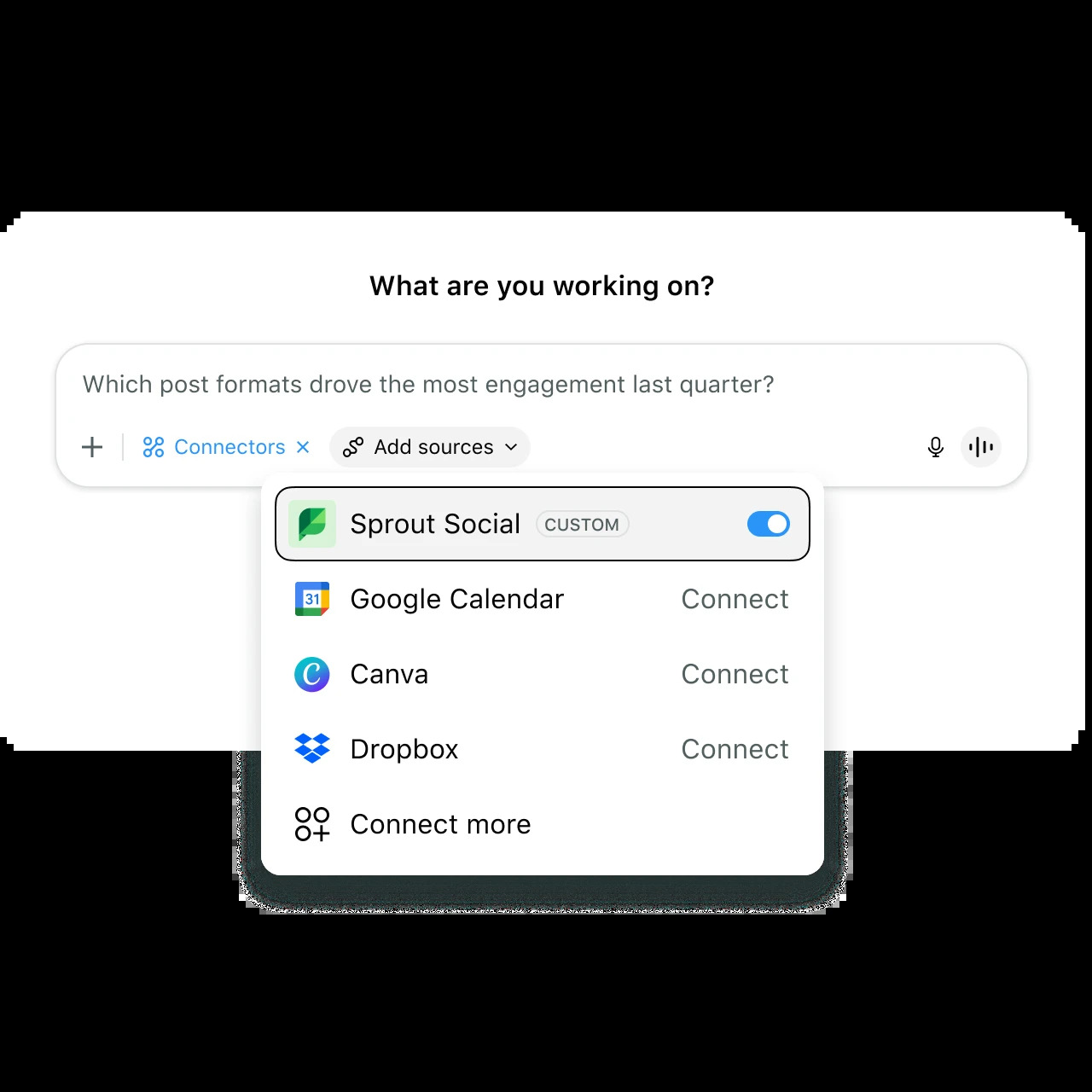
Most social AI begins with writing more captions. Sprout is attempting the more valuable job of deciding what the chatter means. Its proprietary agent, Trellis, can query social data in ordinary language, summarize performance, flag changes in sentiment, identify emerging risks and create executive-ready reports. Trellis Studio lets teams save recurring analytical workflows. The agent expanded across Listening, Publishing, Smart Inbox and Reporting and became available on every plan in July 2026.
Early customer accounts are promising but young. JetBlue said Trellis reduced the time needed to interpret weeks of performance data. Ipsy used it to monitor reactions to launches and send themes to product and care teams. NewsWhip gives the system a stream of stories and engagement signals to watch before they peak. Reddit and Snapchat partnerships widened the places Sprout can listen and act.
The bet works if Sprout’s network-native data produces answers a general model cannot, and if those answers travel into real decisions. It fails if Trellis becomes a summary button with a grand name, if customers distrust automated sentiment, or if cheaper rivals reproduce the workflow. AI also changes the budget conversation. A chief marketing officer may fund social intelligence, but the same executive can redirect money toward a broader analytics platform or an internal agent.
Sprinklr and Khoros compete on governance, care and large global deployments.
Brandwatch, Meltwater and Hootsuite’s listening products compete for consumer and media intelligence.
Buffer, Later, Agorapulse and native network tools win when scheduling is the whole job.
Premium usability plus publishing, care, creators and intelligence in one cross-functional layer.
The copyable playbook - and its limits
The lesson worth copying is not “add AI.” Start with a recurring coordination tax. Sprout found people switching among networks, copying numbers into slides and losing customer context between marketing and support. It built a shared workflow around the mess, then charged for the work removed. Next, it used integrations to make the product more useful without trying to own the underlying networks. Finally, it moved from recording activity to interpreting it.
Copy this
Measure hours, handoffs and errors before buying. Run one team through a trial. Connect care and CRM systems. Build approval rules. Track response time, reporting time and incidents avoided.
Skip this
Do not buy an enterprise nervous system for one person and five posts a week. If native tools handle the work and listening never changes a decision, Sprout is overhead.
There is one structural catch Sprout cannot remove. Its platform depends on APIs owned by Meta, X, TikTok, Reddit, LinkedIn and others. Those companies can change access, prices and functionality. Sprout is the useful tenant who renovated the building; the social networks remain the landlords. The same risk applies to every vendor in the category, but breadth does not eliminate it.
Sprout’s next chapter will be judged with unfashionably plain numbers: revenue growth, retention, larger contracts, margins and evidence that Trellis changes decisions. The company has already proved that social chaos can support a substantial software business. Now it must prove that intelligence is more than a new label for the dashboard - with fewer employees, more demanding customers and no shortage of cheaper calendars waiting below.