A person likes a photograph of a watch. Another clicks the link. A third buys it. To the person selling the watch, these are three very different events. To a marketing department, they may also be three different reports, handled by three different people. Later has spent the past few years buying and building its way across the spaces between them.
- Later Social plans and publishes content; Later Influence helps run creator campaigns.
- The $250 million Mavely acquisition added affiliate commerce in 2025.
- Mavely became Later in September 2026, bringing sales history closer to campaign decisions.
- The useful lesson: choose a measurable goal before choosing a creator.
There is a small comedy here. The name promises postponement. The business sells preparation: get the posts ready, get the contracts signed, get the right person talking, then work out whether anyone bought anything. For a social manager, the attraction can be a calmer Tuesday. For an enterprise buyer, it is a more defensible budget.
The first thing to go was the name
Before Later was a company assembled from several businesses, it was Latergramme. Its original founders were Roger Patterson, Ian MacKinnon, Matt Smith and Cindy Chen. The idea emerged from a Vancouver hackathon; Patterson has described MacKinnon bringing the idea for an Instagram scheduler. The company dates its founding to 2014.
In April 2016, the team announced a change to Later. Instagram preferred other companies to avoid “gram” in their names, the founders explained. They also wanted to expand into visual content marketing beyond a single network. Naming had become a constraint before the product had exhausted its ambitions. The founders’ announcement said the hackathon project had begun with no intention of becoming a company. Encouragement from the creative community helped turn it into one.
That origin gives the present company a useful point of reference. A scheduler answers an ordinary problem: the person who makes the content cannot always be standing beside the publish button. Make the future visible and some of the daily panic goes away.
A calendar with commercial ambitions
Later Social still does that job. Its visual planner lets a team arrange an Instagram feed before it appears in public. The calendar handles scheduling across supported networks. A media library gathers assets, including imports from Canva and Dropbox. Timing recommendations help decide when to publish. Approvals make it possible to collect feedback before a post escapes into the world.
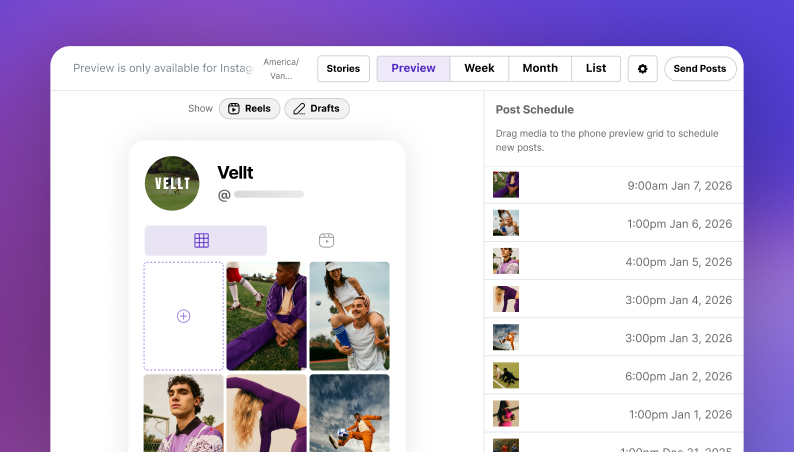
For a retail brand, that might mean reviewing a product launch as a sequence rather than a pile of separate pictures. For an agency, it means a client can inspect the plan without an archaeological expedition through email. Link in Bio provides a destination for social traffic to find products and other content. These are useful tools precisely because the underlying chores are so unglamorous.
The MeUndies case study supplies a particularly good detail: its team describes planning content 60 days ahead while leaving room for unexpected cultural moments. A calendar can make spontaneity easier to accommodate. When the routine work is already arranged, a timely idea has somewhere to land. The brand also uses feed previews to share its plans with stakeholders.
Buying the missing pieces
Mavrck approached the same market from the brand’s side. It helped enterprise marketers work with influencers. In December 2021, Summit Partners invested $120 million in Mavrck. A further $135 million investment supported the combination with Later in April 2022. Those are financing amounts; the Later purchase price was not disclosed. In January 2024, Mavrck and Later united under the Later brand.
In January 2025, Later announced the acquisition of Mavely for $250 million. Mavely’s business connected creators with affiliate earnings. This added a way to observe what happens after a recommendation: a shopper follows a tracked link, makes a purchase, and a creator earns a commission. The acquisition gave Later another part of the transaction to manage.
By September 1, 2026, Mavely was operating under the Later name. The company said affiliate sales data would feed campaign recruiting, giving marketers evidence of creators’ ability to sell. Existing links, commissions and payout schedules were preserved. A creator’s record of converting interest into purchases could now accompany them into the campaign conversation.
The spreadsheet has met its opponent
Later Influence covers creator discovery, vetting and campaign operations, while the company also sells managed campaign services. That combination matters. Some customers want software their own teams can operate. Others want help selecting creators, developing the work and running the program. The company serves both, alongside the smaller businesses and creators buying social tools.
Rosefield shows what becomes difficult first when a program succeeds. The watch brand already had an active audience and an influencer strategy. The problem was expanding and managing ambassador campaigns across markets without overwhelming its internal team. Later and Rosefield organized participants into influencers, consumer advocates and referrers, used individual referral links, and rewarded performance with redeemable points. The published case study reports more than 70,000 ambassadors and a 400% increase in sales attributed to influencers. These are reported campaign results, not a forecast for the next customer.
The lesson is wonderfully pedestrian: enthusiasm needs administration. A brand can attract people faster than it can brief, reward and measure them. Software earns its place when the program would otherwise bury its own operators.
Two creators and a very specific bill
Later tested its own proposition in a July-to-September 2025 B2B campaign. It worked with two creators, produced ten pieces of content, and amplified strong material with paid ads aimed at likely buyers and website visitors. Its case study lists $7,350 in paid spend, 129 marketing-qualified leads and $291,500 in new inbound pipeline. Paid spend is a component of cost; pipeline is prospective business, not booked revenue.
“Quality over quantity.”Later’s learning from its Customer Zero campaign
The practical thing to copy is the sequence. Define the action, find people the intended buyer trusts, test their content, then put paid distribution behind what performs. The case offers evidence for that approach. It does not establish that a larger creator roster, or a bigger ad bill, would have produced a better result.
A price for the calendar, a conversation for the campaign
As checked on September 30, 2026, Later Social advertises Starter at $18.75, Growth at $37.50 and Scale at $82.50 per month, each billed annually in US dollars before tax. Starter includes one user and one social set; Growth adds collaboration and a social inbox; Scale expands capacity and reporting. Enterprise influencer work is a separate sales conversation. A campaign budget and a scheduler subscription answer different purchasing questions.
Buffer, Hootsuite and Sprout Social are familiar alternatives for social management. Linktree overlaps with the link-in-bio job. Later’s distinctive proposition is the combination of publishing tools, campaign expertise and affiliate commerce in one business. Whether that combination is valuable depends on how many of those jobs a buyer actually needs connected.
Network details still deserve attention. Later’s getting-started documentation says built-in analytics are not currently offered for LinkedIn, YouTube Shorts or Snapchat. Supporting publication on a platform does not automatically mean offering the same measurement everywhere. Buyers should check the exact workflow they intend to use.
Counting what happens after attention
Later introduced EdgeAI predictive intelligence in October 2025 and Later 360 unified reporting in February 2026. The direction is consistent: bring creator, content and commerce information into decisions about campaigns. Predictions remain predictions. They help form a judgment; the eventual result still has to be measured.
In September 2026, Later reported more than $300 million in cumulative creator payouts and revenue growth of 50% over the preceding 12 months. Payouts are money earned by creators. They are not Later’s revenue. On September 24, the company announced a YouTube Creator Partnerships API integration, already live across more than 300 campaigns and 70 brands, to add first-party audience and performance insights.
Tracked purchases also answer a narrower question than all the reasons someone bought. A brand still needs to distinguish attributed sales from additional sales caused by a campaign. Trust, an appealing product, usable content rights and a working checkout remain conditions for the commercial plan to make sense. A dashboard cannot supply them.
The old scheduling problem has not disappeared. Someone still needs to decide what goes out on Thursday. Later’s larger wager is that Thursday’s post can belong to the same working picture as the creator contract and the eventual purchase. The distance between a like and a sale is where its business now lives.
Follow the work
Explore Later, its customer stories, blog and newsroom. Watch the social management product demo or browse Later’s YouTube channel.