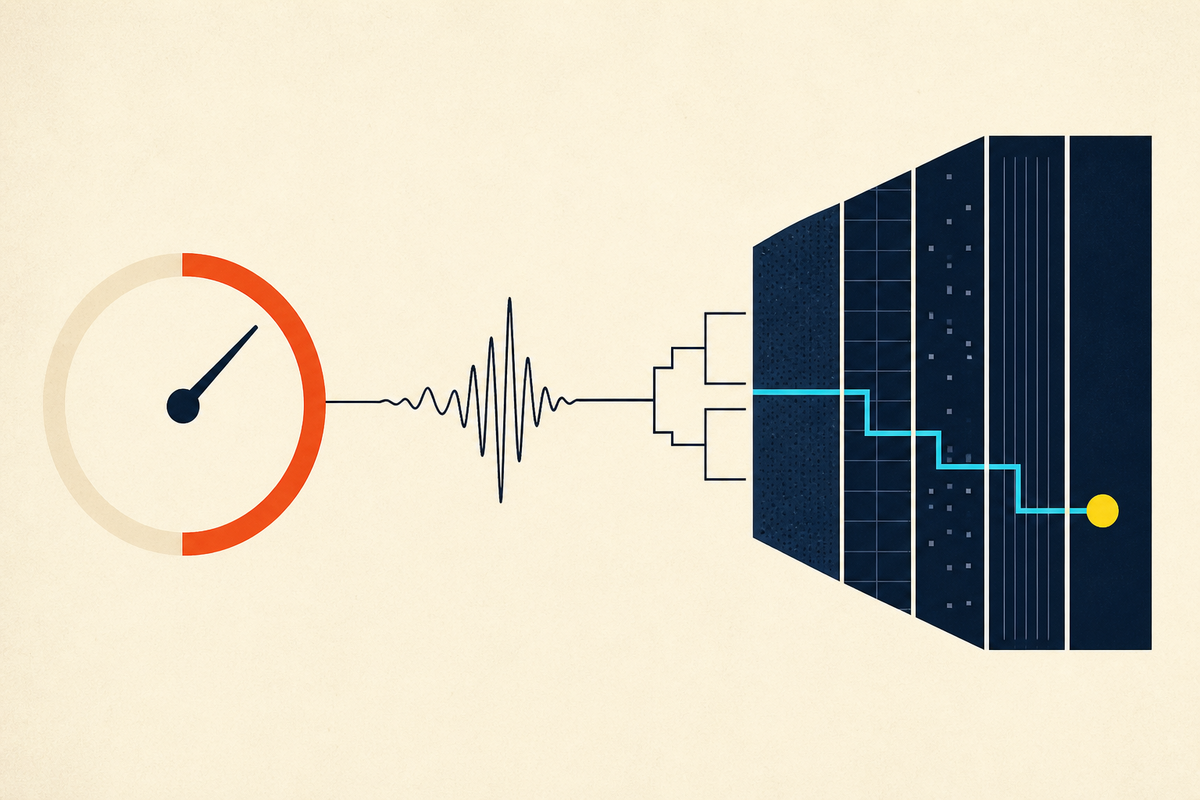
The dashboard is glowing red. Negative sentiment rose 14 points after Tuesday’s release. Calls are longer. Customers sound furious. An operations team can route the angriest conversations to experienced agents, coach a softer response and watch the score inch back toward neutral. Yet on Wednesday, the same customers call about the same problem. The company got better at managing the complaint, not removing the reason for it.
That is the expensive gap between sentiment analysis and root-cause analysis. The two are often packaged in the same broad category of conversation intelligence, and modern platforms increasingly offer both. But they begin with different questions. Sentiment asks, “How did this customer feel?” Root cause asks, “Why did this customer need us at all?” The first can improve an interaction. The second can change the product, policy or process that created it.
Read the temperature
Classify positive, neutral or negative language. Prioritize risk, track emotional movement and coach the conversation in front of you.
Find the condition
Identify a specific recurring issue, quantify its reach and cost, then give an owner enough evidence to eliminate it.
The emotion is real. It is not the diagnosis.
Sentiment has serious uses. It can flag a call that is sliding toward escalation, show whether an agent recovered a difficult conversation, detect a broad change in customer mood and help supervisors find coaching moments without listening to every recording. Qualtrics, for example, documents sentiment in XM Discover at the sentence level, placing language along a negative-to-positive scale. That is useful instrumentation. It is still instrumentation.
A calm customer may be reporting a severe security flaw. An angry customer may be reacting to a one-day shipping delay. Sarcasm, idiom and context make emotional scoring harder still. More important, two identically negative calls may have entirely different causes: a failed password reset, an unclear invoice or a bug introduced in the latest mobile build. Group them under “negative,” and the most actionable detail disappears.
“Sentiment is a thermometer. Root cause is a diagnosis.”The distinction that changes what teams fix
The risk is organizational. A contact-center leader sees a red line and launches empathy training. The training works; agents sound better. But the authentication loop keeps sending customers to the phone, so volume and cost remain. The company optimized treatment at the point of pain while leaving the source untouched.
Four platforms, four routes to “why”
This is not a simple contest between sentiment-only incumbents and a root-cause newcomer. The official materials for CallMiner, NiCE and Qualtrics all describe capabilities that go beyond mood scoring. The useful comparison is how each system travels from raw conversations to a cause that another team can act on.
CallMiner
Eureka combines conversation content, customer intent, sentiment and emotion with categorization and visualization. CallMiner says product teams can apply root-cause analysis to aggregated conversations and drill into process challenges and other cause indicators.
Explore CallMiner’s approach ↗NiCE Nexidia
Now called NiCE Interaction Analytics, the platform says it analyzes 100 percent of interactions to surface sentiment, trends, bottlenecks and root causes. Its current positioning adds workflows, dashboards and a conversational assistant for evidence-backed answers.
Explore NiCE’s approach ↗Qualtrics XM Discover
XM Discover brings calls, chats, emails, surveys, reviews and social feedback into projects. Qualtrics describes topic models and machine learning for root-cause insight, alongside configurable sentiment rules, lexicons, dashboards and feedback exploration.
Explore Qualtrics’ approach ↗Spiral by UJET
Spiral’s stated differentiator is an autonomous issue hub: it generates a taxonomy from the data, uses multi-label classification to separate chief complaints from sub-issues and lets users investigate findings in plain language.
Explore Spiral’s approach ↗The contrast is partly one of workflow. Traditional text-analytics deployments often begin with categories, keywords, rules or analyst questions that an organization already knows to ask. Those controls can be valuable, especially when a business has a mature ontology and needs consistent reporting. Yet they can also create a tidy map of yesterday’s problems. An unanticipated bug does not politely enter the category built for it.
Spiral’s pitch is to start closer to the evidence. UJET says the product combines large language models with unsupervised clustering to build a changing taxonomy from the organization’s own data. It is designed to detect “unknown unknowns,” including sparse signals, then make the resulting corpus queryable through an investigative AI agent. A product manager can ask what changed after a release and seek the issue, affected customers, trend line, financial impact and recommended fix in one investigation.
Do not buy the noun. Test the workflow.
“Root cause” has become a crowded promise. A buyer should not accept the label as proof. Give each platform the same body of calls, chats and support tickets. Include several known problems, one low-volume issue and a release regression that uses unfamiliar language. Then watch the work required to find them.
Does the system require someone to define the category first? Can it distinguish the chief complaint from the side effects discussed in the same conversation? Does it show source evidence, or merely produce a confident summary? Can users slice the finding by product version, region and customer value? Can a non-analyst ask a follow-up question? And does the result identify an owner and a measurable intervention?
The Monday-morning test
- Find a known issue without being told its preferred label.
- Surface a sparse, emerging problem before volume spikes.
- Trace every conclusion back to real conversations.
- Quantify affected customers, cost and trend direction.
- Measure whether the fix prevents the contact from returning.
Those questions matter because a taxonomy is not a diagnosis by itself. Neither is a topic cloud, a negative-sentiment cluster or a generative summary. A diagnosis earns its name when it is specific enough to test. “Billing complaints increased” is a direction. “Customers on the annual plan are being charged twice after retrying a failed card payment” is a product ticket.
Evidence also needs a path into the company. CX teams can identify the issue; product, engineering, finance or policy owners usually have to remove it. The strongest programs create a common issue language across those groups and preserve the customer examples behind the numbers. Otherwise, insight becomes another dashboard admired at a meeting and forgotten by lunch.
The metric is the silence after the fix
Sentiment programs naturally report sentiment: the share of negative interactions, emotional movement during a call, or change after coaching. Root-cause programs need a harder scoreboard. Did repeat contacts fall? Did the issue-specific queue shrink? Did the affected cohort recover? Did refunds, handle time or churn change after the repair? How much avoidable volume disappeared?
UJET’s description of Spiral frames that destination as decision-grade intelligence: not simply what happened, but why it happened and what to fix first. That is a vendor claim worth testing against a buyer’s own conversations, but it points to the right standard. Analytics should shorten the distance between a customer’s words and an upstream correction.
“The best contact is the one that never needed to happen.”The outcome root-cause analytics should optimize
A thermometer remains valuable. No sensible doctor throws it away. But nobody mistakes a fever reading for an explanation, and nobody celebrates a more elegant chart while the illness spreads. Contact centers have spent years learning how to hear the emotion in millions of conversations. The next advantage belongs to teams that can turn those conversations into fewer reasons to call.