creator-tools
(63)
Peatix sells the ticket. The return visit is the real business.
A ticket gets you through the door. Peatix wants to give you a reason to come back - and its latest redesign admits how much work remains between those two things.

Allstar gives your best game a second life
The clever part of Allstar happens after the match: game data becomes a shareable video, with the editing work done in the cloud. Its business grew by making that small act of showing off easier.

BlogTalkRadio gave everyone a radio station. The telephone was the trick.
A phone call became a live show, then a podcast. BlogTalkRadio made broadcasting approachable - and its January 2025 closure exposed how much a creator can leave inside somebody else’s platform.

Descript and the Power of the Delete Key
An audio-tour company built an editor for its own headaches. The editor became Descript - and turned a humble transcript into a new way to make video.

Threads and the trouble with a borrowed crowd
Instagram could get people through the door. Keeping them there required a different guest list - and a lesson in the unglamorous business of building a habit.

The Million-Dollar App and the Price of an Edit
A fitness creator spent years and, by his account, more than $1 million on a custom app. Passion.io offered him a less glamorous prize: the power to fix the next thing himself.

The Social Media Company That Showed Its Work
Buffer began with a queue for tweets. It grew into a business that publishes its salaries, revenue, and mistakes - including the hiring spree that forced ten layoffs.
Mewtant Found a Business in the Margins of the Picture
Its product, PixAI, began with a simple bargain: describe an anime character and see one appear. The more interesting business emerged after the image was made.

The Camera Inside the Headset
VR is thrilling to inhabit and famously dull to watch. LIV built a business by fixing that awkward translation - first with green screens, now with a camera that lives inside the game.

The Four-Day App That Taught Podcasts to Answer Back
Castbox started as a holiday-weekend Android experiment. Its lasting bet was stranger and more useful: if every spoken sentence could become an index, a podcast library could behave less like radio and more like the web.

The Podcast Company That Outgrew Podcasts
Podcastle began by turning articles into audio. Six years later, it changed its name because the product had become an AI studio, a model switchboard, and a voice API - all before the market finished deciding what a podcast tool should be.

Two People, Thirty-Five Days, and a Very Different Game Studio
Series Entertainment began with an AI engine for professional game makers. Three years later, it is testing a bigger wager: that the studio, the store, and the audience can become one product.

Arcbound Learned That a Personal Brand Is Not a Posting Schedule
It began with $20,000 of debt and an $800-a-month writing offer. Eight years later, Arcbound is betting that serious reputations need infrastructure, not an endless appetite for posting.

Captions Put the Editing Room in Your Pocket
Captions began as a clever subtitle app. Now it cuts footage, fixes eye contact, dubs speech, builds AI presenters and even takes edit notes by text - useful power for people whose real job is not editing video.

Flick Put the Hashtag Spreadsheet Out of Its Misery
Flick grew from a scrappy hashtag finder into a social media control room. Its best trick is still turning the least charming part of Instagram into a repeatable system.

PixVerse Gives the Prompt Box a Director's Chair
PixVerse can animate a photo, block a multi-shot ad, mimic a dance, or spin up a world that answers back. The trick is knowing when to let it improvise - and when every reroll starts eating the budget.

Hailuo AI Makes the First Cut. You Still Direct.
MiniMax’s pocket video studio can turn a prompt and a pile of references into a polished short with sound. The trick is knowing when to applaud the take, when to regenerate it, and when to call an editor.
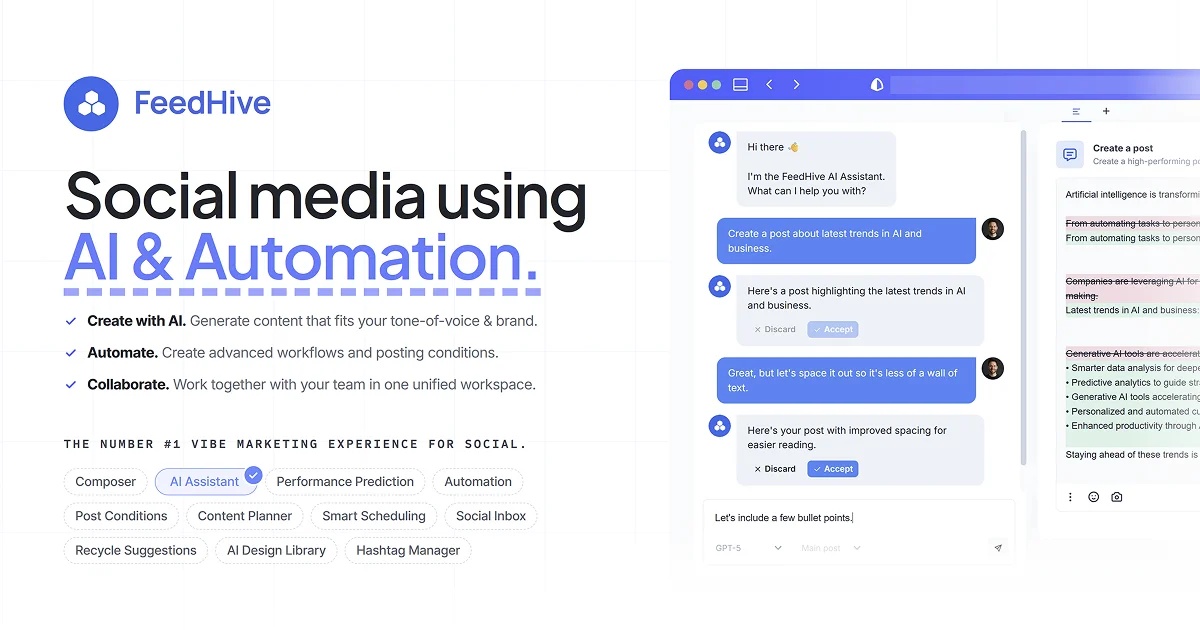
FeedHive Wants Your Content Calendar to Run Itself
The former Twitter scheduler has grown into a programmable social desk for creators, lean teams, and agencies. Its best trick is not writing posts for you. It is turning the dull machinery around those posts into a system.

Murf Put the Recording Booth in a Browser
Murf turns scripts into finished narration without the microphone ritual. Its cleverest move is serving two very different customers: the team polishing a training video and the developer trying to make a phone bot answer before the silence gets awkward.

Taplio Wants Your LinkedIn Habit, Not Just Your Posts
Taplio turns the weekly LinkedIn scramble into a repeatable system for ideas, writing, scheduling, engagement, and leads. The catch is simple: its best value appears only when posting is already part of your job.

Artlist Sold Filmmakers One Simple License. Now It Wants the Whole Editing Room.
A filmmaker’s complaint about expensive music licensing became a $300 million recurring-revenue business. The next wager is harder: make generative AI behave less like a slot machine and more like a film set.

OpusClip Paid People to Use Its First Product. Then One Feature Found 5 Million Users
The livestreaming app stalled at roughly 200 users. Its clipping tool did the opposite - revealing a useful lesson about product-market fit, creator software and the limits of one-click editing.

Mehul Agarwal Is Teaching AI to Listen Before It Shoots
The Koyal founder began with stand-up jokes, a pandemic meme group and machine-learning research. Now he and his sister Gauri are building an audio-first filmmaking system where the camera is software and consent is part of the architecture.

Sameer Sadana Built the Business Behind the Creator
The AppX founder turned a teacher’s frustration into infrastructure for independent educators - then learned to compete on product, patience, and profit.

Akash Nigam Bet on Avatars Before AI Learned to Speak
A failed chat app, a rejected exit and a stubborn interest in how people express themselves led Akash Nigam to spend nearly a decade building digital characters. Now Genies is trying to give artificial intelligence a face, a wardrobe and somewhere to play.

Dan Carr Built the Shortcut, Then Followed It Somewhere New
Before AI workflows, Dan Carr made smart contracts less intimidating. His career keeps returning to the same practical question: how much friction can a careful system remove?

Genies Burned Through Three Internet Eras to Make AI Wear a Face
The Los Angeles startup began with animated news, found money in celebrity cartoons, rode the NFT wave, and emerged with a more practical bet: persistent, game-ready AI characters. The lesson is not to predict the next platform perfectly - it is to keep the expensive technical core while replacing the story around it.

Sony’s Quiet Trick: Own the Camera, the Console and What Plays on Both
Sony spent decades assembling a strange collection of consoles, cameras, songs, films and sensors. Now the collection is becoming a system - and its smartest lesson is knowing when the pieces truly reinforce one another.

The $1,699 Lens That Explains Tamron’s 76-Year Bet on Doing More With Less
Tamron built its name by squeezing more range into less bag space. Its newest ultra-wide lens shows how a 13-person polishing shop became the Americas’ quiet alternative to camera-brand glass - and what builders can copy from the journey.

The Company Betting Creators Will Pay Rolls-Royce Prices for a Light
Formerly Hobolite, Harlowe makes photography lights that reviewers compare to Leica and Hasselblad. Here is how a lighting brand decided that taste, not lumens, was the thing worth selling.