A picture arrives on the screen: a girl with silver hair, a coat with too many buckles, and a background that looks as though rain has finally learned to take a bow. The creator may have written only a sentence. The next person who sees it, however, can inspect the prompt, find the model, borrow a LoRA, and start again. That second act is where Mewtant's story gets interesting.
Mewtant operates PixAI with its Japan entity, Metanomaly. PixAI is a web and mobile platform for making anime and manga-style images, original characters, edits and short videos. The company says it has more than 16 million registered creators and more than 1.8 million models and LoRAs. Those are company-reported counts, but they describe an ambition plainly: this is a workshop stocked by its users, not merely a prompt box stocked by its maker.
- PixAI gives casual creators daily free credits; frequent users can buy credits or membership.
- Creators share artwork, prompts and lightweight custom models, giving others a starting point.
- Mewtant is extending the workflow from single images toward manga, games and video.
- Its most useful lesson is to build the tools around a niche's habits, not just around a model's output.
The picture has a recipe
An anime character is a particularly fussy customer. The same figure needs a recognizable face, hair, outfit and mood, even when the pose, background and camera angle change. A general image generator can produce a lovely surprise; a creator making a comic, game asset or recurring persona needs control over what happens next. PixAI addresses that need with models tuned for anime styles, reference and editing tools, and LoRAs - small custom model adaptations that can steer a look or character.
The public gallery matters because the image can disclose how it was made. PixAI's search-by-image feature, introduced in July 2026, can find similar public work and open the associated prompts, models and LoRAs. A person who arrives to admire a drawing can leave with a working set of instructions. The platform also awards rebate credits when other users generate with qualifying community-trained LoRAs. That turns a useful style into a reusable tool with a modest reward attached.
That loop is PixAI's distinction in a crowded field. NovelAI, general-purpose image services and do-it-yourself diffusion setups are alternatives for making pictures. PixAI's narrower bet is that anime creators will value an archive of examples, a marketplace of community techniques and a social space where the next prompt is already waiting.
A meter on the imagination
Someone can start on PixAI without paying. The free account includes a daily credit allowance. The bill becomes more interesting when a creator wants quantity, speed or control. PixAI charges credits according to the model, image dimensions, batch size, tools and queue priority. Its published web memberships run from Starter at $9.99 a month to Premium at $49.99 a month, with more monthly credits and larger LoRA allowances at higher tiers. Credit packs offer another route. Prices and plan terms can change.
That is a useful piece of product honesty. Generating four images instead of one, upscaling a result, or choosing a faster queue uses more computing work. The credit system makes those choices visible. For a hobbyist trying a few portraits, free credits may do. For someone iterating through character sheets or video tests, the wait and the meter may make a membership sensible. For a studio, commercial rights and the licenses attached to particular models or characters need checking before the result goes into a product.
When the character has to move
The hardest task for this kind of product may be keeping a character recognizably itself after the still image begins to move. PixAI added text-to-video in 2025 and expanded its image-to-video models. In December that year, it acknowledged user feedback about stiff or floating motion and unstable limbs in its v3.0 Flash model. The company said it had strengthened motion continuity, reduced jitter and cut the credit price of those runs by 20 percent in Basic and Professional modes.
“We heard your feedback loud and clear about v3.0 (Flash).”PixAI's December 2025 product update
There is the first failure one can actually document: motion that looked less convincing than creators wanted. There is also a visible response: revise the model and charge less for using it. The update does not prove every animation now works. PixAI itself noted that runs with an end frame would still use the previous model at that point. Yet it shows how a creative platform learns in public - by letting the awkward arms appear, listening, and making another version.
Mewtant's newer Tsubaki.3 model addresses another set of stubborn problems. Its August 2026 technical report describes anime illustration as dense with unusual visual concepts, character combinations, difficult poses and styles that are not easily expressed in ordinary prose. The model is designed for illustration, manga and webtoons, with attention to text rendering and complex scenes. That is specialized expertise, and it helps explain why Mewtant has resisted the temptation to be a generator for every imaginable picture.
From tool to production partner
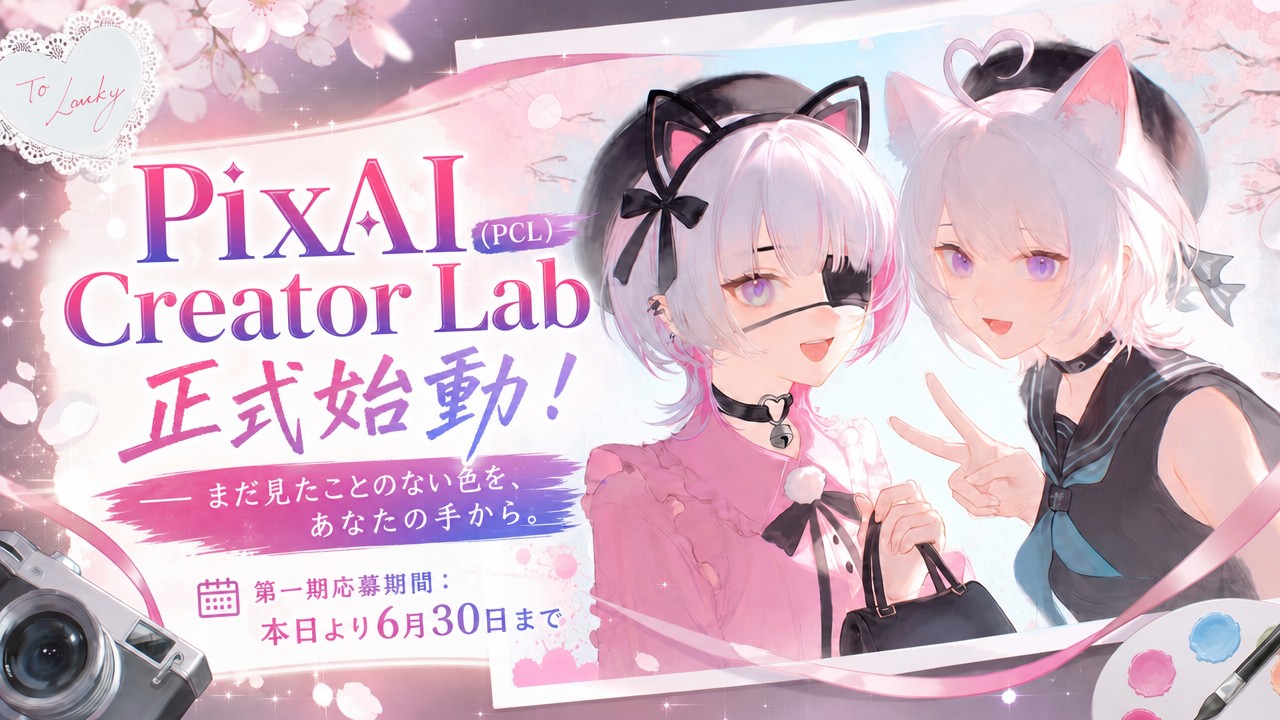
In May 2026, PixAI launched Creator Lab, a selective program for game and manga projects. Accepted makers were offered partial production funding, platform access, technical guidance and promotion. A game developer could use the tools for concept art, character designs, backgrounds or interface mockups. A manga creator might build character sheets and backgrounds before committing to a series. The program's promise is practical: help creators finish something that can leave the platform.
The company's own footprint has a similarly international shape. Stanford introduced Raven Gao as PixAI's founder and Mewtant's CEO at a June 2026 discussion on AI and media in Japan. Mewtant's LinkedIn page places its headquarters in San Mateo, while PixAI identifies both the US company and Japan's Metanomaly as operators. The platform serves creators across languages and devices. Funding databases report a $19 million Series A in July 2023, with Peak XV Partners and Soma Capital among the investors. None of that settles the question that matters most to an individual creator: can this help me keep the same person on the page, in the next panel, and perhaps in motion?
The answer depends on the work. A profile picture or an experimental scene can be made in minutes. A recurring comic character, a licensed game asset or a production video asks much more of consistency, rights and human judgment. PixAI's catalog and controls make those jobs more approachable; they do not make the decisions for the artist. The company has found a market in that gap. The first image may win a click. The workflow that follows is what might keep a creator there.
There is a lesson here for builders outside anime. Start with one group whose creative language has its own rules. Let users keep and share the settings that produce a good result. Give the best community contributions a path back into the product. But the loop weakens when the work must be private, when rights are unclear, or when a client needs an exact character across dozens of frames. In those cases a public gallery and a lucky prompt are poor substitutes for controlled production. Mewtant's wager is that enough people want both the spark and the workbench.