The useful thing was supposed to be the walking tour. Andrew Mason’s company Detour made audio walks that let people explore a place at their own pace. Someone still had to edit those walks. While trying to make that job less miserable, the team built an internal tool that treated recorded speech like a document. Eventually, the tool attracted the attention the tours had struggled to earn.
- The idea: cut a sentence in the transcript, cut it in the recording.
- The audience: podcasters, video creators, and teams with more footage than editing time.
- The business: subscriptions with separate allowances for media and AI.
- The useful lesson: your least glamorous internal tool might be your most interesting product.
01 / The side project people actually wanted
In a 2018 conversation with South Park Commons, Mason said Detour’s users liked it, but four years of work had not produced widespread traction. Audio and video producers, meanwhile, responded enthusiastically when shown its editor. Descript became a separate company in 2017.
That distinction matters. The evidence for changing direction came from people outside the building. An editor designed to solve one company’s production problem turned out to address other producers’ problems too. It is a pleasingly inconvenient origin story for anyone who believes the business plan ought to precede the useful invention.

02 / A sentence becomes a handle
Descript’s central move is easy to describe. Import a recording, get a transcript, and edit the words. Removing or rearranging passages changes the corresponding media. Text becomes a handle attached to sound and pictures. A person who can spot a rambling answer on a page can begin shaping an interview without first becoming fluent in waveforms.
The workspace now combines video and multitrack audio editing, scenes, layouts, captions, recording, and collaboration. Its product interface still offers a timeline and precision controls. The point is to make the transcript a useful place to begin, while leaving room to attend to what the viewer sees and hears.
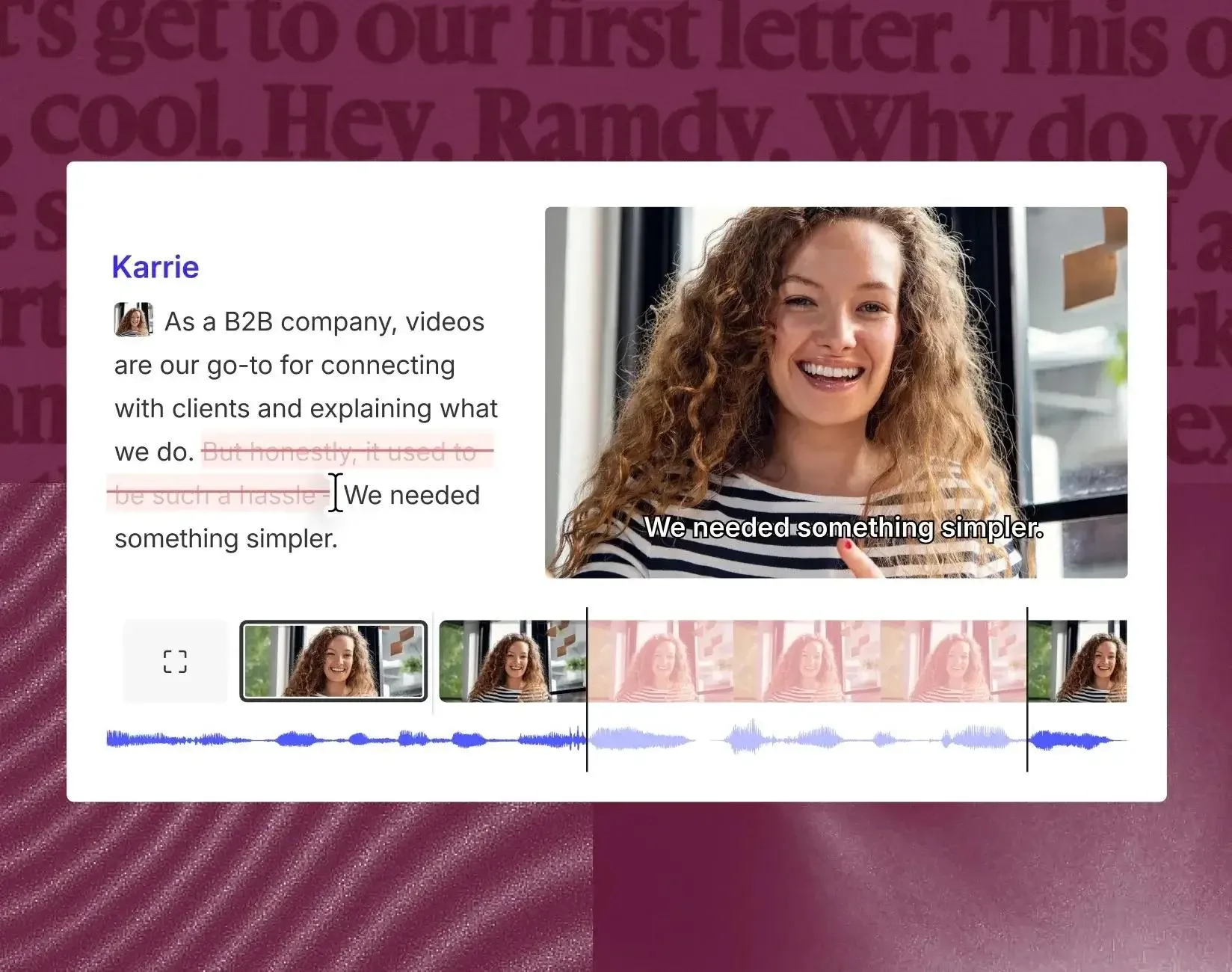
There was an obvious hole in the original idea: deleting speech was easier than adding it. A changed line still meant another take. The 2019 Lyrebird acquisition brought speech-synthesis expertise and helped produce Overdub, which could generate words in a modeled voice. Mason thanked early NPR users, including Planet Money and Rough Translation, for tolerating iterations and bugs.
Today, voice cloning sits within AI Speech. Descript’s published consent policy requires verbal authorization from the voice owner. That is a product constraint with an editorial consequence: a synthetic correction is still a correction someone must approve. Convenient speech is not automatically honest speech.
The transcript is the control surface.
We can um, publish this today.
Illustration only. The matching piece of media follows the text.
03 / The first cut gets a new owner
A creator can use Descript to record a podcast, tighten an interview, make captions, and extract shorter videos. A business team can turn a webinar into clips, explain a product on screen, or update a training video. Rooms puts remote recording inside the workflow. Studio Sound reduces noise and echo by isolating and regenerating speech.
Those features become interesting when they change who handles the work. In Descript’s LinkedIn case study, teams use transcripts for rough cuts and clip selection, then hand edited projects to Premiere through XML. The account reports about an hour saved per project and more than ten clips from an interview. Adoption took six to nine months of workshops and iteration. Buying the tool was the short part.
LinkedIn case study
LinkedIn case study
SaaStr’s published account describes bringing more editing in house, requesting feedback through cloud collaboration, and marking potential clips in the transcript. It reports doubling content production and publishing three to four videos a day. These are customer examples, rather than a forecast for every account. Their common feature is a shorter journey from recorded material to something a colleague can review.
“Our video production timeline went from weeks to ‘I can release this the next day.’”
Amelia Ibarra, SaaStr customer story
04 / Two meters are running
Descript sells access by subscription. Its current pricing lists Hobbyist, Creator, and Business at $24, $35, and $65 per person per month on monthly billing. Annual billing lowers the monthly equivalents to $16, $24, and $50. There is a free tier and custom enterprise pricing. Prices checked September 30, 2026.
Media allowances and AI credits are separate. A team should count both the footage it processes and the automated work it requests. The seat price alone is an incomplete production budget.
The company itself took a different financing route: venture capital. Its November 2022 announcement disclosed a $50 million Series C led by the OpenAI Startup Fund, bringing total funding to $100 million. That same announcement accompanied a rebuilt editor and more than 30 new visual and AI features. Making the interface feel simple had become an expensive undertaking.
05 / The assistant arrives after the janitors
Big releases also leave messes. In June 2023, Mason wrote that a majority of engineering time over the preceding six months had gone to bugs, stability, and polish. A media editor has to preserve work before it can accelerate it. That is less entertaining than a launch video, and more persuasive to someone with an unfinished episode.
Underlord, Descript’s AI co-editor, adds another interface: requests. Users can ask it to edit, create clips, or help with writing. Instead of remembering where every command lives, they can describe an outcome and inspect the result. The company also publishes audio and video research; its capabilities grew beyond the original transcription trick.
The September 17, 2026 release roundup added caption presets and animations, generated music and sound effects, and access to the ElevenLabs voice library. It also changed jump-cut smoothing to per-second charges: 0.5 AI credits for regenerated audio and 1 for video. The feature that makes a cut feel effortless still has a meter attached.
The leadership changed too. In August 2025, Mason announced Laura Burkhauser as CEO and became executive chairman. He reported $55 million in annual recurring revenue and 75% year-over-year growth. ARR is a subscription run-rate measure, not annual revenue booked in a financial statement. He also credited Burkhauser with naming Underlord. Evidently, the executive vocabulary was allowed a little fun.

Its hiring materials describe remote, hybrid, and office work in the US and Canada, with periodic gatherings. The room may be theatrical; the arrangements are practical. Public perks include parental leave, retirement matching, and a home-office stipend.

06 / A document is a door, not a director
Descript occupies the space between specialist post-production and everyday communication. The transcript alone cannot defend that position: Premiere offers text-based editing too. Descript’s argument rests on the surrounding workflow, from recording through cleanup and clips. For demanding color work, Resolve’s dedicated grading tools address a different set of priorities.
The practical experiment is small. Take one spoken recording, shape a rough cut from its transcript, choose two useful excerpts, and ask a colleague to review them. Measure the time to an approved result. If the job is mostly dialogue, the text gives you something useful to grab. If the story depends on gesture, music, or visual rhythm, reading will reveal less of what needs editing.
Finally, watch the cut. Readability cannot tell you whether a pause carries meaning, whether a shortened answer changes a speaker’s intent, or whether a generated correction sounds plausible. Descript makes more people capable of making those decisions. It leaves them responsible for making them well.