Taplio is for the person who declares LinkedIn important on Monday, opens a blank draft on Tuesday, and quietly abandons the whole enterprise by Thursday. It gathers the work around a professional feed - finding an angle, writing, scheduling, commenting, measuring, and following up - into one blue-and-white cockpit. The appeal is not mysterious. A routine is easier to keep when it has a queue.
That focus separates Taplio from the giant social suites. Buffer and Hootsuite help publish across networks. Taplio cares about one peculiar place where a good story about a sales mistake can become a client call, a hiring conversation, or 47 comments from people saying “this.” It is built for founders, consultants, salespeople, ghostwriters, agencies, and B2B teams who can explain what a LinkedIn audience is worth. If you post twice a quarter to congratulate former colleagues, keep your money.
Buy a workflow, not a ghostwriter
Taplio's useful unit is the loop. Search a database of more than five million successful posts. Save an idea. Ask for hooks or a draft. Edit until it sounds like a person with a pulse. Put it in the queue. Return to a curated engagement feed. Later, inspect the numbers and reuse the insight that worked. Each piece exists elsewhere, often more cheaply. The case for Taplio is that the pieces remember one another.
The five-stop LinkedIn commute
an angle
and edit
the post
the replies
the signal
The AI is an assistant inside that loop, not a substitute for having something to say. Taplio says it learns from your earlier posts and edits. Its current public pages do not name the underlying model, although older materials and reviews mention GPT-4. More important than the model badge is the input. Feed it a sharp customer observation and it can shape the material. Ask it to “write a viral leadership post” and you have volunteered to become part of the beige internet.
“Some of the ideas for new posts are helpful, but not all of them.”Philip Black, Product Hunt reviewer
That sentence is a better buying guide than any promise about virality. Taplio is good at removing friction and offering starting points. Taste, evidence, and restraint remain billable human skills. Reddit comments split along the same seam: one user praised the product for making regular posting and idea discovery easier, while others called the generated writing robotic or worried that everyone would inherit the same voice. Both reactions can be true because the tool magnifies the quality of the editing around it.

A crowded desk, tidied
A niche-ranked feed and searchable library replace the ritual of wandering LinkedIn until inspiration happens.
Hooks, rewrites, full drafts, tone matching, and carousel generation help turn raw expertise into post-shaped material.
A calendar and visual queue batch text, images, video, polls, and document carousels for personal or company pages.
Curated people lists, comment prompts, and unanswered replies make relationship work less dependent on the main feed.
Post and profile analytics track reach, engagement, and followers, then compare performance with similar-sized accounts.
Pro adds a lead database and outreach sequences for teams that want a line from attention to actual conversations.
The Chrome extension puts quick statistics, saved inspiration, and comment help inside LinkedIn. The API supports custom workflows. The 2026 addition is a remote Model Context Protocol server, which gives compatible assistants such as Claude and ChatGPT access to Taplio actions after account authentication. From the chat window, a user can search inspiration, create a draft, schedule it, and pull analytics. Publishing remains an explicit action, according to Taplio's documentation.
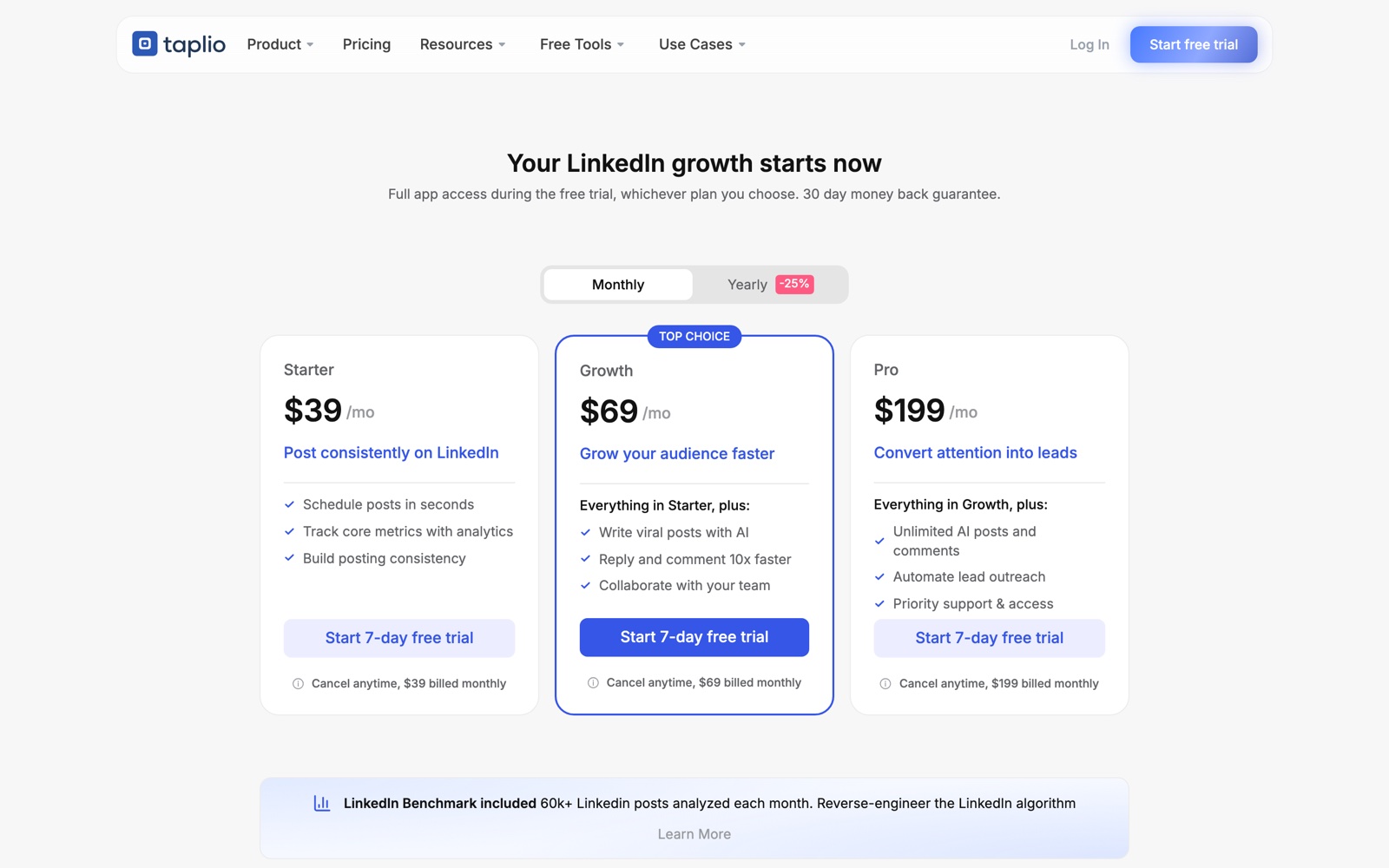
One small housekeeping note: Taplio's own pages disagree on the Benchmark's size. The pricing page says at least 60,000 posts are analyzed monthly; an llms.txt file says more than 200,000. We use 60,000 because the lower, prominently priced figure is the safer one. Either way, the Benchmark is more useful than a giant vanity number when it answers a practical question: is this engagement normal for an account this size and this post format?
The $39 plan does not write
Taplio has three paid levels. Starter costs $39 monthly and covers scheduling, analytics, and consistency tools. It includes zero AI writing credits. Growth is $69 monthly and adds the writing features, faster replies and comments, and collaboration. Pro costs $199 monthly, removes AI and comment limits, and adds the lead database, outreach automation, and priority support. Annual billing lowers the advertised monthly equivalents to $32, $49, and $149. A seven-day trial exposes the Pro feature set, and Taplio advertises a 30-day refund window after payment.
The honest comparison begins with your bottleneck. If all you need is a queue, Buffer's entry economics are difficult to argue with. AuthoredUp suits people who want a LinkedIn-native editor and analytics without turning every blank line into an AI prompt. Supergrow puts more emphasis on learning a creator's voice. Hootsuite handles many networks and enterprise governance. Taplio earns its premium when inspiration, creation, engagement, and lead context all matter to the same operator.
| Tool | Best fit | Where Taplio differs |
|---|---|---|
| Taplio | LinkedIn as an audience and pipeline channel | One workflow from ideas through leads |
| AuthoredUp | Editing, formatting, and deep post analytics | Taplio adds inspiration, engagement, carousels, and leads |
| Supergrow | Voice-first AI writing for solo creators | Taplio has the larger end-to-end growth system |
| Buffer | Low-cost scheduling across several networks | Taplio is deeper on LinkedIn and far narrower elsewhere |
| Hootsuite | Multi-network teams and enterprise controls | Taplio is aimed at personal brands and B2B creators |
Built after the failures, sold to a school friend
Taplio's backstory is brisk and slightly improbable. French founders Thibault “Tibo” Louis-Lucas and Thomas “Tom” Jacquesson had already endured startup failures. Under Pony Express Studio, they adopted a rule: ship one product every week until something worked. Tweet Hunter, a search and creation tool for Twitter, worked. About six months later they adapted the idea for LinkedIn, whose professional norms and technical constraints pushed Taplio into a distinct product.
Taplio soft-launched in April 2022 and reported more than 1,000 customers by its November Product Hunt launch, where it ranked number two product of the week and picked up a Golden Kitty badge. Creator partnerships helped distribution. Before acquisition, independent reporting put Taplio at roughly 3,000 customers, while Taplio and Tweet Hunter together reached about $100,000 in monthly recurring revenue.
The buyer was lempire, the company behind lemlist. Its founder, Guillaume Moubeche, happened to be Louis-Lucas's middle-school friend and a user of Tweet Hunter. They negotiated the deal in roughly two weeks, much of it over WhatsApp. The structure mixed a $2 million upfront payment with growth-based earn-outs that the founders said could bring the total to $10 million to $15 million. The funniest part is also the strategic lesson: a product built to turn personal relationships into business was bought through a personal relationship.
The product sells consistency. Its own history is a monument to trying again quickly.
Keep a hand on the wheel
Reviews praise the time saved and criticize familiar SaaS irritants: uneven AI output, price, slow screens, clunky multi-user work, and support or billing friction. A 2024 Trustpilot reviewer wrote that the AI posting was good and had helped their LinkedIn growth, then deducted points for a confusing account pause and cancellation experience. Another liked the features but objected to limited weekend support and the way AI credits were consumed. Product Hunt's review summary similarly notes the strong LinkedIn focus alongside concerns about price and team usability.
Automation deserves more care than a cheerful toggle. Taplio says its connection and outreach features use conservative, human-paced limits. LinkedIn users on Reddit have also reported warnings while discussing third-party automation tools, including Taplio. Those reports are anecdotal, and feature behavior changes, but the general rule is sound: do not treat a professional identity like a disposable growth experiment. Review current permissions, keep sequences modest, and prefer actions you would be comfortable performing manually.
There is a softer risk too. A searchable library of winners teaches format very efficiently. It can also tempt users to confuse borrowed cadence with original thought. Use high-performing posts to study structure - the opening, proof, pacing, and close - then return to your own calls, mistakes, numbers, and odd little observations for substance. The post that sounds unlike every other Taplio user is probably the one worth publishing.
The verdict
Buy Taplio if LinkedIn is already attached to revenue, hiring, or reputation. Growth is the practical starting plan for most buyers because that is where AI writing begins. Starter makes sense for confident writers who chiefly need a queue and analytics. Pro is for operators who can responsibly turn engaged readers into a sales workflow.
Skip it if you post casually, publish across many networks, or hope the machine will supply a personality. Taplio can make a good LinkedIn practice easier to repeat. It cannot decide what you have earned the right to say.