He gave up snapping the ball for the Ivy League champs to snap out a short essay every single day - and convinced 10,000 people to do it too.
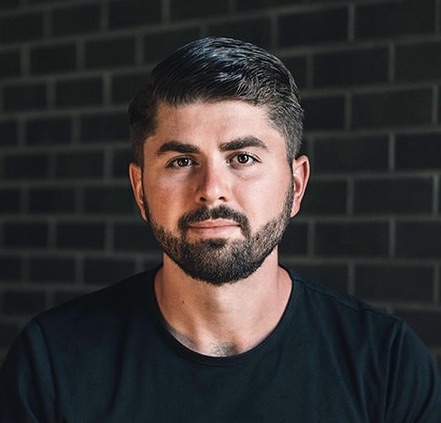
The smile of a man who has shipped something before breakfast, every day, for over a thousand days straight.
Every morning, before most of his 400,000 followers have finished their coffee, Dickie Bush has already written something and put it on the internet. Not a polished essay. Not a book chapter. A short, self-contained idea - what he named an "atomic essay" - sized to be read in the time it takes to wait for an elevator. He has done this so many times that the habit became a company.
That company is Ship 30 for 30, the cohort-based course he runs with the writer Nicolas Cole. The premise is almost insultingly simple: write one atomic essay a day for thirty days, and publish every one of them whether you like it or not. More than 10,000 people have paid to be told to do this. The ones who finish tend to say it changed how they think.
Bush did not arrive here as a literary type. He arrived as an athlete and a quant - a Princeton center with a degree in one of the hardest programs the school offers, then a portfolio analyst at BlackRock with a Bloomberg terminal and a Manhattan commute. The writing was supposed to be a hobby. It ate the career instead.
Most people think prolific writing is about coming up with 1,000 great ideas. It's not. It's about coming up with 1 great idea, then finding 1,000 different ways to say it.
— Dickie BushBush did not build one product. He built the rails - a course to teach the habit, software to make it frictionless, and an academy to turn it into a paycheck. Each one points back at the same loop: write, ship, repeat.
Thirty days, thirty atomic essays, no exceptions. Built with Nicolas Cole, it started near $50 and now runs into the hundreds. It has graduated more than 10,000 writers.
A writing and publishing tool he co-founded so students would stop wrestling with formatting and just hit publish. A media-shaped business wearing a SaaS coat.
The next rung: teaching writers to get paid. The Premium Ghostwriting Academy turns the daily habit into a freelance income, with AI-assisted workflows folded in.
In January 2020 he started a newsletter called Dickie's Digest. By that September it had drifted to roughly 300 subscribers and stalled. Most people would have quietly let it die. Bush did something stranger: he decided the problem was reps, not talent, and committed to writing 30 Twitter threads in 30 days.
It worked, but not on a schedule he controlled. On day 28, Naval Ravikant retweeted one of his threads, and his following doubled overnight. That single moment is the hinge the whole story turns on - proof, to Bush, that volume buys you lottery tickets and consistency keeps you in the draw long enough to win.
The lesson became the product. In November 2020, around family dinner conversations back home in Tampa, the Ship 30 for 30 idea took shape: bottle the exact constraint that had unstuck him - daily, public, finite - and sell it to everyone else who felt stuck.
*Sep 2020 figure is newsletter subscribers, the moment he pivoted to threads.
Princeton University. Studies Operations Research and Financial Engineering, one of the school's most punishing degrees, and plays starting center for the Ivy League champion Tigers.
Joins BlackRock in Manhattan as a portfolio analyst.
Starts writing online with the newsletter Dickie's Digest.
Moves from New York back to Tampa to ride out the pandemic with family.
Newsletter stalls near 300 subscribers. Pivots to Twitter, commits to 30 threads in 30 days. On day 28, Naval retweets him.
Launches the Ship 30 for 30 writing challenge.
Partners with Nicolas Cole to turn the challenge into a cohort course; co-founds the writing software Typeshare.
Leaves BlackRock to run Ship 30 for 30 full-time after the firm calls people back to the office.
Passes 326,000 followers on X, roughly two and a half years in.
The engine under everything is a contrarian bet on quantity. Bush posts a handful of single tweets each week as cheap experiments, watches which two land, and only then expands the winners into longer pieces. He calls the failures micro-failures and treats them as data, not embarrassment.
He rarely spends more than an hour on a piece unless the audience has already validated the idea. The point is not to protect a precious draft. The point is to find the one idea worth saying a thousand ways - and to say it before lunch.
It is a quant's approach to art: run enough trials, measure the signal, double down on what compounds. He gives a lot of it away, including a free guide to writing online that runs past 13,000 words. Generosity, in his system, is just the top of the funnel done honestly.
Write online every day for 30 days. Ship 30 atomic essays in 30 days.
— The Ship 30 for 30 promiseThe discipline did not appear at BlackRock. It was always there. He read Harry Potter at four and memorized Tampa Bay Rays box scores out of the newspaper at five. At eight he taught himself to solve a Rubik's Cube and ground his time down to 19 seconds - the same instinct, decades early, of taking a hard thing and drilling it until it bends.
His real name is Richard Bush - the Princeton football roster lists him as Richard.
ORFE at Princeton is widely considered one of its most demanding programs. He played starting center while doing it.
He coined "atomic essays" - short, self-contained pieces sized for a social feed.
The entire Ship 30 for 30 idea was born from family dinner conversations in Tampa.
The aim has never really changed: make daily writing a habit anyone can build, then hand them the tools, courses, and crowd that turn a habit into leverage.
— The throughline of everything he builds